


To avoid damage to the vehicle, lift and tow the vehicle in strict accordance with the instructions. In addition, follow all applicable regulations governing the towing of vehicles.
Towing a front-wheel drive vehicle is carried out with the front wheels raised. If damage to the vehicle or other reasons prevent this, use front wheel jack stands.
When towing a front-wheel drive vehicle on the rear wheels, release the parking brake.
It is forbidden to tow the car by the rear wheels with the support of the front drive wheels on the road. This will result in transmission failure.
If you are unable to call a specialized towing service, tow the vehicle with all wheels on the road using the front towing eye. At the same time, it is allowed to tow the car only on roads with improved coverage, for a short distance (up to 5 km) and at low speed (up to 25 km/h).
Follow the instructions below when towing the vehicle with all wheels on the road.
1. Engage neutral in manual transmission, move automatic transmission range selector to neutral position (N).
2. Turn the ignition switch to position «ACC» (auxiliary consumers of electricity), to prevent the steering wheel from locking.
3. Release the parking brake.
Remember that when the car engine is not running, the power steering and vacuum brake booster do not function.
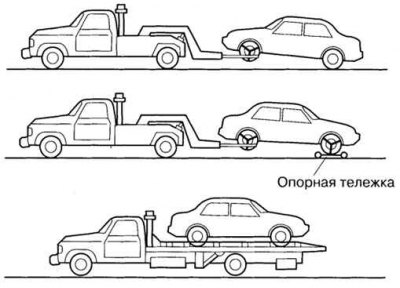
Pic. 1.169. Ways to evacuate a car
Attention! Towing eyelets are designed for use in emergency situations (e.g. to pull out a stuck car). Always make sure that the towing cable or chain is parallel to the longitudinal axis of the vehicle. It is forbidden to load the towing eye with transverse forces. Do not use the rear eyelets to tow a vehicle. These loops are ONLY for securing the vehicle during transport. Using them to tow a vehicle will damage the rear bumper.