


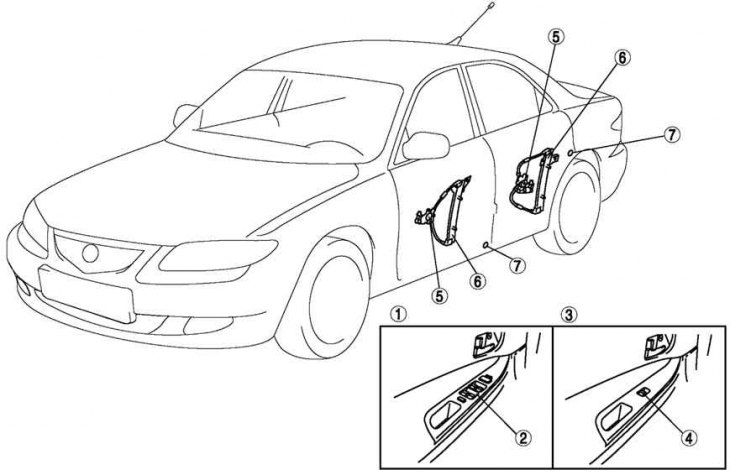
Fig. 8.29. Mazda 6 window lifters: 1 – driver's side; 2 – main switch for power window; 3 - except driver's side; 4 – Power window switch; 5 – electric window lift motor with servo drive; 6 – Power window regulator; 7 – door switch
Based on the pulse signals from the contactless switches on the Hall sensor in the power window motor, the power window control module in its main switch determines the position of the window and the direction of movement of the glass. Accordingly, the main switch controls the power window system on the driver's side (Fig. 8.29).
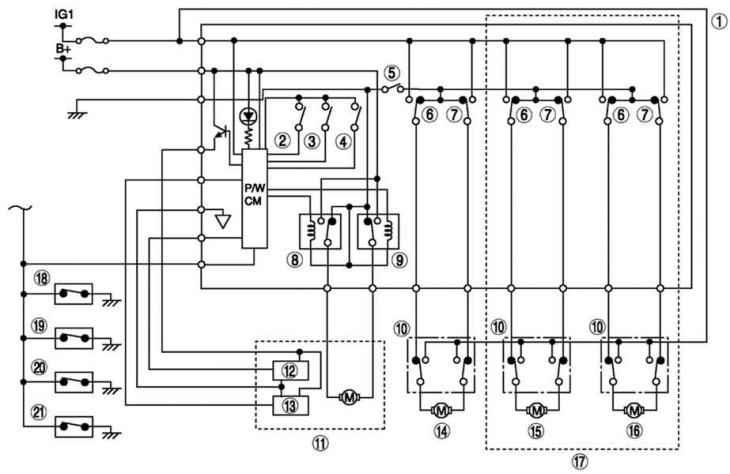
Fig. 8.30. Wiring diagram of electric windows: 1 – main switch for power window; 2 – manual closing; 3 – manual opening; 4 – AUTO; 5 – Power supply cut-off switch; 6 – closed; 7 – open; 8 – closing relay; 9 – opening relay; 10 – Power window switch; 11 – Front power window motor with servo drive (driver side); 12 – contactless switch on Hall sensor No.1; 13 – contactless switch on Hall sensor No.2; 14 – Front power window motor with servo drive (passenger side); 15 – Rear window lifter motor with servo drive (right side); 16 – Rear window lifter motor with servo drive (left side); 17 – Electric motor with servo drive system for rear windows; 18 – door switch (driver side); 19 – door switch (passenger side); 20 – door switch (back right side); 21 – door switch (back left side)
When the initial position is set before the vehicle is handed over, the position of the window glass and the direction of operation are stored in the control module in the main switch of the power window. Therefore, the initial position adjustment is necessary if the cable from the negative terminal of the storage battery, the main switch connector or the connector of the power window motor are disconnected (Fig. 8.30).
Note: If the home position has not been set, the driver's side power window automatic operation, automatic window return and fine movement functions will not be available.
The article is copied from the resource MazBook.ru