


In this case, the refrigerant is atomized, which facilitates the evaporation process.
The expansion valve also regulates the flow of refrigerant supplied to the evaporator.
The flow rate of the refrigerant is regulated by the opening amount of the ball valve in the expansion valve.
The opening amount is controlled by the balance of R-134a pressure on the diaphragm and the resulting force of the evaporator outlet pressure (PI) on the lower part of the diaphragm and the spring force (Fs) acting on the ball valve.
When PI increases, the temperature of the temperature sensor near the diaphragm increases, and the Pd of heated R-134a on the diaphragm increases.
When Pd is greater than PI + Fs, the diaphragm deflects downward and the shaft attached to the end of the temperature sensor stem pushes the ball valve downward, increasing the refrigerant flow.
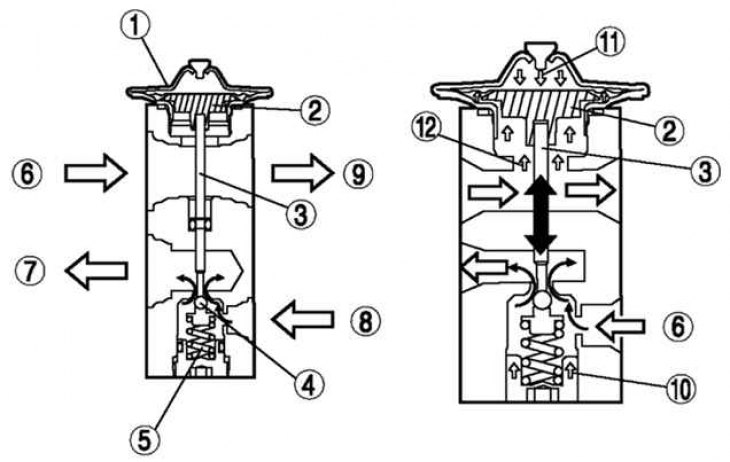
Fig. 8.65. Operating principle of the expansion valve: 1 – diaphragm; 2 – temperature sensor; 3 – shaft; 4 – ball valve; 5 – spring; 6 – from the evaporator; 7 – to the evaporator; 8 – from the capacitor; 9 – to the capacitor; 10 – spring force; 11 – HFC-134a pressure; 12 – outlet pressure
When the temperature of the refrigerant at the evaporator outlet decreases, PI + Fs becomes greater than Pd, the ball valve rises, and the refrigerant flow decreases.
The full text is on the website (MAZbook.ru)