


The valve clearance on a 1.3 L engine should be checked every 30 thousand km, on a diesel engine - every 45 thousand km and, if necessary, adjusted.
Necessary tools:
- Set of flat feeler gauges with a pitch of 0.05 mm.
- Set of wrenches.
- Diesel: Valve Compressor, Valve Plate Clamp.
Necessary spare parts:
- Valve Cover Gasket: On 1.25-/1.4L engines, the gasket is tightly connected to the valve cover and cannot be replaced.
- Diesel and 1.25-/1.4L engines: adjusting washers of different thicknesses.
To compensate for thermal expansion in the valve train, there must be a certain distance between the camshaft lobe and the valve tappet or between the valve and the rocker arm.
This valve clearance changes over time due to valve settlement and wear of drive components.
If the clearance is too small, the valve timing changes, the sealing deteriorates, the engine power decreases, and the engine operation becomes uneven. In extreme cases, the valves can become deformed and burn.
If the gap is too large, strong mechanical noises appear, the valve timing changes, and engine power drops due to insufficient cylinder filling. Engine operation is uneven.
The valve clearance is checked and adjusted on a cold engine.
Engine 1.3 l
Valve clearance check
Remove the plugs from all the spark plugs, numbering them to avoid mistakes during installation.
Unscrew the spark plugs with a spark plug wrench.
Remove the engine oil filler cap.
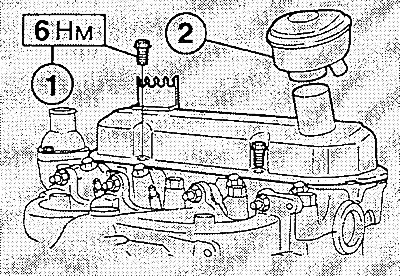
Unscrew the four bolts (I), remove the washers. Remove the valve cover. (2 - oil filler cap).
Turn the crankshaft pulley in the normal direction of its rotation, i.e. clockwise. This can be done in three ways:
- 1. Disengage the gear on the transmission, apply the parking brake and fit the ratchet socket onto the center bolt of the pulley.
- 2. Engage fourth gear, release the parking brake and roll the car.
- 3. Raise and support the car on the right front to lift the wheel, engage fourth gear and turn the right front wheel by hand.
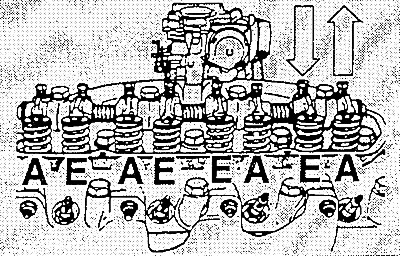
Turn the crankshaft pulley until the valves on the first or fourth cylinder overlap. This means that when one rocker arm moves up, the other rocker arm starts to move down, and when both rocker arms are at the same height, the valves overlap. When, for example, the valves of the fourth cylinder (arrows) overlap, you can check and adjust the valve clearance on the first cylinder. (A - exhaust valve; B - inlet valve).
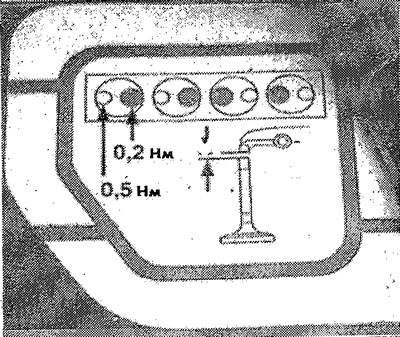
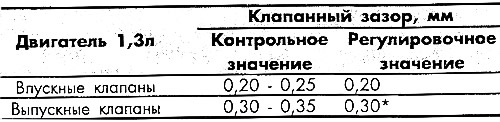
* When there is a sticker on the valve cover indicating the valve clearance for the exhaust valve is 0.5 mm, then this value should be used as a guide.
Then turn the pulley another half turn and adjust the valve clearances according to the ignition order 1-2-4-3.
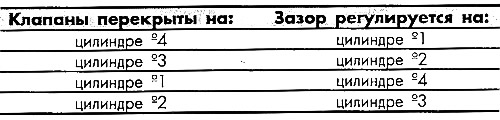
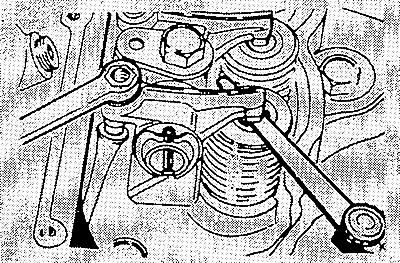
Measure the valve clearance using a flat feeler gauge. If the clearance value is within the control value range, then the valve clearance does not need to be adjusted.
Adjustment
Turn the adjusting bolt so that the feeler gauge is of the desired thickness (adjustment value) could move with a slight squeeze.
To check, try inserting a feeler gauge that is 0.05 mm thicker than the upper range of the control value (see table). It should not slide between the valve and the rocker arm. If necessary, repeat the adjustment.
Check and adjust the valve clearances of the remaining cylinders according to the firing order.
Replace the valve cover gasket. Install the valve cover and tighten its bolts evenly and lightly (moment 6 Nm).
Screw in the spark plugs and tighten to a torque of 20 Nm.
Place the spark plug connectors on the spark plugs and secure the high-voltage wires in the holder on the valve cover.
Diesel engine
Valve clearance check
Remove the engine ventilation valve from the valve cover by loosening the clamp.
Remove the valve cover.
Unscrew the four nuts and remove the oil deflector.
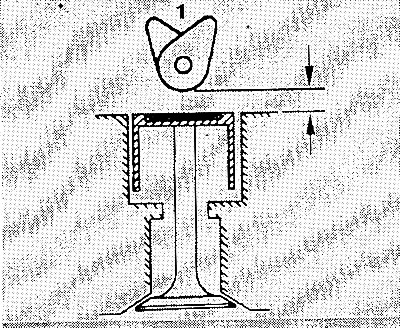
1. Valve in position for clearance check.
Turn the engine until the cams of the corresponding cylinder are uniformly directed upward. The methods for turning the engine are described in the previous section.
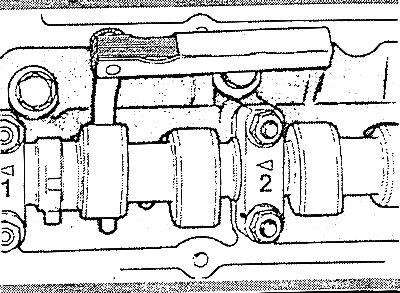
Insert a flat feeler gauge between the cam and the tappet and measure the valve clearance.
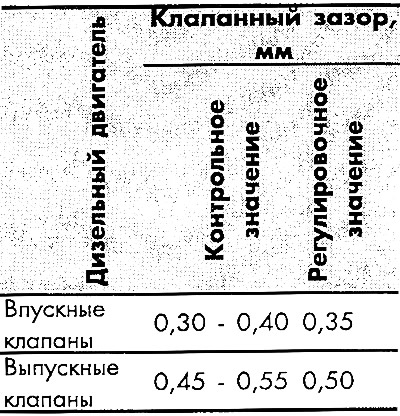
Attention! For all cylinders the valves are located at the front (i.e. from the toothed belt side) so: 1 - inlet valve; 2 - exhaust valve.
A flat feeler gauge of the required thickness should fit between the cam and the tappet with a slight pinch. Record the resulting valve clearance value.
Turn the crankshaft further by half a turn and measure the valve clearance on the next cylinder in the firing order (in this case the third). Firing order: 1-3-4-2.
Adjustment
To adjust the valve clearance, you need to replace the old adjusting washer with an adjusting washer of a different thickness.
Example of calculating the thickness of the washer: Permissible variation: 0.30-0.40 mm (0.35±0.05 mm).
Measured value: 0.45 mm. Valve clearance: increased by 0.05 mm.
If the obtained values are within the acceptable range, then the adjusting washer does not need to be changed. If the value is outside the range, then when adjusting, you need to achieve the adjusting (average) value, in this case 0.35 mm. The thickness of the average adjusting washer: 3.85 mm.
The thickness of the required adjusting washer is 3.95 mm.
When adjusting the valve clearance, the piston should not be at TDC, otherwise the valves and/or pistons may be damaged. In this case, turn the crankshaft by 1/4 turn.
Adjust the valve clearance. This requires special tools. Without them, adjustment is impossible.
Press the plate tappet with the device and pull out the adjusting washer with a special clamp. Then insert a new adjusting washer so that the inscription is facing down.
Remove the device, turn the camshaft further and adjust the valve clearances on the other cylinders.
Install the oil deflector and tighten its mounting bolts to a torque of 20 Nm.
Install the valve cover with a new gasket and tighten the bolts slightly (moment - 5 Nm).
Install the crankcase ventilation hose and secure it with a clamp.
Engines 1.25/1.4 l
Checking/adjusting valve clearance
Attention! Since the service interval (150 thousand km) coincides with the timing belt replacement period and at the same time performs a large amount of work, and also requires many different devices, then it is recommended to carry out this operation in a workshop.
To adjust the valve clearance, as for diesel, you need to replace the adjusting washer in the plate tappet with a washer of a different thickness. At present, there is no information on the use of any devices for valves. In this regard, the following sequence of operations is recommended:
Remove the valve cover.
Crank the engine and check the valve clearances on all valves:
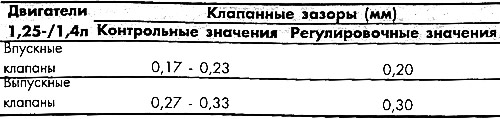
If the valve clearance needs to be adjusted on several valves, record the measured valve clearances.
Remove the corresponding camshaft.
Remove the adjusting washer with a clamp or a sharp awl. Then insert a new adjusting washer with the inscription facing down.
Install the camshaft(s) and new timing belt.