


Valve clearances
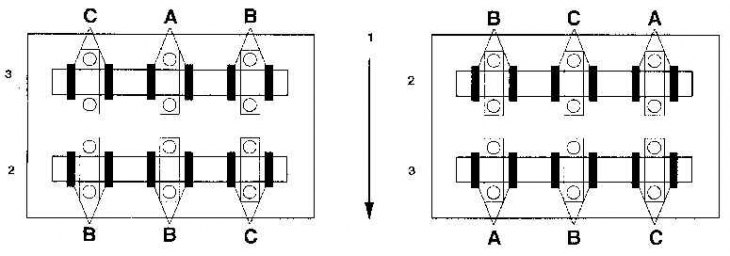
1. Forward
2. Intake valves
3. Exhaust valves
4. Front cylinder block
5. Rear cylinder block
1. Disconnect the negative battery cable.
2. Remove the valve cover.
3. Set the piston of cylinder N1 to the TDC position at the moment of compression stroke.
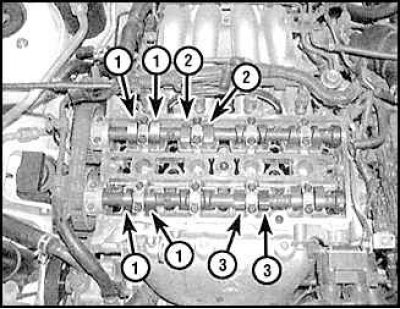
4. On 4-cylinder models, set the N1 cylinder piston to TDC on the compression stroke and measure the clearances of the indicated valves.
5. On a 6-cylinder engine, when piston N1 is at TDC on the compression stroke, measure the clearances of the valves marked A, turn the engine crankshaft 240° clockwise and measure the clearances of the valves marked B, then turn the engine crankshaft another 240° and measure the clearances of the valves marked C (see figure Valve clearances).
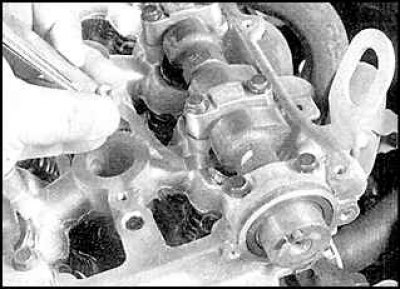
6. Measure the clearance between the valve lifter and the camshaft lobe using a set of feeler gauges - if the clearance is correct, friction should be felt when the feeler gauge is removed.
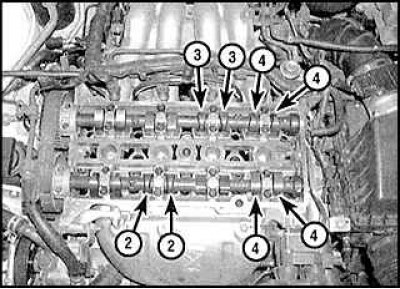
7. On four-cylinder models, when the piston of cylinder N4 is at TDC during the compression stroke, measure the clearances of exhaust valves N1 and 4, and intake valves N3 and 4.
8. Adjusting the valve clearances can be done with or without removing the timing belt.
Adjustment operation with removal of the timing belt
1. Remove the timing belt and camshafts.
2. Remove the washers from the valve lifters that require adjustment and measure their thickness.
3. Install new washers of the required thickness, then install the camshafts and bearing caps. Tighten the mounting bolts to the specified torque.
4. Recheck the valve clearances.
Adjustment operation without removing the timing belt
1. Turn the crankshaft so that the cam lobe above the valve requiring adjustment is raised up.
2. Turn the valve lifter so that the slot faces the spark plug. On a 6-cylinder engine, remove the inner bolts of the outer camshaft bearing caps (excluding large thrust bearing caps). On a 4-cylinder engine, remove the inner bearing cap bolts closest to the valve being adjusted. Install the clamping bar onto the bearing caps and secure it with long bolts. Tighten the clamp by lowering the valve lifter and remove the adjusting washer using a small screwdriver and a magnet or tweezers.
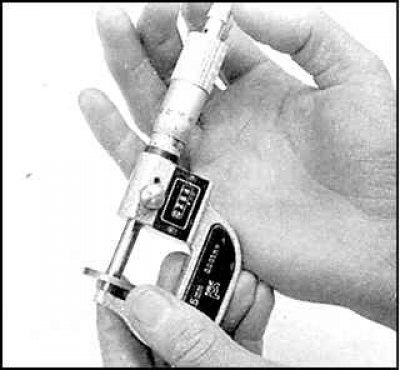
3. Measure the thickness of the washer using a micrometer.
Calculate the required thickness of the new washer using the following formula:
(Text taken from an online platform: mazbook.ru)
H = T + (Z – P)
where T is the thickness of the old washer
Z – valve clearance
H – thickness of the new washer
P – recommended valve clearance
4. Install a new washer and recheck the valve clearance.