


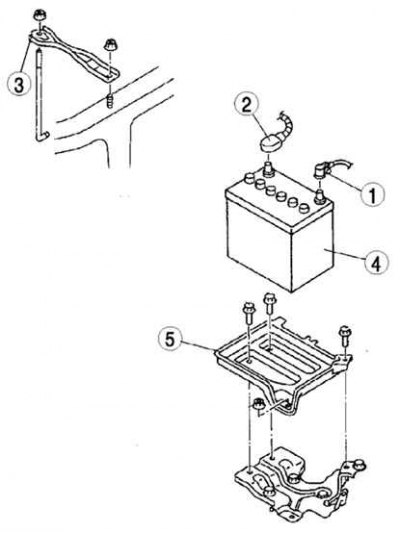
Fig. 7.4. Mazda 6 battery: 1 – negative terminal wire; 2 – positive terminal wire; 3 – mounting bracket; 4 – battery; 5 – lower tray
The vehicle covered in this manual has a 12-volt electrical system. The body ground is connected to the negative terminal of the battery. The battery is located in the engine compartment or under the rear seat (models with air conditioning, as well as some diesel modifications).
The battery performs three main functions in the vehicle's electrical system:
- provides electric current to start the engine;
- stabilizes the voltage in the electrical system;
- can provide current for a short time when the power consumption exceeds the generator output power.
Sealed battery packs are standard for all vehicles. They have no filler plugs on the hull. The battery pack is completely sealed, apart from two small side vents for ventilation. These vents allow the resulting gases to escape.
Sealed batteries have the following advantages over conventional batteries:
- to ensure longevity of batteries, there is no need to add water;
- the battery is protected from overcharging. If too much voltage is applied to the battery, it will not accept as much current as a regular battery. The increase in voltage will continue to charge the regular battery, which will cause gassing and loss of electrolyte;
- the battery can be recharged like a regular one. This is very important when the car is parked in one place for a long time;
- with smaller dimensions and weight, the voltage and current remained the same.
The battery has two indicators:
- the battery capacity is determined at 27°C. The capacity at full charge provides 10.5 V and more;
- the battery's cold start capacity is determined by testing at -18°C. This test can be used to determine the battery's cranking power when the engine is cold.
The battery reserve capacity is defined as the maximum possible continuous time for driving at night with a minimum electrical load without using the generator output. Expressed in minutes, the reserve capacity (or the E indicator) is the time required for a fully charged battery at 27°C and discharged at 25 A to reach a terminal voltage of 10.5 V.
[The original article is posted on MAZBOOK.RU]
The service life of a battery is not unlimited. However, with proper care, the battery will last for many years.
If the battery tests well but shows problems, the cause of the malfunction or failure may be one of the following:
- some appliance was left on all night;
- the car was moving at low speed for short periods;
- the vehicle's electrical load exceeded the generator's output, often with non-standard equipment being turned on;
- fault in the charging system - alternator belt slipping, alternator or voltage regulator fault, etc;
- improper use of the battery - failure to clean, improperly fastened terminals or loose clamps;
- mechanical faults in the electrical system - shorted or pinched wires.
Sealed batteries have a built-in hydrometer used for diagnostics.
A visible "green dot" means the battery is ready for testing.
If the "green dot" changes color to a darker color, the battery is not ready for testing. In this case, the electrical systems and charging should be checked.
Light yellow means the fluid level has dropped below the tip of the hydrometer. This may be due to overcharging, prolonged charging, or battery wear. If the battery cannot be recharged, replace it.