


Precautionary measures
If the following precautions are not observed, there is a risk of electrolyte spillage. There is also a risk of battery explosion or damage to electrical equipment.
Do not bend over the battery - you may get burned by the electrolyte.
When starting the engine, do not use an open flame or smoke near the battery, as flammable gases may escape from it.
Make sure that auxiliary wires are not damaged by moving parts, such as a fan.
The cross-section of auxiliary wires for starting petrol engines with a volume of up to 2.5 litres must be at least 16 mm² (diameter about 5 mm). For diesel engines or petrol engines with a working volume of more than 2.5 l - not less than 5 mm². The cross-section of the wires is usually indicated on their packaging. When buying wires, it is better to buy wires with a cross-section of 25 mm², because they are more universal.
Both batteries must be rated for 12V.
A discharged battery can freeze at temperatures as low as -10°C. Before connecting auxiliary cables, a frozen battery must be defrosted.
(The article is reprinted from the portal: MazBook)
The discharged battery must be properly connected to the vehicle's electrical system.
Check the electrolyte level in the discharged battery, add distilled water if necessary.
The cars should not touch each other, otherwise current will flow immediately when the positive terminals of the battery are connected.
On both vehicles, apply the parking brake. The gearbox should be in neutral, the automatic transmission selector should be in the "P" position.
Turn off all power consumers.
A car with a charged battery should have its engine idling during the starting process. This prevents damage to the alternator due to voltage surges.
Connect the auxiliary wires in the following order:
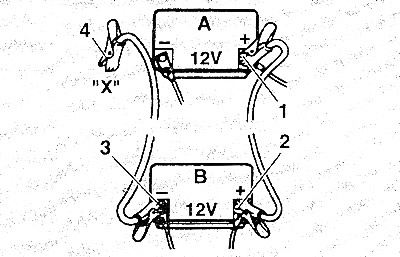
1. Connect the red wire to the positive terminal of the discharged battery (A).
2. Connect the other end of the red wire to the positive terminal of the charged battery (B).
3. Connect the black wire to the negative terminal of the charged battery.
4. Connect the other end of the black wire to a good ground (X) on the vehicle with the dead battery, preferably to the cylinder block components. Do not connect the wire to the negative terminal of the dead battery, otherwise it may explode when a spark from the detonating gas jumps through.
Caution! The clamps of the auxiliary wires and the connected wires must not touch each other, and the contacts of the "positive" wire must not touch the "ground" - a short circuit may occur.
Start the engine of a car with a charged battery and let it idle. When starting the engine of a car with a discharged battery, do not turn on the starter for more than 10 seconds, because the contacts and wires heat up due to the high current consumption. Between starting attempts, you need to take a break of 30 seconds for cooling.
After starting, disconnect the auxiliary wires in reverse order, i.e. first the black wire, then the red one.