


Warning! Only a 12-volt battery may be used to start the engine. If you try to start the engine with a 24-volt power source, (for example, a 24-volt battery or two 12-volt batteries connected in series) the engine starter, ignition system and other electrical devices of the car will fail.
1. Make sure the booster battery you intend to use has a nominal voltage of 12V.
2. If the auxiliary battery is installed in another vehicle, the vehicles must not touch each other. Turn off the engine of the vehicle whose battery will be used as an auxiliary battery. Turn off all unnecessary electrical consumers in both vehicles.
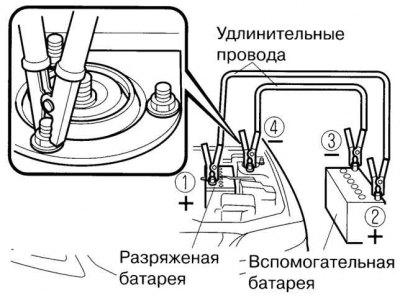
Fig. 1.173. Connecting the second terminal of the battery
3. Connect the terminals of the extension wires strictly in the sequence shown in Figure 1.173.
- Connect the extension cable terminal to the positive terminal of the discharged battery (1).
- Connect the second terminal of this wire to the positive terminal of the auxiliary battery (2).
- Connect the terminal of the other extension cable to the negative terminal of the auxiliary battery (3).
- Connect the second terminal of this wire to an exposed solid metal fixed part that is located at a sufficient distance from the discharged battery (4). Such a part can be, for example, a suspension strut mounting bolt.
4. Start the engine of the car with the booster battery and let it run for a few minutes. Then start the engine of the car with the discharged battery.
5. After the engine has started successfully, carefully disconnect the extension cable terminals in reverse order.
[Text taken from an online platform www.MAZbook.ru]