


The vehicles are equipped with alternators. When installing additional electrical equipment, check that the generator power is sufficient to power this equipment. The main elements of the generator are the rotor, stator, rectifier, collector brushes, electronic voltage regulator, bearings and belt pulley.
The generator is driven by a belt from the engine crankshaft.
The generator is a three-phase synchronous electric machine with electromagnetic excitation. To convert alternating current into direct current, a diode rectifier is built into the generator. The voltage is regulated by a built-in electronic voltage regulator.
When the generator is running, the electric current flowing through the excitation winding creates a magnetic flux around the rotor poles. As the rotor rotates, the south and north poles of the rotor are under each stator tooth; the working magnetic flux passing through the stator teeth changes in magnitude and voltage. This variable magnetic flux creates an electromotive force in the stator winding. The wedge shape of the rotor pole pieces is selected in such a way that it allows obtaining a curve shape of the electromotive force close to sinusoidal.
At a high generator rotor speed, when the voltage of the latter becomes greater than 13.6–14.6 V, the voltage regulator locks, and the current does not pass through the excitation winding. The generator voltage drops – the regulator unlocks and again passes the current through the excitation winding. The higher the generator rotor speed, the longer the regulator locks, and therefore the more the voltage at the generator output decreases. The process of locking and unlocking the regulator occurs with a high frequency, so the voltage fluctuations at the generator output are not noticeable and can practically be considered constant, maintained at a level of 13.6–14.6 V.
When checking the generator and operating the vehicle, it is necessary to follow a number of rules in order not to damage the generator:
- do not allow the generator to operate with the battery disconnected from its terminal. Without a battery, dangerous overvoltage pulses occur in the vehicle's on-board network when any power consumers are disconnected. They can damage the vehicle's electronic equipment, including the voltage regulator and the generator's rectifier block diodes;
- do not check the generator's performance "for a spark" even by briefly connecting the "positive" terminal of the generator to the "ground", since in this case a significant current flows through the diodes, and they are damaged. The generator voltage can only be monitored with a voltmeter;
- the negative terminal of the battery must always be connected to the car's ground, and the positive terminal to the generator clamp. Incorrect (reverse) connection of the battery will immediately cause increased current to flow through the generator diodes, and they will fail;
- do not check diodes with a voltage higher than 12 V or with a megohmmeter, as it has too high a voltage for diodes, and when checking they will be broken (a short circuit will occur)When checking the insulation of electrical wiring with a megohmmeter, it is necessary to disconnect all wires from the generator;
- it is necessary to disconnect all wires from the generator and battery when electric welding any body parts;
- it is necessary to check the circuits and components of electrical equipment and troubleshoot problems with the engine not running and the battery disconnected.
The original article is posted on [www.MAZbook.ru]
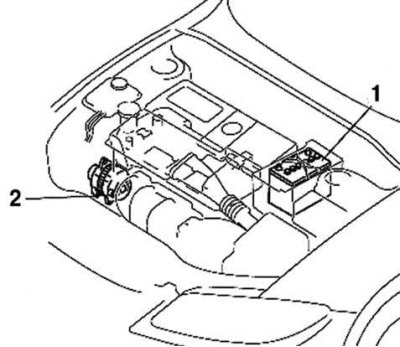
Fig. 7.1. Electrical supply system of the Mazda 3: 1 – alternating current generator; 2 – starter