


Contents: Forward clutch ⇓ Clutch 3/4 ⇓ Reverse clutch ⇓ Brake bands 2/4 ⇓ Reverse and low range brake ⇓ One-way clutch ⇓ Planetary gear ⇓
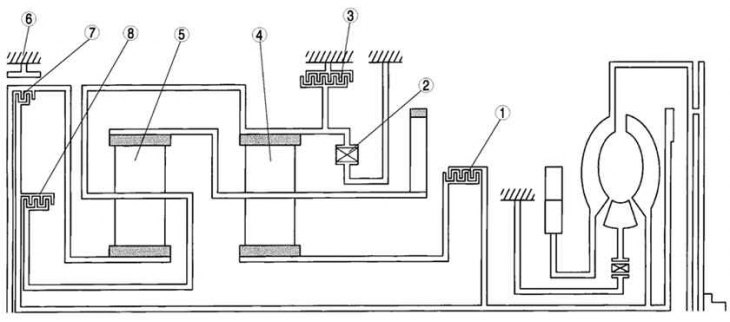
Fig. 3.73. Design of the transmission mechanism: 1 – forward clutch; 2 – one-way clutch; 3 – reverse and low gear brake; 4 – forward planetary gear; 5 – reverse planetary gear; 6 – brake bands 2–4; 7 – reverse gear clutch; 8 – clutches 3–4
The transmission mechanism (Fig. 3.73) consists of three pairs of clutches, a brake, a band brake, a one-way clutch and two pairs of single planetary gears. The planetary gear changes the gear ratio according to the driving conditions of the vehicle. In the transmission mechanism, hydraulic pressure is transmitted from control valves or shift solenoids A, B or C (working cycle) to clutches and brakes.
Forward clutch
Transfers torque from the turbine shaft to the front sun wheel.
Works in the forward range of first, second or third gear.
Clutch 3/4
Transfers torque from the turbine shaft to the rear planetary gear carrier.
Works in the forward range of fourth or third gear.
Reverse clutch
Transfers torque from the turbine shaft to the rear sun wheel.
Works when the vehicle is in reverse.
Brake bands 2/4
Blocks the rotation of the reverse drum and fixes the rear sun wheel.
Works in second or fourth gear position.
Reverse and low range brake
Fixes the rotation of the front internal gear.
Works when the vehicle is in reverse or first gear (l range, HOLD mode)
One-way clutch
Locks counter-clockwise rotation of the front internal gear in first gear.
The original article is on www.MazBook.ru
Planetary gear
The planetary gear operates in the transmission by engaging/disengaging clutches and/or brakes, converting the driving force of the turbine shaft and transmitting it to the drive gear of the final drive.
Note: All directions of rotation are considered from the torque converter side.