
MazBook.ru
English Русский
Български
Беларускі
Український
Српски
Hrvatski
Română
Polski
Slovenský
Magyar
• Bookmark • Sitemap • Contacts •   
Cars Opel Cars Ford Cars Volkswagen Cars Audi Cars Kia Cars Renault Cars Peugeot


Familia Capella Mazda3 Mazda6 CX-? Others Articles
Mazda6 GG (2002-2008)

Checking and adjusting the brake system components (Mazda 6 GG)

  • Home
  • Mazda 6
  • Mazda6 GG (2002-2008)
  • Chassis
  • Brake system
  • Checking and adjusting the brake system components
0
Check the brakes on a dry and level road, at different vehicle speeds with light and strong pressure on the brake pedal, avoiding locking the brakes and slipping the tires.

There are three main factors that influence the braking process:
  • different wheels will have different conditions of tire adhesion to the road, which will cause different braking forces. Air pressure and tire treads should be the same;
  • the braking forces on the front and rear axles must be proportional to the vertical loads acting on them;
  • misalignment of the wheels may cause the vehicle to pull to the side when braking.

To check for a brake fluid leak, press the brake pedal with the engine idling and the gearshift lever in neutral. If the pedal gradually sinks under constant pressure, there is a leak in the system. Visually check for a leak and the brake fluid level in the master cylinder reservoir. A slight drop in the brake fluid level is due to normal wear of the brake pads. An abnormally low level indicates a leak in the system. Both internal and external leaks are possible in a hydraulic system. If the brake fluid level is normal, check the length of the brake booster piston rod. If an improper piston rod length is found, adjust the length or replace the piston rod.

Check the brake master cylinder in the following order:
  • for damage and leakage of brake fluid around the master cylinder. A decrease in the brake fluid level can only indicate the presence of a leak. Wetting of the surface of the master cylinder is also an abnormal condition;
  • pedal rod connection and rod length. If they are normal, disassemble the master brake cylinder and check for stretching or swelling of the cylinder seals, then for wear of the rubber parts. If the seals are swollen, non-standard or contaminated brake fluid may be used. If contaminated brake fluid is found, all metal components should be disassembled and cleaned, and all rubber components should be replaced. All pipelines should also be flushed.

[The article is reprinted from the portal www.mazbook.ru]


Incorrect brake fluid, mineral oil, or water in the fluid can cause the brake fluid to boil or damage the rubber components. If the main piston seals in the master cylinder are swollen, the rubber components are damaged. If rubber wear is detected, disassemble all hydraulic system components and wash them with alcohol. Dry the components with compressed air before reassembling. Replace all rubber components in the system, including hoses. When the brake mechanism is operating, check for fluid in the gaskets. If fluid is detected, replace the gaskets. If the condition of the piston seals of the master brake cylinder is normal, check for leaks or excessive overheating. If these conditions are not detected, drain the brake fluid, fill the master brake cylinder, and drain the fluid from the system again.

Table 6.5. Possible malfunctions of the brake system, their causes and methods of elimination
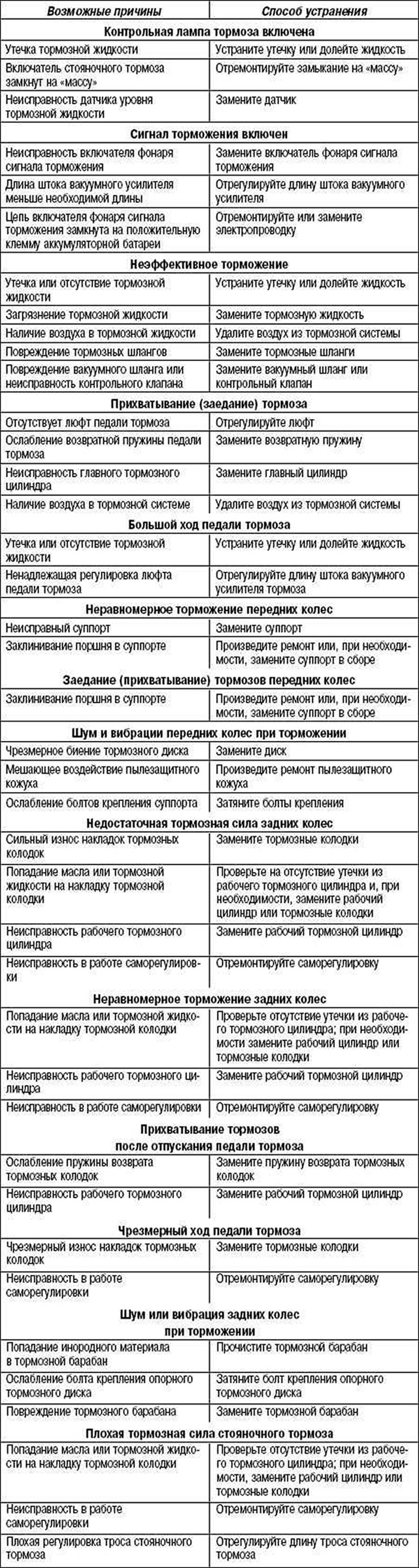


Table 6.5. Possible malfunctions of the brake system, their causes and methods of elimination
This article is available at: russian, bulgarian, belarusian, ukrainian, serbian, croatian, romanian, polish, slovak, hungarian
This text was checked by: Evdokia Filimonova
Share with friends on social networks:

Previous
Mazda6 GG » Brake system
Next

On-board diagnostics of the brake system
Controller Area Network (CAN)
Emergency Brake Control
DSC HU/CM Dynamic Stability Control Unit
Integrated Dynamic Stability Control Sensor
Checking the brake fluid level in the hydraulic reservoir of the…
Brake hoses — checking
Bleeding the brake system
Checking the vacuum hose check valve (brake booster)
Checking the brake pedal height
More articles on repairing other Mazda models
Checking and adjusting the injection system Mazda Familia 5 (1985-1989)
Idle Speed Control System — checking and adjusting Mazda Capella 3 (1982-1992, petrol)
Checking and adjusting the brake system components Mazda3 BK (2003-2009)
Checking the intake system components Mazda CX-5KE (2012-2017)
Parking brake — checking and adjusting Mazda BT-50 (1) (2006-2011)
Link in different formats to this article
Comments and feedback from visitors
No comments yet


How much will 21 + 45 ?


Mazda6 GG (2002-2008) 
  • User manual
  • Vehicle description
  • Keys, locks and alarms
  • Controls and instruments
  • Air conditioning and heater
  • Seat adjustment
  • Security systems
  • Driving and operation
  • Faults en route
  • Maintenance
  • Power unit
  • Engine device
  • Engine repair
  • Lubrication system
  • Cooling system
  • Fuel system
  • Exhaust system
  • Electrical equipment of engines
  • Control system
  • Transmission
  • Clutch
  • Mechanical gearbox
  • Automatic gearbox
  • Drive shafts and hubs
  • Chassis
  • Suspension and wheels
  • Steering
  • Brake system
  • Body
  • Exterior (external elements)
  • Interior (internal elements)
  • Doors and windows
  • Air conditioning and heater
  • Electrical equipment
  • Equipment and devices
  • Power devices
  • Lighting system
  • Windshield wipers and washers
MazBook.ru © 2018–2026 · Mobile version · Articles and news · Sitemap: EN BG BY UA RS HR RO PL SK HU · Feedback · Site search · Add to bookmarks Familia 5 (BF) · Familia 6 (BG) · Capella 3 (GC) · Capella 3 and 4 (GC) · Capella 4 (GD) · Capella 5 (GE) · Capella 6 (GF) · Mazda3 BK · Mazda6 GG · CX-5KE · Mazda 121 (3) · Mazda BT-50 (1) ·
By continuing to use the site, you agree to the use of cookies 🔐