
MazBook.ru
English Русский
Български
Беларускі
Український
Српски
Hrvatski
Română
Polski
Slovenský
Magyar
• Bookmark • Sitemap • Contacts •   
Cars Opel Cars Ford Cars Volkswagen Cars Audi Cars Kia Cars Renault Cars Peugeot


Familia Capella Mazda3 Mazda6 CX-? Others Articles
Familia 5 (1985-1989) Familia 6 (1989-1994)

Checking and adjusting the injection system (Mazda Familia BF)

  • Home
  • Mazda Familia
  • Familia BF (1985-1989)
  • Model «B» engine
  • Power system (injector)
  • Checking and adjusting the injection system
0
Contents: Checking the fuel supply pressure of…⇓ Checking the fuel pressure regulator ⇓ Checking the injector flow capacity ⇓
Note: The injection system components are checked using a pressure gauge with a scale of up to 9 kg/cm²; measuring cups with a capacity of up to 100 cm³ for measuring the amount of gasoline and an electrical connector with two clamps.


Checking the fuel supply pressure of the fuel pump


Disconnect the wire from the negative terminal of the battery.

Disconnect the fuel outlet hose from the fuel filter and attach the hose fitting connected to the pressure gauge to the filter pipe.

Shunt the fuel pump relay with a wire.
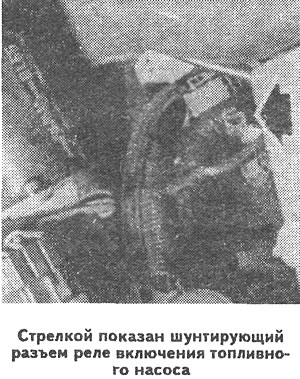
Shunt the fuel pump relay with a wire.


Connect the wire to the negative terminal of the battery.

Turn on the ignition and measure the fuel supply pressure of the pump with a pressure gauge, which should be within 4.5-6.0 kg/cm².

If there is any deviation from the norm, check the technical condition of the fuel filter and fuel pump.

Checking the fuel pressure regulator


Disconnect the wire from the negative terminal of the battery.

Disconnect the fuel outlet hose from the fuel filter and attach a tee to the opening of the hose and the branch pipe, then attach a pressure gauge to the tee.


Connect the wire to the negative terminal of the battery.

Start the engine and measure the fuel pressure in the system at idle speed with a pressure gauge, which should correspond to the values specified in the subsection "Detailed technical specifications".

Disconnect the vacuum hose from the pressure regulator and plug the hose opening.

Measure the fuel pressure in the system at idle speed, which should correspond to the values specified in the subsection "Detailed technical specifications".

If there is any deviation from the norm, replace the pressure regulator.

Disconnect the pressure gauge, tee and connect the fuel outlet hose to the fuel filter.

Checking the injector flow capacity


Disconnect the wire from the negative terminal of the battery.

Remove the distribution line with injectors without disconnecting the supply and drain pipes.

Secure the injectors to the fuel rail with wire.

(For details, see the website: www.MAZbook.ru)

Disconnect the injector plugs.

Connect the wire to the negative terminal of the battery and turn on the ignition.

Shunt the fuel pump relay with a wire.

Make sure the injectors are tight.

Turn off the ignition.

Connect the connector of the injector being tested to the terminals of the battery using a wire.

Insert the nozzle into the measuring cup.

Turn on the ignition for 15 seconds.

Turn off the ignition.

Determine the amount of fuel that has flowed out of the injector nozzle into the measuring cup and compare the obtained value with the nominal value (see subsection "Detailed technical specifications").
This article is available at: russian, bulgarian, belarusian, ukrainian, serbian, croatian, romanian, polish, slovak, hungarian
This text was checked by: Yaroslav Odintsov
Share with friends on social networks:

Previous
Familia 5 » Power system (injector)
Next

Structural diagram of the injection system
Fuel injection engine power supply system
Checking electrical parameters
Removal and installation the fuel pump
Removal and installation the fuel pressure regulator
Adjusting engine idle speed
Turbocharger — removal and installation
More articles on repairing other Mazda models
Idle Speed Control System — checking and adjusting Mazda Capella 3 (1982-1992, petrol)
Checking and adjusting the brake system components Mazda3 BK (2003-2009)
Checking and adjusting the brake system components Mazda6 GG (2002-2008)
Checking the exhaust system Mazda CX-5KE (2012-2017)
Instructions for checking the injection system Mazda 121 (3) (1996-2003)
Link in different formats to this article
Comments and feedback from visitors
No comments yet


How much will 25 + 36 ?


Familia 6 (1989-1994) 
  • General information
  • Introduction to guide
  • User manual
  • Maintenance
  • Power unit
  • Petrol engines
  • Diesel engines
  • Lubrication system
  • Cooling system
  • Ignition system
  • Supply system
  • Carburetor
  • Injection system
  • Exhaust system
  • Transmission
  • Clutch
  • Car gearbox
  • Chassis
  • Front suspension
  • Rear suspension
  • Steering
  • Brake system
  • Wheels and tires
  • Body
  • Body elements
  • Doors and windows
  • Body Care
  • Electrical equipment
  • Equipment and devices
  • Power devices
  • Heating system
  • Lighting and headlights
  • Windshield wipers and washers
  • Wiring diagrams (since 1987)
  • Wiring diagrams (since 1991)
Familia 5 (1985-1989) 
  • General information
  • Vehicle data
  • Model «E» engine
  • Engine repair
  • Cooling and lubrication system
  • Power and ignition system
  • Model «B» engine
  • Engine repair
  • Cooling and lubrication system
  • Ignition system
  • Power system (carburetor)
  • Power system (injector)
  • Transmission
  • Clutch
  • Mechanical gearbox
  • Automatic gearbox
  • Front wheel drive
  • Chassis
  • Steering
  • Front suspension
  • Rear suspension
  • Brake system
  • Electrical equipment
  • Equipment and devices
  • Electrical circuits
  • Wiring diagrams (station wagon)
MazBook.ru © 2018–2026 · Mobile version · Articles and news · Sitemap: EN BG BY UA RS HR RO PL SK HU · Feedback · Site search · Add to bookmarks Familia 5 (BF) · Familia 6 (BG) · Capella 3 (GC) · Capella 3 and 4 (GC) · Capella 4 (GD) · Capella 5 (GE) · Capella 6 (GF) · Mazda3 BK · Mazda6 GG · CX-5KE · Mazda 121 (3) · Mazda BT-50 (1) ·
By continuing to use the site, you agree to the use of cookies 🔐