


The combined sensor is mounted on the left side of the parking brake lever (left hand drive models) or on the right side of the parking brake lever (right hand drive models) and determines the angular velocity of the vehicle's yaw (angular velocity of a car in a turn) and longitudinal acceleration. The sensor transmits a signal to the DSC HU/CM system.
Output voltage of the combined sensor (2.5V when the vehicle is stationary) changes in accordance with the yaw rate and the magnitude of longitudinal acceleration.
The yaw rate is determined when the sensor detects a Coriolis force proportional to the rotational speed.
The magnitude of longitudinal acceleration is determined when the sensor detects an inertial force proportional to the longitudinal acceleration acting on the silicon sensing element.
Note.
- Coriolis force.
- When an object placed on a rotating disk moves toward its center, a force is generated that is directed at right angles to the path of the object's movement.
- This results in the object's direction of movement remaining unchanged relative to its starting point, and the object does not reach the center.
- This force that deflects the object from the center is called the Coriolis force, and the actual movement of the object is in a straight line.
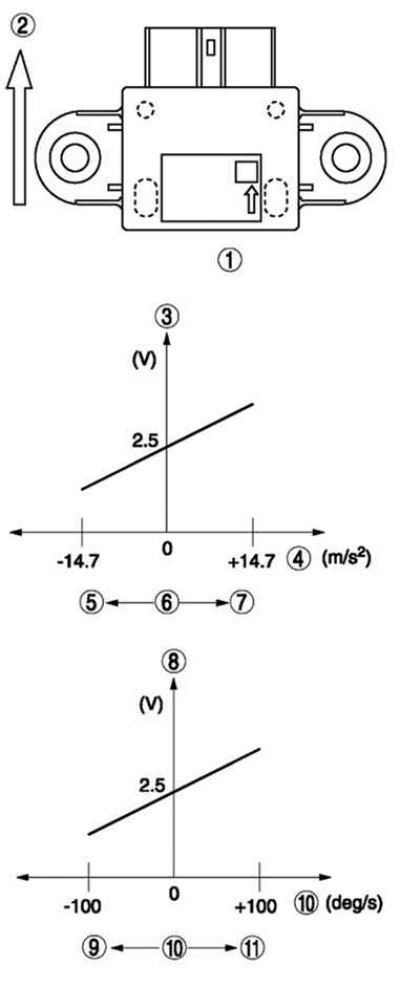
Fig. 6.10. Operation diagram of the integrated dynamic stability control sensor of the Mazda 6 vehicle: 1 – appearance; 2 – front of the car; 3 – output voltage; 4 – acceleration; 5 – left turn; 6 – longitudinal acceleration; 7 – right turn; 8 – output voltage; 9 – left turn; 10 – yaw rate; 11 – right turn
(Data provided by the website MAZBOOK)