


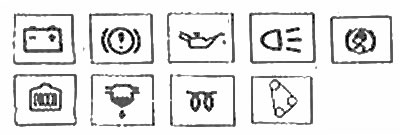
The indicator lamps light up when the key in the steering wheel lock is turned to the "ON(II)" position (do not start the engine and apply the handbrake). If some warning lights do not light, have them checked at a Mazda service station.
 High beam indicator lamp. This lamp lights up when the high beam is on.
 Battery alarm. This warning light indicates that the battery is discharged or there is damage in the electrical system.
If the lamp lights up while the vehicle is moving:
- Carefully pull over to the side of the road and stop the car.
- Turn off the engine, check the condition and tension of the drive belt.
- If the belt is in good condition, take it to a Mazda service center for inspection and repair
 Brake system warning light. This lamp has three functions:
a. Parking brake indicator light: lights up when the parking brake is applied. Before starting to move, release the parking brake completely; the indicator lamp goes out as soon as the parking brake is released.
b. Brake fluid warning light: If the warning light remains on even when the handbrake is released, this may mean that the brake fluid level is below normal.
If the lamp remains on:
- 1. Check that the parking brake is fully released.
- 2. Pull over to the side of the road and stop the car.
- 3. Turn off the engine, check the brake fluid level and add fluid if necessary. Also check all fluid flow paths to detect leaks.
- 4. If a leak is detected, if the warning light does not go out, or if the brakes do not work, do not drive further. Have your vehicle towed to a Mazda service center for inspection and any necessary repairs.
c. Brake booster warning light (for vehicles with diesel engines). The brake booster only functions when the engine is running. If the warning light comes on with the engine running, the parking brake fully released and the brake fluid level sufficient, the following must be checked:
- 1 If the warning light comes on while you are driving, pull over and stop the vehicle.
- 2 Turn off the engine.
- 3 Check the tension and condition of the power steering pump belt.
Note: If the indicator lamp lights up for a few seconds after repeatedly pressing the brake pedal briefly, this means that the brake booster pressure has temporarily decreased; however, this does not indicate the presence of damage. On the contrary, if the control the lamp does not go out, there is a malfunction in the brake system.
Caution! Driving in this case is dangerous. Correct the problem with the brake system immediately.
 Hazard warning lights indicator lamp. This lamp comes on when you press the hazard warning light lever.
 Oil pressure alarm. The indicator lights up when the oil pressure level is insufficient. If the indicator comes on during
movements:
Oil pressure alarm. The indicator lights up when the oil pressure level is insufficient. If the indicator comes on during
movements:
- 1. Pull over to the side of the road and stop the car.
- 2. Check the engine oil level. If the oil level is insufficient, add oil.
- 3. Have the vehicle towed to the nearest Mazda service station to have the oil added.
Caution: Failure to follow the above instructions and continuing to operate the vehicle under these conditions may result in serious engine damage.
 Low fuel level alarm. This indicator indicates the need to refuel. The indicator lights up when the fuel level in the tank has dropped to approximately 8-12 liters.
 Indicator of poor functioning of brake lights and rear lights. This control lamp performs two functions:
1. Brake light malfunction indicator. If the light comes on, it means one of the brake light bulbs is faulty. It is necessary to replace the brake light bulb as soon as possible.
2. Function of indicator of poor functioning of rear lights. If the lamp lights up, it means that one of the rear light bulbs is faulty. Replace the light bulb as soon as possible.
 Windshield washer fluid level indicator. The indicator indicates that the level of washer fluid in the windshield washer reservoir is low. Check the fluid level in the reservoir and add fluid if necessary
 Door not closed properly alarm. The indicator indicates that the vehicle doors are not tightly closed and that the ignition switch is in the "ON(II)" position.
 4-wheel drive (4WS) steering indicator light. If there is a fault in the 4WD steering system, the 4WS indicator lamp will light or flash. The rear wheels will automatically be aligned in a straight line (as in cars with 2 driving wheels 2WS). The turning radius of the wheel becomes larger and the car can be steered in the same way as with 2-wheel drive. If you experience this problem, please contact your Mazda service center.
 Anti-lock braking system (ABS). The anti-lock braking system indicator light comes on after the engine starts. If the ABS control unit determines that all system elements are functioning normally, it turns off the warning lamp.
 Sound or light signal of coolant level (for vehicles with diesel engines)
Caution: Since engine parts are made of aluminum, it is recommended to use only ethylene glycol-based coolant.
This indicator lamp lights when contact is established (for example, if you are checking the functioning of the lighting) and should go out when the engine starts.
If the light comes on or the signal sounds while driving:
- 1. Pull over to the side of the road and stop the car.
- 2. Turn off the engine and let it cool. If no coolant leak is found, check the coolant level in the reservoir and radiator. Add coolant if necessary.
- 3. If the light does not go out, have the vehicle towed to a Mazda service station.
 Sump alarm (for vehicles with diesel engines)
 Glow plug indicator light (for vehicles with diesel engines)
 Overdrive Disable (O/D OFF) Indicator Lamp
 Engine drive belt indicator (for vehicles with diesel engines). The indicator comes on approximately every 100,000 km to indicate the need to replace the drive belt. In this case, contact a Mazda service station to have the belt replaced.
 Rear fog lights. This indicator lamp comes on when the rear fog lamp is switched on.