


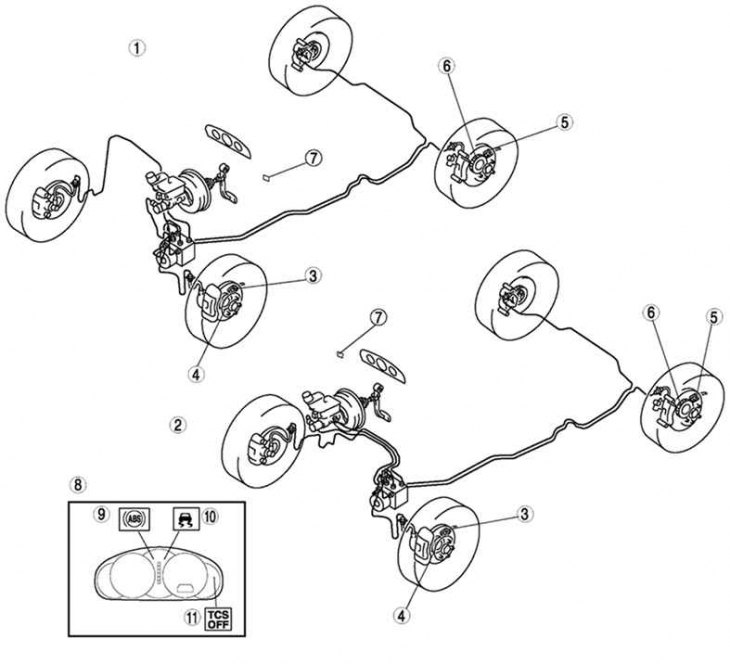
Fig. 6.3. ABS/TCS system of the brake circuit of the Mazda 6: 1 – left-hand drive vehicles; 2 – vehicles with right-hand drive; 3 – Anti-lock braking system wheel speed sensor (front); 4 – Anti-lock brake system sensor rotor (front); 5 – Anti-lock braking system wheel speed sensor (rear); 6 – Anti-lock brake system sensor rotor (rear); 7 – TCS system switch; 8 – instrument cluster; 9 – Anti-lock braking system warning light; 10 – TCS system control lamp; 11 – TCS system shutdown indicator lamp
The anti-lock braking system (Fig. 6.3) limits the pressure created in the hydraulic brake drive so that the amount of slip is optimal. The action of this system must be separate for each wheel. The system must respond immediately to each change in the surface (coefficient of adhesion) and the load on the vehicle.
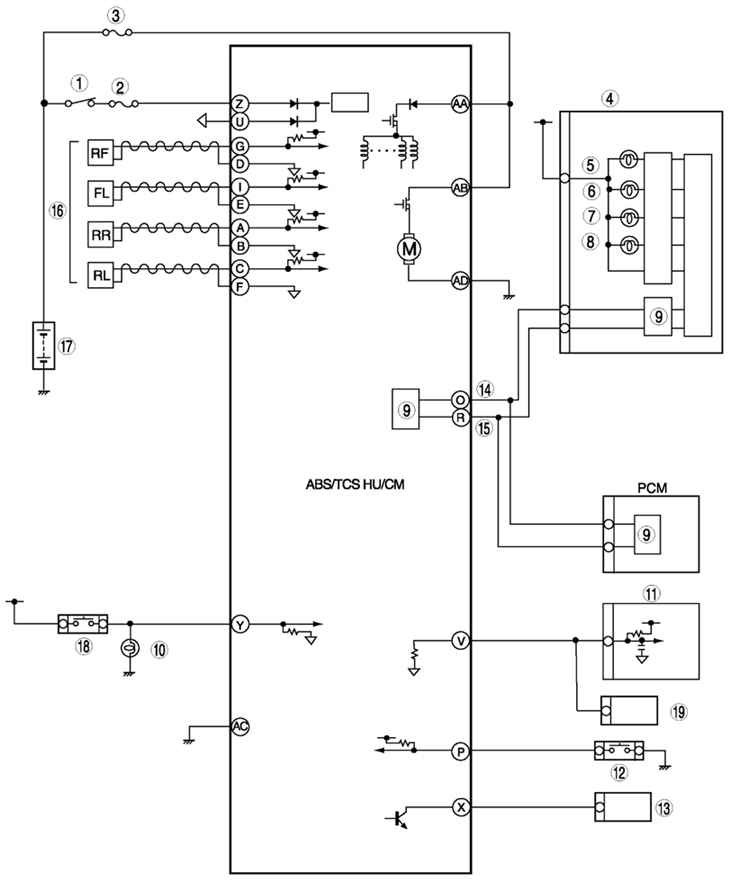
Fig. 6.4. Diagram of the ABS/TCS brake circuit of the Mazda 6: 1 – IG switch; 2 – SUS 15 a (fuse box); 3 – Anti-lock braking system 60 A (fuse box); 4 – instrument cluster; 5 – Anti-lock braking system warning light; 6 – brake system warning light; 7 – TCS system shutdown indicator lamp; 8 – TCS control lamp (only with TCS system); 9 – CAN driver; 10 – brake signal; 11 – actuator of the automatic speed control system; 12 – TCS system switch (only with TCS system); 13 – diagnostic connector DLC-2; 14 – CAN-H; 15 – CAN-L; 16 – Anti-lock braking system wheel speed sensor; 17 – battery; 18 – Brake light switch; 19 – audio unit, windshield wiper and washer switch, car navigation unit, control unit
[Information copied from the portal: mazbook.ru]
The anti-lock braking system prevents the wheels from locking during sudden braking, thereby reducing the braking distance. The force of adhesion between the wheels and the road is greater in this case if the wheels continue to rotate during braking. Even with full braking, the car remains controllable. Speed sensors, one on each wheel, measure the speed of rotation of the wheel. Based on the signals from the sensors (see fig. 6.4) the electronic control unit calculates the average speed, which roughly corresponds to the speed of the vehicle. By comparing the rotation speed of each individual wheel with the average calculated speed, the electronic control unit determines the slip state of the individual wheel and thus determines which wheel is in the pre-lock state.
When one of the four wheel speed sensors signals that the corresponding wheel has locked, the electronic control unit immediately issues a closing signal to the corresponding inlet solenoid valve, which shuts off the supply of brake fluid through the line to the wheel brake. The braking force remains constant. If slipping continues, the outlet valve opens and the pressure in the hydraulic system of this brake decreases. The wheel does not brake, and excess brake fluid returns to the reservoir. As soon as the wheel starts to rotate again, the inlet valve opens and the outlet valve closes. The pressure in the circuit increases, and the wheel brakes again.
The change between braking and free wheel rotation cycles occurs very quickly (several times per second) and continues until the vehicle stops or until the brake pedal is released.
The process is repeated under hard braking separately for each wheel until the brake pedal is released.
The emergency system ensures that ABS is switched off in the event of any malfunction or low voltage in the vehicle's on-board network (below 10 V). ABS malfunction does not affect the operation of the brakes.
The hydraulic drive consists of a hydraulic unit, brake calipers and brake pipes. The hydraulic unit includes an electric pump that creates pressure and electromagnetic valves.