


If a wheel is prone to locking, i.e. the brake fluid pressure in the respective caliper is too high in relation to the traction force of the wheel on the road, the hydraulic system keeps the fluid pressure constant based on the signal from the control unit. This means that the pressure no longer increases, despite the pedal being pressed. If there is still a risk of locking, the brake pressure is reduced by opening the release valve until the wheel begins to accelerate again, then the pressure is again kept constant. The rear wheels are steered together, the pressure in the system is determined by the rear wheel with the greatest slip.
If the wheel accelerates faster than a certain value, the pressure in the system increases again, but not more than the total pressure of the entire system.
This process is repeated for each wheel until the gas pedal is released or the car is in a state close to a stop (2-3 km/h).
The protection system ensures automatic disabling of ABS in case of its failure (for example, due to a cable break) or if the voltage is too low (battery voltage below 10.5V). In this case, the ABS warning light comes on while driving. The normal braking system remains in operation. When braking, the car behaves as if it did not have ABS. If the ABS warning light comes on while driving, this means that the anti-lock braking system is disabled.
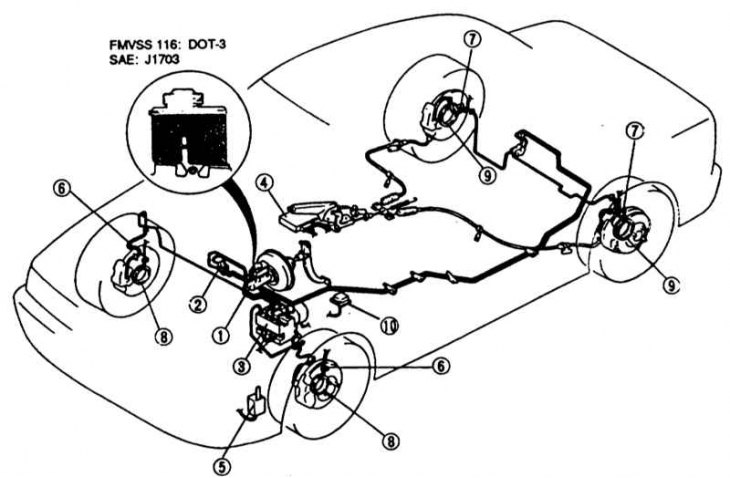
1 - master brake cylinder; 2 - braking force distributor; 3 - hydraulic unit; 4 - ABS control unit; 5 - ABS relay; 6 - front speed sensors; 7 - rear speed sensors; 8 - Front touch ring; 9 - rear touch ring; 10 - diagnostic plug
1. Stop the car, turn off and start the engine again.
2. Check the battery voltage. If the voltage is below 10.5V, charge the battery.
Caution! If the ABS warning light was on at the start of the trip and then went out again after a while, this means that the battery voltage was initially too low and then increased due to charging from the generator.
3. Check that the battery terminals are securely tightened and have perfect contact.
4. Raise the vehicle, remove the front wheels, check the electrical wires of the speed sensors for external damage.
5. Further ABS checks should be carried out in a workshop. The control unit registers any malfunctions that occur and records them in the memory. In MAZDA workshops, the recorded malfunctions can be read from the memory via the diagnostic plug.
Attention! Before electric welding, disconnect the plug from the control unit. Disconnect the plug only when the ignition is off.