
MazBook.ru
English Русский
Български
Беларускі
Український
Српски
Hrvatski
Română
Polski
Slovenský
Magyar
• Bookmark • Sitemap • Contacts •   
Cars Opel Cars Ford Cars Volkswagen Cars Audi Cars Kia Cars Renault Cars Peugeot


Familia Capella Mazda3 Mazda6 CX-? Others Articles
Mazda6 GG (2002-2008)

General description of engines of models L8, LF and L3 (Mazda 6 GG)

  • Home
  • Mazda 6
  • Mazda6 GG (2002-2008)
  • Power unit
  • Engine device
  • General description of engines of models L8, LF and L3
0
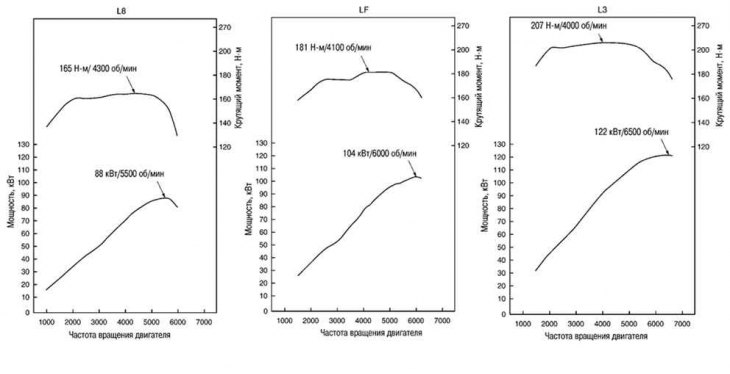
The Mazda 6 is equipped with modern new generation engines with improved dynamic and maintainability characteristics. The L8 engine has a displacement of 1.8 liters, max. power - 88 kW (120 hp), max. torque - 165 N·m / 4300 min⁻¹ developing a maximum speed of 197 km / h. The LF engine has a displacement of 1.8 liters, max. power - 104 kW (141 hp), max. torque - 181 N·m / 4100 min⁻¹ developing a maximum speed of 208 km / h. The L3 engine has a displacement of 2.3 liters, max. power - 122 kW (166 hp), max. torque. torque – 207 N·m / 4000 min⁻¹, developing a maximum speed of 214 km / h. The L3 engine can be equipped with a turbocharger - Sequential Valve Timing (S-VT) system. The principle of operation of the turbocharger is that the turbocharger drive works due to the energy of burnt exhaust gases. The compressor consists of two axial blade wheels. Hot exhaust gases enter the turbocharger housing, where they spin the working (first) wheel to a rotation speed of 100,000 min⁻¹.

Fig. 2.1. Diagram of dynamic characteristics of Mazda 6 engines

Fig. 2.1. Diagram of dynamic characteristics of Mazda 6 engines


The impeller, in turn, spins the second impeller by means of a shaft, which pumps air into the compressor and delivers it to the combustion chamber. The heated air that has passed through the turbocharger is cooled in the intake air radiator. It is the cooling that provides a greater increase in power (Fig. 2.1).


Mazda has made a number of technical improvements to the design and technical components of the new engines.

For example, the L3 engines use a variable valve timing mechanism. In order to reduce the overall weight of the vehicle, the cylinder block on the new engines is made, like the cylinder head, from an aluminum alloy.

Major changes have been made to the design and mechanical parts of the engines in order to reduce vibrations and noise levels. For example, a cassette-type balancing unit is used on the L3 engines. All engines are now equipped with a silent timing chain. The cylinder block is equipped with a long piston skirt and an integrated main bearing cap. In addition, all engines use a crankshaft pulley with a torsional vibration damper and a pendulum-type suspension.

[Text taken from an online platform: mazbook.ru]

The auxiliary drive belt circuit has been simplified to improve maintainability. Now a single drive belt is used for all auxiliary engine units. The drive belt tension is adjusted by an automatic tensioner. The front engine cover has a service opening (to release the chain adjustment ratchet and lock the tensioner lever).

The Mazda 6 cars use 4-cylinder engines as a power plant, in which the cylinders are located in one row. The engine is covered from below by a sump, forming a crankcase, which is also a reservoir for oil, which is necessary for lubrication, cooling and protection of engine parts from wear.

All three engines are 16-valve, with four valves per cylinder. The valves are actuated by two overhead camshafts via plate tappets.


The engine is lubricated by an oil pump mounted on the end face of the crankcase and driven by the crankshaft. Oil sucked from the oil pan is supplied through holes and channels to the crankshaft and camshaft bearings and to the working surfaces of the cylinders.

The preparation and supply of the fuel-air mixture is carried out by an electronic engine management system that does not require maintenance.
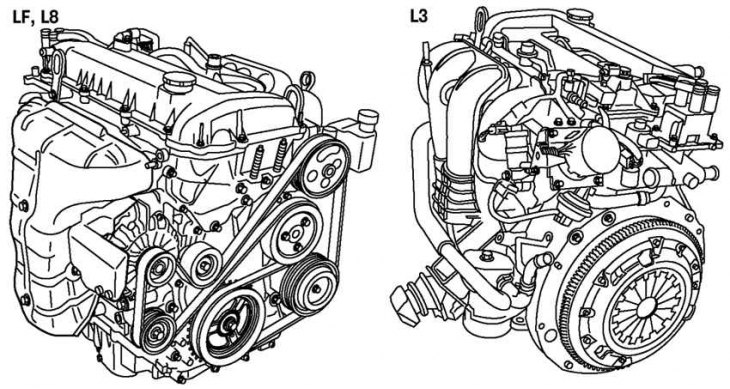
Fig. 2.2. General view of the Mazda 6 engines

Fig. 2.2. General view of the Mazda 6 engines


Table 2.1. Technical characteristics of engines
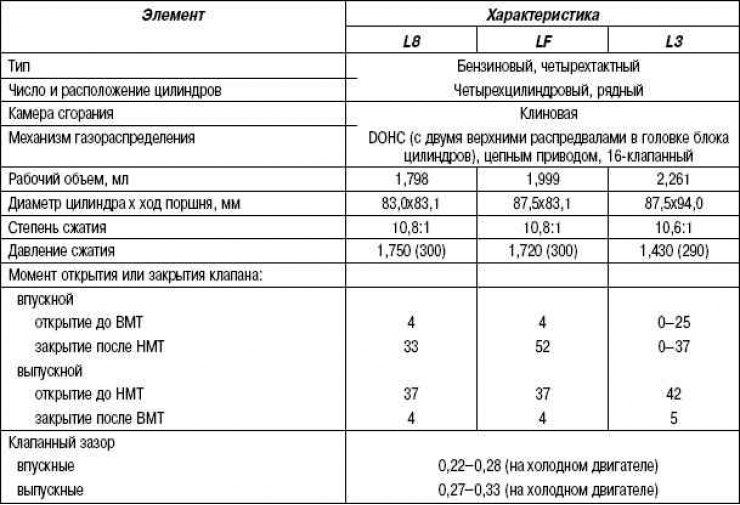


Table 2.1. Technical characteristics of engines
This article is available at: russian, bulgarian, belarusian, ukrainian, serbian, croatian, romanian, polish, slovak, hungarian
This text was checked by: Evdokia Filimonova
Share with friends on social networks:

Previous
Mazda6 GG » Engine device
Next

Cylinder head cover
Cylinder head
Cylinder head gasket
Cylinder block
Crankshaft and main bearing
More articles on repairing other Mazda models
General diagram of electrical equipment with engines E1, E3, E5 Mazda Familia 5 (1985-1989)
Hatch (late models) — general information Mazda Capella 3 (1982-1992, petrol)
General description of engines of models L8, LF and L3 Mazda3 BK (2003-2009)
Vehicle Technical Information — General Overview Mazda CX-5KE (2012-2017)
General description of engines Mazda 121 (3) (1996-2003)
Link in different formats to this article
Comments and feedback from visitors
No comments yet


How much will 35 + 13 ?


Mazda6 GG (2002-2008) 
  • User manual
  • Vehicle description
  • Keys, locks and alarms
  • Controls and instruments
  • Air conditioning and heater
  • Seat adjustment
  • Security systems
  • Driving and operation
  • Faults en route
  • Maintenance
  • Power unit
  • Engine device
  • Engine repair
  • Lubrication system
  • Cooling system
  • Fuel system
  • Exhaust system
  • Electrical equipment of engines
  • Control system
  • Transmission
  • Clutch
  • Mechanical gearbox
  • Automatic gearbox
  • Drive shafts and hubs
  • Chassis
  • Suspension and wheels
  • Steering
  • Brake system
  • Body
  • Exterior (external elements)
  • Interior (internal elements)
  • Doors and windows
  • Air conditioning and heater
  • Electrical equipment
  • Equipment and devices
  • Power devices
  • Lighting system
  • Windshield wipers and washers
MazBook.ru © 2018–2026 · Mobile version · Articles and news · Sitemap: EN BG BY UA RS HR RO PL SK HU · Feedback · Site search · Add to bookmarks Familia 5 (BF) · Familia 6 (BG) · Capella 3 (GC) · Capella 3 and 4 (GC) · Capella 4 (GD) · Capella 5 (GE) · Capella 6 (GF) · Mazda3 BK · Mazda6 GG · CX-5KE · Mazda 121 (3) · Mazda BT-50 (1) ·
By continuing to use the site, you agree to the use of cookies 🔐