
MazBook.ru
English Русский
Български
Беларускі
Український
Српски
Hrvatski
Română
Polski
Slovenský
Magyar
• Bookmark • Sitemap • Contacts •   
Cars Opel Cars Ford Cars Volkswagen Cars Audi Cars Kia Cars Renault Cars Peugeot


Familia Capella Mazda3 Mazda6 CX-? Others Articles
Mazda6 GG (2002-2008)

General information about electrical equipment (Mazda 6 GG)

  • Home
  • Mazda 6
  • Mazda6 GG (2002-2008)
  • Electrical equipment
  • Equipment and devices
  • General information about electrical equipment
0
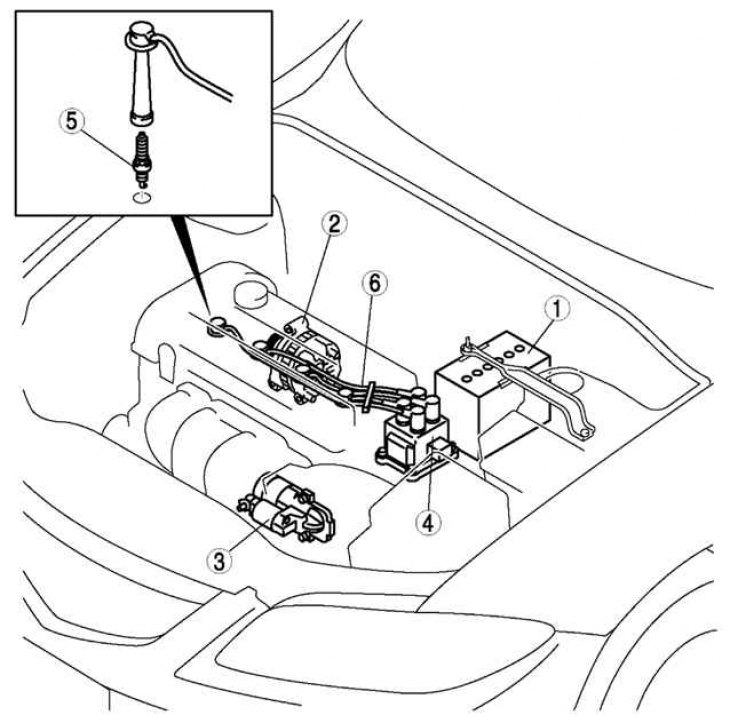
Fig. 7.1. Electrical supply system of the Mazda 6: 1 – battery; 2 – alternating current generator;…

Fig. 7.1. Electrical supply system of the Mazda 6: 1 – battery; 2 – alternating current generator; 3 – starter; 4 – ignition coil; 5 – spark plug; 6 – high voltage wires


Consumers are connected to the "positive" power source by a wire, and to the "negative" power source - through the car body ("ground"). This method allows to reduce the number of wires and simplify installation.

The electrical system consists of a battery, generator, starter, electrical consumers and electrical circuits.

Lighting devices include headlights, taillights, fog lights, turn signals, license plate lights and interior lights.

The battery is charged by a generator, which is driven by a belt from the crankshaft pulley.

The starter is a DC motor with mixed excitation and an electromagnetic traction relay. When starting, the traction relay engages the pinion with the flywheel ring gear before the starter receives power from the battery. After the engine starts, the freewheel clutch disconnects the starter anchor from the flywheel ring gear.

(The original article is posted on: «MazBook.ru»)

It should be noted that to prevent short circuits and burns when working with any electrical component of the vehicle, always disconnect the wire from the negative terminal of the battery.
This article is available at: russian, bulgarian, belarusian, ukrainian, serbian, croatian, romanian, polish, slovak, hungarian
This text was checked by: Evdokia Filimonova
Share with friends on social networks:

Previous
Mazda6 GG » Equipment and devices
Next

Determining the source of the fault
Fuses — Description and Replacement
Relay — purpose and location
Removal and installation the alarm sensor
Removal and installation a security alarm siren
More articles on repairing other Mazda models
Detailed technical characteristics of electrical equipment Mazda Familia 5 (1985-1989)
General information about electrical equipment Mazda Capella 3 and 4 (1982-1992)
General information about the engine electrical equipment Mazda3 BK (2003-2009)
Replacing electrical fuses Mazda CX-5KE (2012-2017)
General information about on-board electrical equipment Mazda 121 (3) (1996-2003)
Link in different formats to this article
Comments and feedback from visitors
No comments yet


How much will 38 + 42 ?


Mazda6 GG (2002-2008) 
  • User manual
  • Vehicle description
  • Keys, locks and alarms
  • Controls and instruments
  • Air conditioning and heater
  • Seat adjustment
  • Security systems
  • Driving and operation
  • Faults en route
  • Maintenance
  • Power unit
  • Engine device
  • Engine repair
  • Lubrication system
  • Cooling system
  • Fuel system
  • Exhaust system
  • Electrical equipment of engines
  • Control system
  • Transmission
  • Clutch
  • Mechanical gearbox
  • Automatic gearbox
  • Drive shafts and hubs
  • Chassis
  • Suspension and wheels
  • Steering
  • Brake system
  • Body
  • Exterior (external elements)
  • Interior (internal elements)
  • Doors and windows
  • Air conditioning and heater
  • Electrical equipment
  • Equipment and devices
  • Power devices
  • Lighting system
  • Windshield wipers and washers
MazBook.ru © 2018–2026 · Mobile version · Articles and news · Sitemap: EN BG BY UA RS HR RO PL SK HU · Feedback · Site search · Add to bookmarks Familia 5 (BF) · Familia 6 (BG) · Capella 3 (GC) · Capella 3 and 4 (GC) · Capella 4 (GD) · Capella 5 (GE) · Capella 6 (GF) · Mazda3 BK · Mazda6 GG · CX-5KE · Mazda 121 (3) · Mazda BT-50 (1) ·
By continuing to use the site, you agree to the use of cookies 🔐