


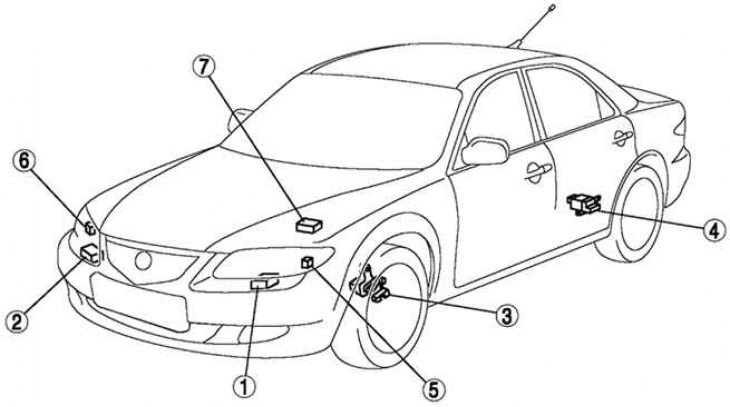
Fig. 7.14. Automatic headlight leveling system: 1 – Automatic alignment control unit (main); 2 – Automatic leveling control unit (additional); 3 – Front automatic leveling sensor; 4 – rear automatic leveling sensor; 5 – headlight alignment actuator (left); 6 – headlight alignment actuator (right); 7 – ABS/TCS HU/CM or DSC HU/CM
The optical axes of the headlights are automatically set at certain angles to improve visibility and prevent blinding oncoming drivers when the speed or load of the vehicle changes.
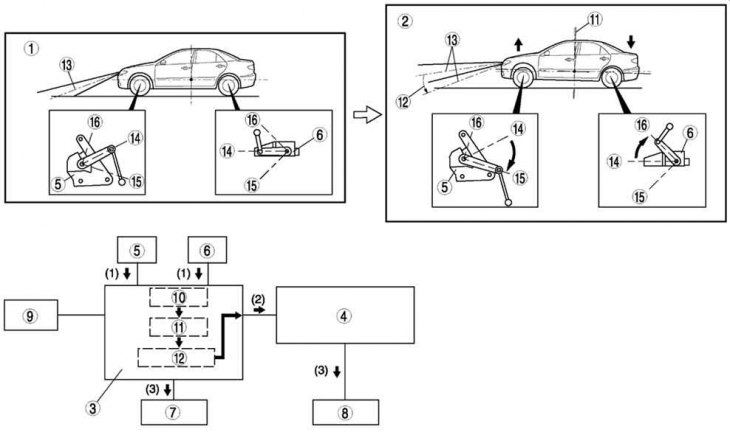
Fig. 7.15. Scheme of operation of the automatic headlight leveling system when the vehicle load changes: 1 - set to zero; 2 – increase in loading; 3 – Automatic alignment control unit (main); 4 – Automatic leveling control unit (additional); 5 – Front automatic leveling sensor; 6 – Rear automatic leveling sensor; 7 – headlight alignment actuator (left); 8 – headlight alignment actuator (right); 9 – ABS/TCS HU/CM or DSC HU/CM; 10 – the difference between two voltage signals; 11 – spatial position of the car; 12 – optical axis adjustment value; 13 – optical axis; 14 – start of counting; 15 - high; 16 - low
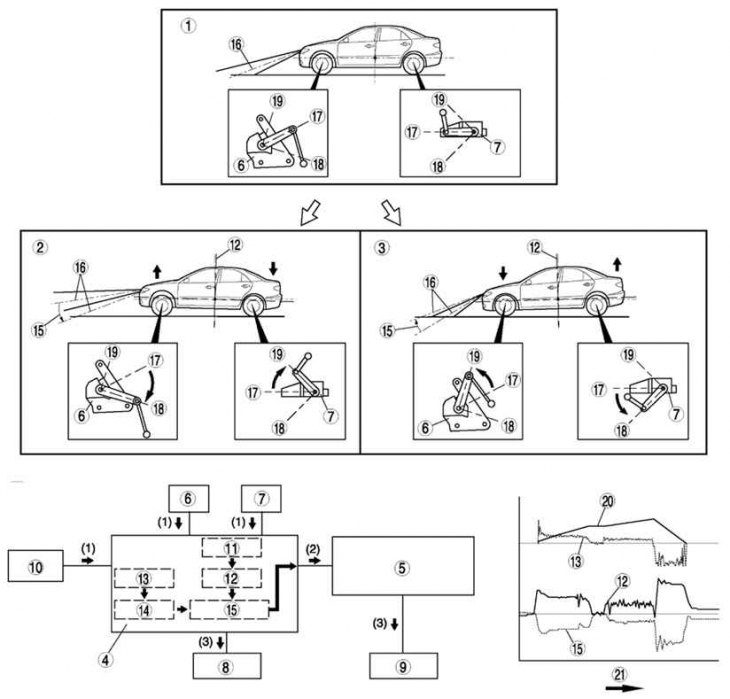
Fig. 7.16. Scheme of operation of the automatic headlight leveling system when the vehicle is moving: 1 - set to zero; 2 – acceleration; 3 - slow down; 4 – Automatic alignment control unit (main); 5 – Automatic alignment control unit (additional); 6 – Front automatic leveling sensor; 7 – Rear automatic leveling sensor; 8 – headlight alignment actuator (left); 9 – headlight alignment actuator (right); 10 – ABS/TCS HU/CM or DSC HU/CM; 11 – difference between two voltage signals; 12 – spatial position of the car; 13 – calculation of the acceleration angle; 14 – change in vehicle speed; 15 – optical axis adjustment value; 16 – optical axis; 17 – the beginning of the countdown; 18 - high; 19 - low; 20 – car speed; 21 – time