


An important point: the spark plugs should be inspected after the engine has been running for a long time, preferably after a long drive on the highway. Very often, some car enthusiasts unscrew the spark plugs to determine the cause of unstable engine operation immediately after a cold start at subzero ambient temperatures, and, having discovered black carbon deposits, they make the wrong conclusion. Although in fact, the cause of such carbon deposits is the forced enrichment of the mixture during engine operation in cold start mode, and the cause of unstable operation is the poor condition of the high-voltage wires.
Therefore, as already mentioned above, if any deviations from the norm in engine operation are detected, it is necessary to drive at least 250-300 km with initially clean spark plugs, and only then carry out diagnostics.
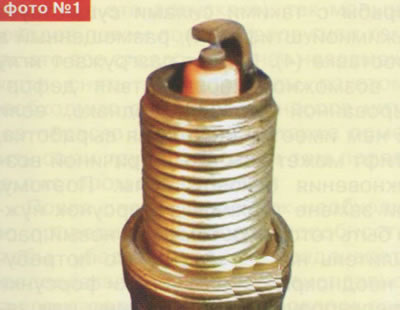
Photo #1 shows a spark plug removed from a normally running engine. The central electrode skirt is light brown, carbon deposits and deposits are minimal, and there are no traces of oil. Such an engine provides optimal fuel and engine oil consumption.
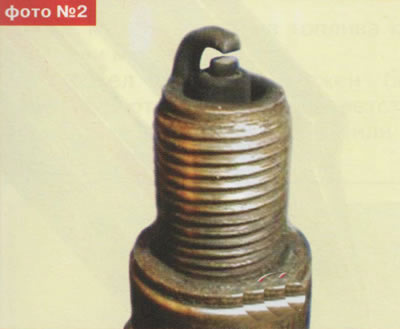
The spark plug shown in photo #2 was removed from an engine with high fuel consumption. The central electrode of such a spark plug is covered with a velvety black carbon deposit. The reasons for this may be a rich air-fuel mixture (incorrect carburetor adjustment or electronic injection system malfunction), clogged air filter.
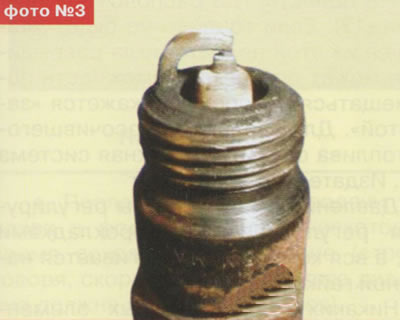
Photo #3 shows a spark plug from an engine whose fuel-air mixture, unlike the previous case, is too lean. The color of the electrode of such a spark plug is from light gray to white. When operating on a lean mixture, the effective power of the engine drops. When using such a mixture, it does not ignite for a long time, and the combustion process occurs with disturbances, accompanied by uneven operation of the engine.
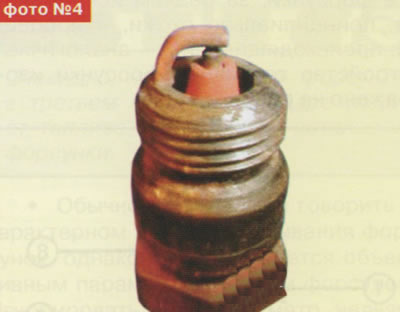
The spark plug electrode skirt shown in photo #4 has a characteristic brick red hue. This color is caused by the engine running on fuel with an excessive amount of additives containing metal salts. Long-term use of such fuel leads to the formation of a conductive coating on the surface of the insulator. The spark will not form between the spark plug electrodes, but at the point of the smallest gap between the outer electrode and the insulator. This will lead to misfires and unstable engine operation.
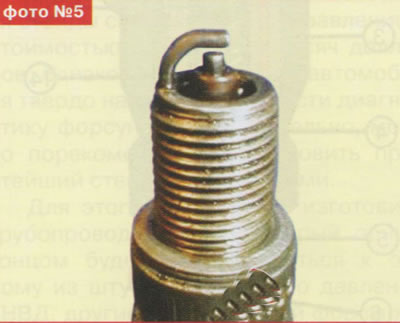
The spark plug shown in photo #5 has clearly visible traces of oil, especially on the threaded part. An engine with such spark plugs tends to "triple" for some time after a long period of standing, during which time characteristic white-blue smoke comes out of the exhaust pipe. Then, as it warms up, the engine operation stabilizes. The cause of the malfunction is the unsatisfactory condition of the oil-deflecting caps, which leads to excessive oil consumption. The process of replacing the oil-deflecting caps is described in the chapter "Mechanical part of the engine".
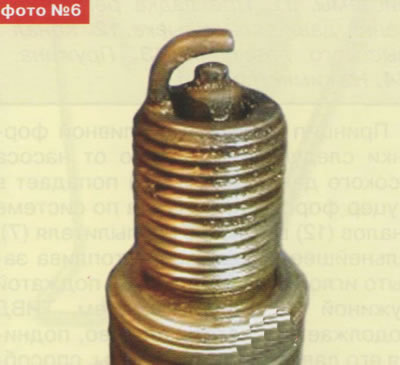
The spark plug shown in photo #6 is removed from a non-working cylinder. The central electrode of such a spark plug, as well as its skirt, are covered with a thick layer of oil mixed with drops of unburned fuel and small particles from the destruction that occurred in this cylinder. The cause of such a malfunction is the destruction of one of the valves or the breakage of the partitions between the piston rings with the ingress of metal particles between the valve and its seat. Symptoms of such a malfunction: the engine "troits" incessantly, a significant loss of power is noticeable, fuel consumption increases many times over. If such symptoms appear, you cannot delay in finding the malfunction. It is necessary to inspect the spark plugs as soon as possible. To eliminate the malfunction in the described case, a major overhaul of the engine is necessary.
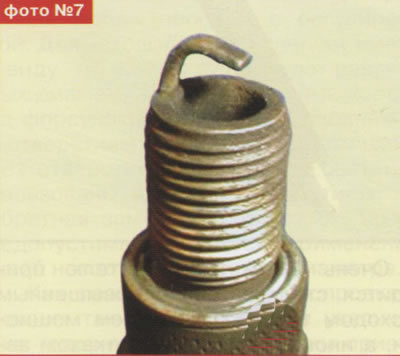
Photo #7 shows a spark plug with a completely destroyed central electrode and its ceramic skirt. The cause of such a malfunction could be prolonged engine operation with detonation, use of fuel with a low octane number, very early ignition, or simply a defective spark plug. The symptoms of engine operation in this case are similar to the previous case. The car owner will be lucky if the particles of the central electrode manage to slip into the exhaust system without getting stuck under the exhaust valve, otherwise repair of the cylinder head cannot be avoided.
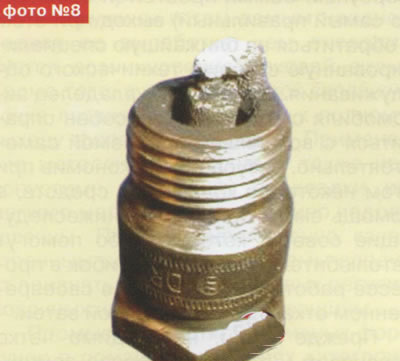
The spark plug shown in photo #8 has an electrode covered with ash deposits. The color of the deposits does not play a decisive role. The reason for this build-up is oil combustion due to wear or sticking of the oil scraper piston rings. The engine shows increased oil consumption, and blue smoke comes out of the exhaust pipe. The procedure for replacing piston rings is described in the chapter "Engine Mechanical Part".
It is also recommended to check the condition of the spark plugs during routine maintenance of the car. In this case, it is necessary to measure the gap between the spark plug electrodes and remove carbon deposits with a metal brush. Removing carbon deposits with a sandblasting machine can lead to the formation of microcracks, which will subsequently develop into more serious defects, which will ultimately lead to the case described in photo No.7. In addition, it is recommended to swap the spark plugs, since the operating temperature modes of different engine cylinders may not be the same (for example, the middle cylinders of engines with central fuel injection operate at higher temperatures than the outer ones).