


Contents: Preparing to test the clutch pedal ⇓ Checking the pedal height ⇓ Checking the pedal free play ⇓ Checking the full travel of the…⇓ Checking the clutch release point ⇓
Note:
When checking the clutch pedal, please note the following:
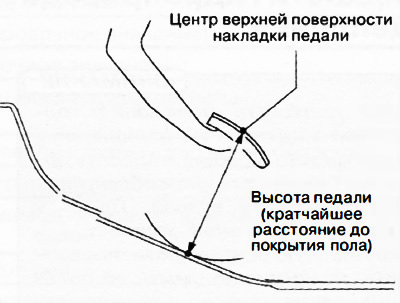
- Each measurement is taken from the center of the top surface of the pedal pad.
- If measuring the distance from the pedal pad to the floor covering, measure the shortest distance.
Preparing to test the clutch pedal
1. Make sure that the level of the clutch hydraulic fluid is between the MIN and MAX marks on the reservoir.
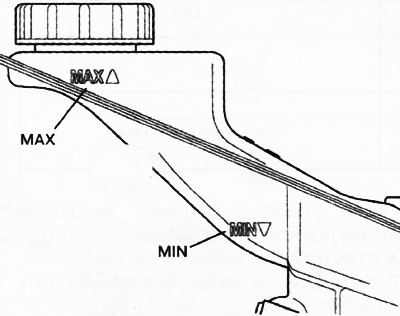
2. Make sure there are no leaks of the clutch hydraulic fluid.
Checking the pedal height
Measure the height of the fully released clutch pedal as shown in the figure.
Note:
Clutch pedal height (approximate value):
- Clutch C66M-R, C66MX-R: 150 mm.
- Clutch D66M-R, D66MX-R: 153.8 mm.
If the measured value is not within the specification, replace the clutch pedal with a new one.
Checking the pedal free play
Press the clutch pedal by hand until you feel a noticeable resistance and measure the free travel of the pedal, as shown in the figure.
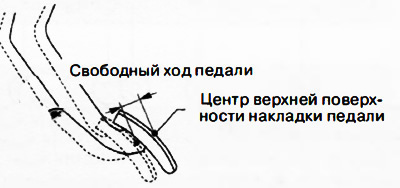
Note: Clutch pedal free play (approximate value): no more than 10 mm.
If the measured value exceeds the norm, replace the clutch pedal.
Checking the full travel of the clutch pedal
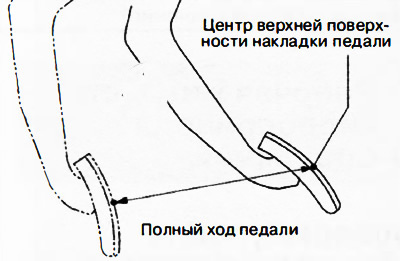
While pressing the clutch pedal from the fully released position to the stop, measure the full pedal travel as shown in the figure.
Note:
Full travel of the clutch pedal:
- Clutch C66M-R, C66MX-R: 146 mm.
- Clutch D66M-R, D66MX-R: 150.3 mm.
If the measured value is not within the norm, replace the clutch pedal.
Checking the clutch release point
Caution: When performing the following procedure, make sure that the area around the vehicle is clear of people or objects, as the vehicle may roll suddenly.
1. Prepare for clutch pedal testing (see above).
2. Make sure that the clutch pedal height is correct.
3. Make sure that the clutch pedal free play is within the normal range.
4. Make sure that the full travel of the clutch pedal is within the norm.
5. Apply the parking brake and place wheel chocks under the front and rear wheels of the vehicle.
[The original article is on mazbook.ru]
6. Start the engine.
7. With the clutch pedal depressed, move the gearshift lever to the position before engaging reverse gear (do not engage reverse gear).
8. Gradually release the clutch pedal, holding it at the point where the sound of gear rotation occurs (clutch release point).
9. With the pedal position corresponding to the clutch disengagement point, measure distance A as shown in the figure.
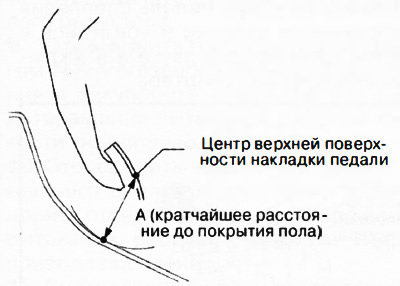
Note: Distance A (approximate value): not less than 82 mm.
10. If the measured value is not within the norm, it is necessary to remove air from the clutch hydraulic system (see above in this chapter).