


Contents: Since 10/89 issue. ⇓ From 9/85 to 9/89. ⇓
The cycles for the direction indicators and hazard warning lights are generated by a single relay, the so-called direction indicator interrupter.
If the blinking rhythm on one side is faster than on the other, the lamp on the "fast" side is faulty or there is a broken wire.
For all other faults, the relay is most often the cause. To check the relay, remove it.
Since 10/89 issue.
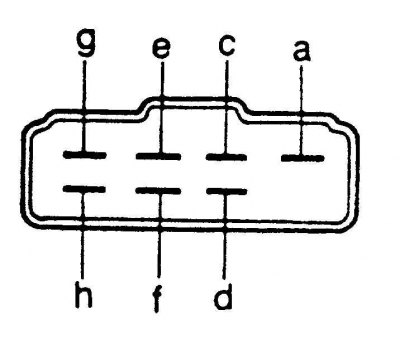
1. Disconnect the relay and check individual contacts for current flow. Set the ohmmeter to the kilo-ohm (kOhm) measurement range. Current or resistance should flow between the following contacts: a - e; a - f; c - a; c - d; c - e; c - f; c - g; c - h; h - a; h - c; h - d; h - e; h - f; h - g.
2. There should be no current flowing between the other contacts, or the resistance should be equal to infinity.
From 9/85 to 9/89.
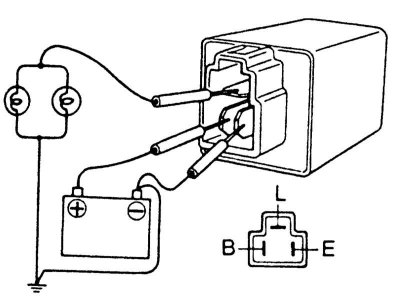
1. Connect the battery plus to terminal B and the battery ground to terminal E via auxiliary cables. Then connect 2 turn signal lamps (21 W) in parallel between terminals L and E or E and the ground. The lamps should flash at a normal rate, otherwise replace the relay.
2. If there is no new relay, carefully insert a thin wire into the relay plug between terminals B and L
Attention! The sensitive contacts of the relay must not be damaged. Before installation, bend the ends of the wire so that there are no sharp edges. Install the faulty relay in place. The connection plugs are so long that the relay will be inserted despite the jumper.
3. Switch on the ignition. If you now switch on the turn signal lever, the corresponding lamp will light without blinking. You can set the rhythm by switching the lever on and off. However: Install a new relay as soon as possible.
4. If the direction indicators do not light despite the jumper contacts, the fault lies in the switch or electrical wires.