


In the front suspension with double wishbones (with floating hinges), the wheels rotate about a kingpin axis running from the ball joint of the upper arm (point C) to an imaginary pivot axis (point D) extending from the lower arm(s). The intersection of the kingpin axis and the road surface (point E) is offset in the car from the center of the wheel on the road (point W), giving the kingpin offset. Compared to a strut front suspension, a double wishbone front suspension (with floating lever joints) has the technical advantages described below.
The moment of inertia relative to the kingpin axis is reduced due to the small offset of the kingpin from the wheel center. This feature reduces the likelihood of drift and intense vibrations of the steering when braking, disruption of smooth steering operation on a bad road, and the effect of uneven road surfaces on the moment of resistance of the vehicle's steered wheels.
Kingpin offset value (negative kingpin offset) optimized. As a result, the influence of the axle weight is not felt, and control is facilitated. In addition, stability during straight-line driving is improved, since the moment of toe-in from the braking force counteracts the moment caused by road irregularities and/or the difference in braking force between the right and left wheels.
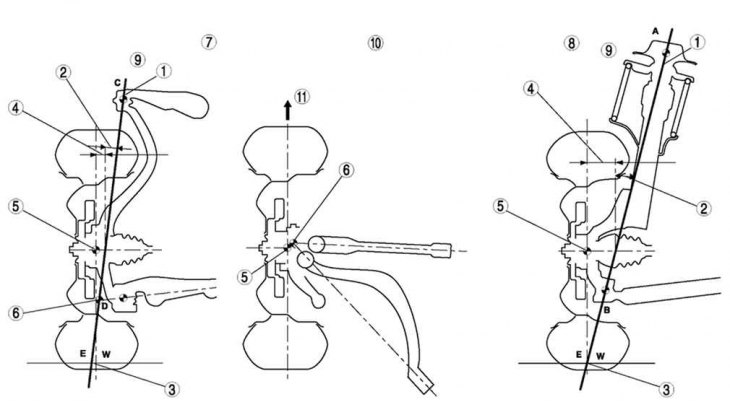
Fig. 4.3. Comparative diagram of suspensions – with a strut and transverse levers: 1 – kingpin axis; 2 – kingpin tilt; 3 – kingpin offset; 4 – offset of the kingpin relative to the wheel center; 5 – wheel center; 6 – imaginary turning point; 7 – High-mount double wishbone front suspension; 8 – front suspension with strut (626); 9 – front view; 10 – top view; 11 – front part
[The full text is on the website: mazbook.ru]