


Hydraulic drive (all models except station wagons and front-wheel drive with petrol engine up to 9/89)
The height and play of the clutch pedal should be checked if difficulties arise in engaging and disengaging, as well as after removing the clutch switch. The clutch switch is located on the pedal block and informs the injection system control unit about the action on the clutch pedal. On a diesel engine, a stop bolt is screwed in instead of a switch.
Checking/Adjusting Pedal Height
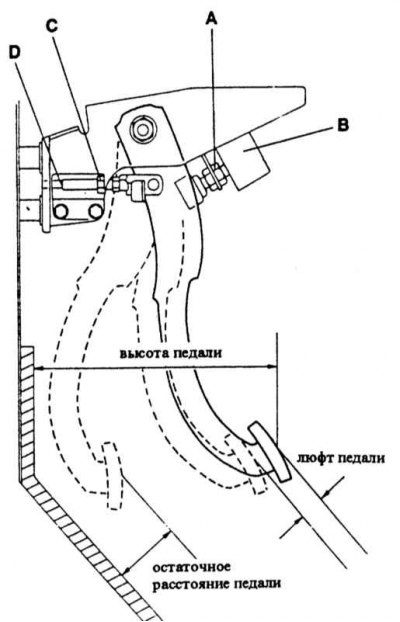
1. Measure the distance from the top of the pedal to the mat. Required value: Models from 10/89: 196 - 204 mm; diesel models, as well as all-wheel drive models up to 9/89: 229 -234 mm.
2. If necessary, remove the lower instrument panel trim to access the adjusting screw. Disconnect the plug from the clutch switch "B", loosen the lock nut "A" and adjust the pedal height by turning the switch. Tighten the lock nut with force 15 Nm.
3. After this adjustment, the pedal play should be checked.
Checking/adjusting the clutch pedal play
1. Press the clutch pedal with your finger until you feel a noticeable resistance. Measure the pedal play. Required value: from 5 to 13 mm. Note: When pressing through 0.7-3.3 mm, a slight resistance should be felt. This is the point where the push rod touches the master cylinder piston.
2. If necessary, loosen the lock nut "C" and adjust the pedal play by rotating the piston rod "D".
3. Press the pedal all the way down and measure the distance remaining from the pedal to the mat. Required value: Models from 9/89: minimum 41 mm; diesel models, as well as all-wheel drive models up to 9/89: minimum 82 mm.
4. Tighten the lock nut "C" with force 15 Nm.
5. After adjusting the pedal play, check the pedal height again.
6. Connect the plug to the clutch switch and install the instrument panel trim.