
MazBook.ru
English Русский
Български
Беларускі
Український
Српски
Hrvatski
Română
Polski
Slovenský
Magyar
• Bookmark • Sitemap • Contacts •   
Cars Opel Cars Ford Cars Volkswagen Cars Audi Cars Kia Cars Renault Cars Peugeot


Familia Capella Mazda3 Mazda6 CX-? Others Articles
Mazda3 BK (2003-2009)

DSC HU/CM Dynamic Stability Control Unit (Mazda 3 BK)

  • Home
  • Mazda 3
  • Mazda3 BK (2003-2009)
  • Chassis
  • Brake system
  • DSC HU/CM Dynamic Stability Control Unit
0
A compact and lightweight integrated DSC HU/CM unit with increased reliability is used.

The DSC HU/CM unit calculates the input signals of all sensors and controls the solenoid valve and the pump motor (on/off), regulates the pressure of the working fluid in the brake cylinders and activates the functions of the dynamic stability system (ABS, electronic brake force distribution (EBD), TCS, DSC and emergency brake assist systems).

The design and operation of the hydraulic unit of the DSC system are similar to the design and operation of the hydraulic unit of the modern model 323 (BJ), with the exception of the operation of the emergency brake booster.

The DSC HU/CM unit outputs the engine torque control signal and vehicle speed signal via the CAN channel.

The DSC HU/CM unit also outputs the vehicle speed signal via wires.
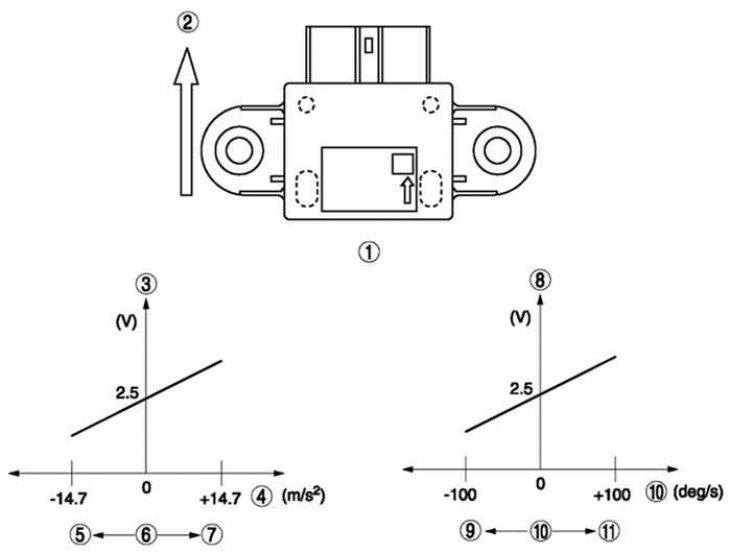
Fig. 6.6. Operation diagram of the integrated dynamic stability control sensor of the Mazda 3…

Fig. 6.6. Operation diagram of the integrated dynamic stability control sensor of the Mazda 3 vehicle: 1 – appearance; 2 – front of the car; 3 – output voltage; 4 – acceleration; 5 – left turn; 6 – longitudinal acceleration; 7 – right turn; 8 – output voltage; 9 – left turn; 10 – yaw rate; 11 – right turn
This article is available at: russian, bulgarian, belarusian, ukrainian, serbian, croatian, romanian, polish, slovak, hungarian
This text was checked by: Evdokia Filimonova
Share with friends on social networks:

Previous
Mazda3 BK » Brake system
Next

Integrated Dynamic Stability Control Sensor
DSC switch, DSC off indicator lamp
DSC indicator light
Dynamic stability management
Anti-lock braking system (ABS)
Emergency Brake Control
Controller Area Network (CAN)
On-board diagnostics of the brake system
Checking and adjusting the brake system components
Checking the brake fluid level in the hydraulic reservoir of the…
More articles on repairing other Mazda models
Heater control unit Mazda Familia 6 (1989-1994)
Control unit of the RVT system (since 1984) Mazda Capella 3 and 4 (1982-1992)
DSC HU/CM Dynamic Stability Control Unit Mazda6 GG (2002-2008)
Removal and installation the engine control unit Mazda CX-5KE (2012-2017)
Removal and installation the engine control unit Mazda 121 (3) (1996-2003)
Link in different formats to this article
Comments and feedback from visitors
No comments yet


How much will 14 + 13 ?


Mazda3 BK (2003-2009) 
  • User manual
  • Vehicle description
  • Keys, locks and alarms
  • Controls and instruments
  • Air conditioning and heater
  • Seat adjustment
  • Security systems
  • Driving and operation
  • Faults en route
  • Maintenance
  • Power unit
  • Engine device (gasoline)
  • Engine repair (gasoline)
  • Diesel engine (Z6)
  • Lubrication system
  • Cooling system
  • Fuel system
  • Exhaust system
  • Engine electrical equipment
  • Engine management system
  • Transmission
  • Clutch
  • Mechanical gearbox
  • Automatic gearbox
  • Drive mechanism
  • Chassis
  • Suspension and wheels
  • Steering
  • Brake system
  • Body
  • Body elements
  • Doors and windows
  • Air conditioning and heater
  • Electrical equipment
  • Equipment and devices
  • Power devices
  • Lighting system
  • Windshield wipers and washers
  • Equipment checks
MazBook.ru © 2018–2026 · Mobile version · Articles and news · Sitemap: EN BG BY UA RS HR RO PL SK HU · Feedback · Site search · Add to bookmarks Familia 5 (BF) · Familia 6 (BG) · Capella 3 (GC) · Capella 3 and 4 (GC) · Capella 4 (GD) · Capella 5 (GE) · Capella 6 (GF) · Mazda3 BK · Mazda6 GG · CX-5KE · Mazda 121 (3) · Mazda BT-50 (1) ·
By continuing to use the site, you agree to the use of cookies 🔐