


The DSC HU/CM system uses a built-in brake fluid pressure sensor to monitor the rate of pressure change in the master cylinder, the emergency brake booster is activated when the pressure change rate exceeds a set value, thus the system determines emergency braking conditions.
The DSC HU/CM system calculates the brake cylinder pressure and increases the fluid pressure in the master cylinder to a specified value. By changing the pressure in the master cylinder, the brake cylinder pressure can be increased.
In addition to the normal brake fluid pressure, since all the solenoid valves are on, the electric motor drives a pump that increases the pressure in the brake system.
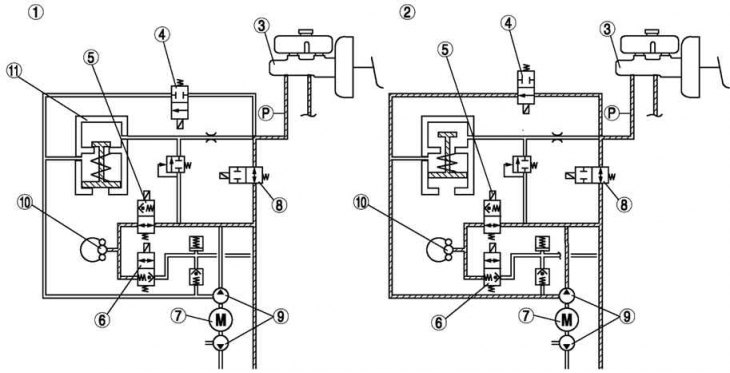
Fig. 6.7. Mazda 3 emergency braking control diagram: 1 – normal braking mode; 2 – braking mode without emergency brake assist; 3 – master cylinder; 4 – electromagnetic valve for maintaining stability; 5 – electromagnetic pressure maintenance valve; 6 – electromagnetic pressure reducing valve; 7 – pump electric motor; 8 – electromagnetic valve of the traction switch; 9 – pump; 10 – caliper piston
The emergency brake assist begins to operate at speeds of 17 km/h or higher and does not engage at speeds below 5 km/h.