


The brake drive is hydraulic, from the pedal and the main brake cylinder with two coaxial pistons, with a vacuum booster and a dual-circuit rear brake pressure regulator.
On all models, except for cars with B6 and B6 EGI engines, front service brakes are disc, rear are drum. On vehicles with B6 and B6 EGI engines, the front and rear service brakes are disc brakes.
The parking brake is mechanical, cable-operated with a drive to the brake mechanisms of the rear wheels.
Front wheel brakes
Brake mechanisms of forward wheels with the ventilated disks, with floating brackets, single-piston.
Brake calipers
Piston diameter, mm:
- on production models before 1988: 50.8;
- on production models since 1988: 51.1.
Brake disk
Disc diameter, mm:
- on production models before 1988: 260;
- on production models since 1988:
- for wheel rims with bore diameter 13": 238;
- for wheel rims with bore diameter 14": 260.
Disc thickness, mm: 18.
Minimum disc thickness during operation, mm: 16.
Axial runout of the disk working surface, not more than, mm: 0.1.
Brake pads
Friction lining thickness, mm: 10.
Minimum friction lining thickness (when worn), mm:
- on production models before 1988: 1;
- on production models since 1988: 2.
Brand and type of brake pads: Sumitomo JBKC 80 FE 7F 501.
Spare parts are supplied with brake pads with an audible friction lining wear indicator, which is a plate fixed on the pad support, which begins to rub against the brake disc when the lining thickness decreases to 2 mm or less.
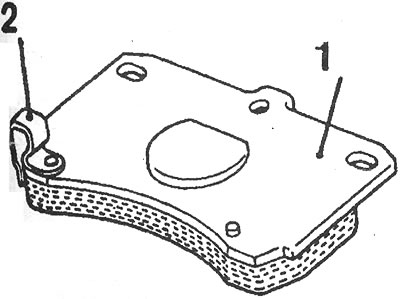
Brake pad with audible friction lining wear indicator: 1 - lining support; 2 - buzzer for pad wear.
Rear wheel drum brakes
The brakes of the rear wheels are drum, with automatic adjustment of the gap between the pads and the drum.
Wheel cylinders
Piston diameter, mm: 17.50.
Brake drums
Nominal drum diameter, mm:
- sedans: 200.0;
- station wagons: 228.6.
Drum diameter increase after boring and grinding, not more than, mm:
- sedans: 201.0;
- station wagons: 229.6.
Brake pads
Friction lining width and length, mm:
- sedans: 25x191.9;
- station wagons: 25x219.5.
Friction lining thickness, mm: 5.
Minimum friction lining thickness (when worn), mm: 1.
Brand and type of friction linings: JB NU 60.
Rear wheel disc brakes
Rear wheel brakes with solid discs, floating calipers, single piston.
Brake calipers
Piston diameter, mm: 30.2.
Brake discs
Disc diameter, mm: 247.
Disc thickness, mm: 10.
Minimum disc thickness during operation, mm: 9.
Axial runout of the disk working surface, not more than, mm: 0.1.
Brake pads
Friction lining thickness, mm: 8.
Minimum friction lining thickness (when worn), mm: 1.
Friction lining brand: Mazda.
Brake drive
Master brake cylinder
Sequential brake master cylinder.
Nominal diameter of the main brake cylinder, mm: 22.22.
Vacuum booster
Piston diameter, mm:
- all models except cars with engines B6, B6 EGI: 177.7 (7");
- models with engines B6, B6 EGI: 203.1 (8");
- station wagons produced since 1989: 213.
Pressure regulator
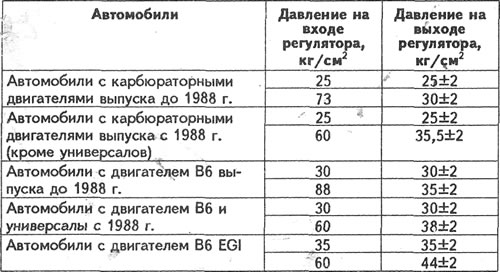
The pressure regulator regulates the pressure in the hydraulic drive of the rear wheel brakes depending on the load on the rear axle of the vehicle. It is included in both circuits of the brake system, and through it the brake fluid flows to both rear brake mechanisms.
Data for checking the pressure regulator
Parking brake system
The parking brake is mechanical, lever-cable type acts on the brake drums or brake discs of the rear wheels.
With a correctly adjusted parking system, the lever should move:
- on cars produced before 1988:
- with drum brakes: for 7-11 sector teeth;
- with disc brakes: 9-15 sector teeth;
- on cars produced since 1988: by 5-7 teeth of the sector.
Brake fluid
Used brake fluid: FMV 55 116 D0T3 or D0T4.
The frequency of checking the brake fluid level: every 15,000 km or every year of operation.
The frequency of replacing the brake fluid: every 30,000 km or every two years of operation.
Tightening torques of the main threaded connections, kgf·m
- Bolt of fastening of a bracket of a forward brake to a rotary fist: 5,0-6,0.
- Bolt for fastening the upper guide pin to the front brake caliper: 1.6-2.5.
- Bolt for fastening the lower guide pin to the front brake caliper: 2.0-3.0.
- Rear brake shoe guide mounting bolt: 5.0-7.0.
- Bolt of fastening of the lower directing finger of the disk brake mechanism of a back wheel: 1,6-2,4.
- Bolt for fastening the brake shield of the rear drum brake to the hub trunnion: 8.0-11.9.
- Bolt for fastening the working cylinder to the brake shield: 1.0-1.3.
- Nut of fastening of the main cylinder to the vacuum booster: 1.9-2.6.
- Nut for fastening the vacuum booster to the bracket: 1.0-1.6.
- Hub nut: 1.3-2.2.
- Wheel nut: 9.0-12.0.