


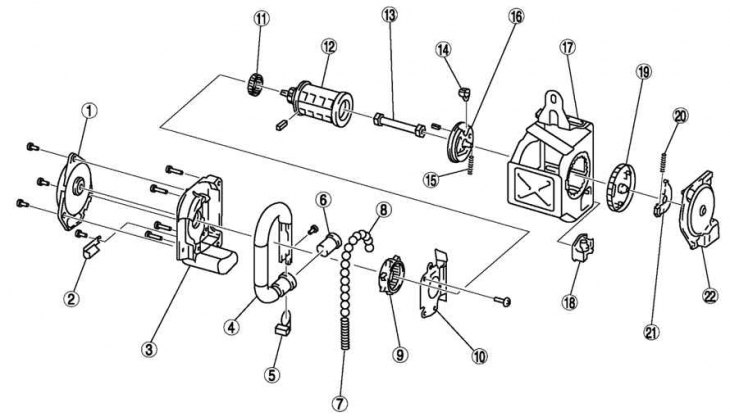
Fig. 7.102. Components of a seat belt with pretensioner: 1 – spring block; 2 – guide plate; 3 – pretensioner cover; 4 – pipe; 5 – guide block; 6 – gas generator; 7 – stopper spring; 8 - ball; 9 – toothed crown; 10 – pretensioner plate; 11 – gear; 12 – coil; 13 – torsion; 14 – latch; 15 – latch spring; 16 – blocking base; 17 – body; 18 – sensor block; 19 – locking mechanism; 20 – hook spring; 21 – flywheel; 22 – holder
Seat belts help reduce the risk of serious injury in road accidents and emergency braking of the vehicle. All seats are equipped with diagonal-lap seat belts. The belts are equipped with an inertia reel, onto which the unused seat belt is pulled. Inertia reels provide comfort for the driver and passenger under normal driving conditions. In the event of a vehicle collision, the inertia reels block the belt from being released and prevent the driver and passenger from dangerous movements. The rear seat is equipped with diagonal-lap seat belts with inertia reels.
Always wear a seat belt and make sure that all passengers are also wearing seat belts or using appropriate restraints. In the event of an accident, the driver and passengers who are not wearing seat belts may hit each other or the bodywork, or be thrown from the vehicle. In this case, they may be seriously injured or even killed. All other things being equal, passengers who are wearing seat belts will be significantly safer.
Do not operate the vehicle with faulty seat belts. In a vehicle collision, the belt webbing may be damaged. Such a seat belt cannot provide effective protection in the event of a vehicle collision. In a traffic accident, the front airbags and pyrotechnic seat belt pretensioners are triggered simultaneously. Regardless of whether there was a passenger in the front seat or not, or whether the airbags or seat belt pretensioners were triggered or not, be sure to check the serviceability of the belts installed on the front seats and all airbags. If necessary, replace faulty airbags and seat belts. Do not use a twisted seat belt. In a vehicle collision, the inertial load from the body weight will not be supported by the entire width of the belt, but only by part of it. This increases the load on the chest bones located under the belt webbing, which can lead to serious injury or death.
It is prohibited to use one seat belt to fasten two (or more) people at the same time.
Always follow the rule: each passenger has their own seat belt.
The original article is on: www.MAZbook.ru
It is dangerous to use the same seat belt to fasten two or more passengers at the same time.
In this case, the seat belt will not ensure proper distribution of the dynamic load from the impact of the car, and passengers wearing the same seat belt will cause serious injuries to each other or may die.