
MazBook.ru
English Русский
Български
Беларускі
Український
Српски
Hrvatski
Română
Polski
Slovenský
Magyar
• Bookmark • Sitemap • Contacts •   
Cars Opel Cars Ford Cars Volkswagen Cars Audi Cars Kia Cars Renault Cars Peugeot


Familia Capella Mazda3 Mazda6 CX-? Others Articles
Mazda6 GG (2002-2008)

Variable valve timing system (Mazda 6 GG)

  • Home
  • Mazda 6
  • Mazda6 GG (2002-2008)
  • Power unit
  • Engine device
  • Variable valve timing system
0
Contents: Operation according to driving…⇓ Medium loads ⇓ Heavy load, low to medium speed ⇓ High load, high speed range ⇓ At low temperature ⇓ When starting or stopping the engine ⇓
The variable valve timing system continuously modifies the phases of the variable valve timing actuator and the intake camshaft under the action of hydraulic pressure, which is controlled by the oil control valve (OCV) so that the opening and closing phases of the valves optimally correspond to the operating conditions of the engine. The operation of the oil control valve (OCV) is based on signals from the camshaft position sensor according to the operating conditions of the engine. It controls the hydraulic pressure acting on the variable valve timing actuator.

Operation according to driving conditions: idle, light loads


By reducing overlap, less combustion products are returned to the cylinder. This stabilizes the idle speed, improving fuel economy, and also ensures stable engine operation at low loads.
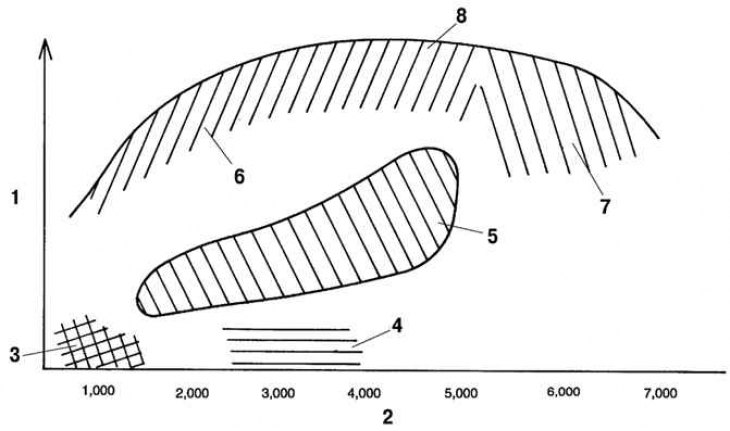
Fig. 2.30. Diagram of changes in valve timing for different engine operating ranges: 1 – load; 2 –…

Fig. 2.30. Diagram of changes in valve timing for different engine operating ranges: 1 – load; 2 – engine speed; 3 – idle speed range; 4 – low load range; 5 – medium load range; 6 – range of high loads of low and medium speeds; 7 – high load and high speed range; 8 – full load operation


Medium loads


The overlap increases and the EGR ratio in the cylinder increases, thereby reducing friction losses (pumping losses), the combustion temperature decreases and the amount of CO in the exhaust gases decreases. The amount of hydrocarbon emissions also decreases due to the re-burning of unignited gas.

Heavy load, low to medium speed


The intake valves close early, resulting in high volumetric efficiency, while improving torque in the low- and mid-speed range.

High load, high speed range


The intake valves close later, high volumetric efficiency ensures maximum power.

At low temperature


Overlap is minimized to prevent combustion products from entering the cylinders and reduce the amount of additional fuel injected into the cylinders. This improves fuel economy and stabilizes high idle speeds.

When starting or stopping the engine


Starting performance is improved by reducing overlap as combustion products do not return to the cylinder.

Table 2.12. Elements and their functions



Table 2.12. Elements and their functions
This article is available at: russian, bulgarian, belarusian, ukrainian, serbian, croatian, romanian, polish, slovak, hungarian
This text was checked by: Evdokia Filimonova
Share with friends on social networks:

Previous
Mazda6 GG » Engine device
Next

Variable valve timing mechanism
Valve lifter
Valve, valve spring, valve stem seal, valve guide
Drive chain tensioner timing mechanism
Camshaft timing chain
Operation diagram of the variable valve timing mechanism
Main characteristics of the variable valve timing mechanism
Design of the variable valve timing mechanism
Oil Control Valve (OCV)
More articles on repairing other Mazda models
Technical characteristics of the valve timing mechanism Mazda Familia 5 (1985-1989)
Scheme 28: Engine management system, cooling fan, ignition, fuel… Mazda Capella 3 (1982-1992, petrol)
Variable valve timing system Mazda3 BK (2003-2009)
Hydraulic valve timing controller Mazda CX-5KE (2012-2017)
Engine and exhaust system maintenance Mazda 121 (3) (1996-2003)
Link in different formats to this article
Comments and feedback from visitors
No comments yet


How much will 39 + 18 ?


Mazda6 GG (2002-2008) 
  • User manual
  • Vehicle description
  • Keys, locks and alarms
  • Controls and instruments
  • Air conditioning and heater
  • Seat adjustment
  • Security systems
  • Driving and operation
  • Faults en route
  • Maintenance
  • Power unit
  • Engine device
  • Engine repair
  • Lubrication system
  • Cooling system
  • Fuel system
  • Exhaust system
  • Electrical equipment of engines
  • Control system
  • Transmission
  • Clutch
  • Mechanical gearbox
  • Automatic gearbox
  • Drive shafts and hubs
  • Chassis
  • Suspension and wheels
  • Steering
  • Brake system
  • Body
  • Exterior (external elements)
  • Interior (internal elements)
  • Doors and windows
  • Air conditioning and heater
  • Electrical equipment
  • Equipment and devices
  • Power devices
  • Lighting system
  • Windshield wipers and washers
MazBook.ru © 2018–2026 · Mobile version · Articles and news · Sitemap: EN BG BY UA RS HR RO PL SK HU · Feedback · Site search · Add to bookmarks Familia 5 (BF) · Familia 6 (BG) · Capella 3 (GC) · Capella 3 and 4 (GC) · Capella 4 (GD) · Capella 5 (GE) · Capella 6 (GF) · Mazda3 BK · Mazda6 GG · CX-5KE · Mazda 121 (3) · Mazda BT-50 (1) ·
By continuing to use the site, you agree to the use of cookies 🔐