


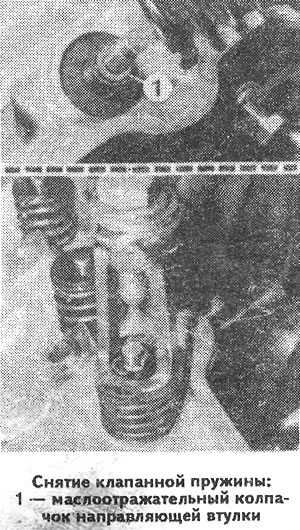
Release the valves from the crackers by compressing the valve springs with a special device.
Remove the springs with plates.
Use pliers to remove the valve stem seals and spring support washers from the valve guides.
Remove the valves.
Note: Non-replaceable parts must be installed in their original locations during assembly.
Clean the removed parts.
Check the inside diameter of the guide bushings and the clearance between the guide bushings and the valve stems (see dimensions in the subsection "Detailed technical specifications").
Check the warpage of the cylinder head joint plane with a ruler; it should not exceed 0.15 mm.
Grind the cylinder head joint plane if necessary.
Based on website data: MazBook.ru
Remove carbon deposits from the valves. Check that the valve stems are not deformed and that there are no cracks on the valve plates. Replace damaged valves. Check the condition of the valve working chamfer. In case of minor damage, it can be ground down, maintaining the required chamfer angle (see subsection "Detailed technical specifications").
Check the valve springs for seating.
Check the shape of the valve seat chamfers, make sure there are no pits, corrosion or damage. Minor damage can be removed by grinding, removing as little metal as possible. Grinding can be done manually or with a grinding machine. It is best to perform this operation in a repair shop.