

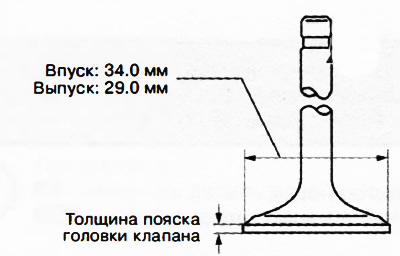
Note:
Valve head belt thickness:
- inlet: 1.75-1.95 mm
- release: 1.95-2.15 mm
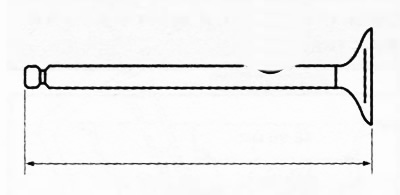
2. Using a caliper, measure the length of each valve. If the measured value is less than the norm, replace the valve with a new one.
Note:
Standard valve length:
- Inlet: 107.00-107.60 mm.
- Issue: 117.09-117.69 mm.
Minimum valve length:
- Intake: 106.78 mm.
- Issue: 116.87mm.
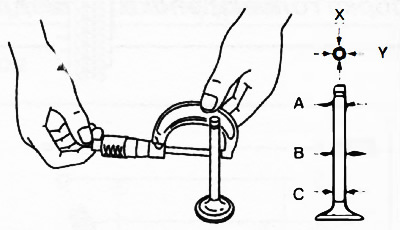
3. Using a micrometer, measure the valve stem diameter in six positions in two mutually perpendicular directions (X and Y) at three points along the stem (A, B and C), as shown in the figure. If the measured values are not within the norm, replace the valve with a new one.
Note:
Standard valve stem diameter:
- Intake: 5.470-5.485 mm
- Release: 5.465-5.480 mm
Minimum valve stem diameter:
- Intake: 5.424 mm
- Issue: 5.419 mm
4. Using a micrometer bore gauge, measure the inside diameter of the valve guide in six positions - in two mutually perpendicular directions (X and Y) at three points along the length of the guide (A, B and C), as shown in the figure. If the measured values are not within the norm, replace the valve guide with a new one.
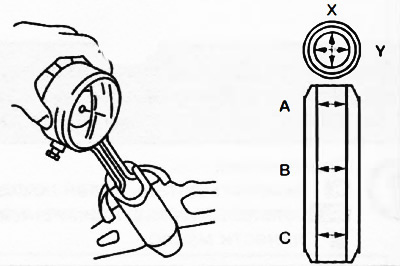
Note:
Standard valve guide inner diameter:
- Intake: 5.510-5.530 mm.
- Issue: 5.510-5.530 mm.
5. Calculate the clearance between the valve stem and the valve guide by subtracting the valve stem diameter from the guide inner diameter. If the resulting value exceeds the maximum allowable value, replace the valve or valve guide with new ones.
Note:
Standard clearance between valve stem and guide bushing:
- Intake: 0.025-0.060 mm
- Issue: 0.030-0.065 mm
The maximum permissible gap between the valve stem and the guide sleeve: 0.10 mm.
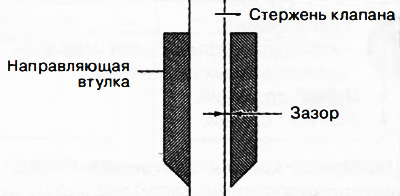
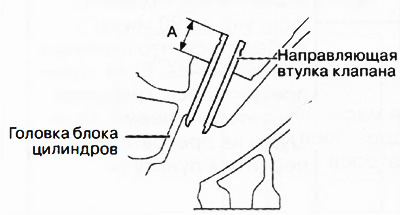
6. Using a caliper, measure the protrusion height (dimension A) of the valve guides. If the measured value is not within the standard, replace the valve guide.
Note: Standard valve guide protrusion height (inlet/outlet): 16.4-17.0 mm.