


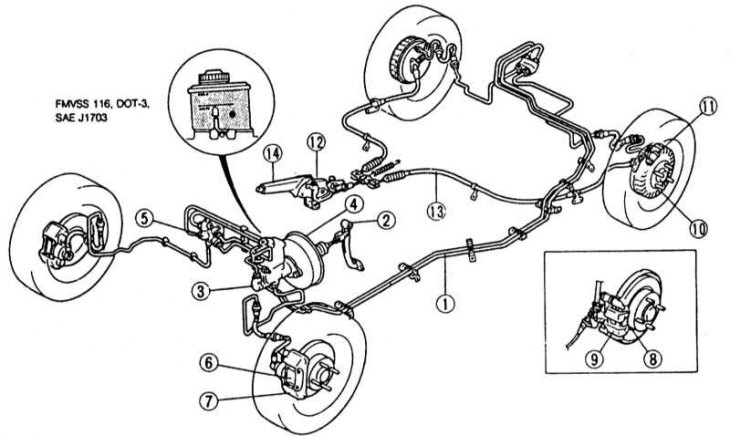
1 - brake line; 2 - brake pedal; 3 - master brake cylinder; 4 - brake booster; 5 - brake pressure distributor; 6 - Front disc brake; 7 - brake caliper; 8 - rear disc brake; 9 - brake caliper; 10 - rear drum brake; 11 - wheel brake cylinder; 12 - handbrake; 13 - handbrake drive; 14 - handbrake lever
The brake system consists of a brake master cylinder, a brake booster, front disc brakes and rear drum brakes. Some models also have disc brakes on the rear wheels. The hydraulic brake system is divided into two circuits that act diagonally. One brake circuit acts on the right front/left rear wheel, the other circuit acts on the front left/rear right wheel. Due to this, if one of the circuits fails, for example due to a leak, the car can be stopped using the other circuit. When the brake pedal is pressed, pressure is created in the dual brake master cylinder for both circuits. The brake pressure distributor, connected after the master cylinder, ensures that the rear wheels do not lock during sharp braking. The expansion tank with brake fluid is located in the engine compartment above the brake master cylinder and supplies the entire system with brake fluid. The brake booster on a gasoline engine accumulates part of the low pressure produced by the engine. If necessary, the pedal pressure is increased by vacuum. Since the diesel engine does not have enough suction vacuum, the low pressure for the brake booster is created by a vacuum pump mounted on the rear of the generator. The disc brakes are equipped with floating calipers. The floating caliper uses only one piston to press both brake pads against the disc.
The handbrake acts on the rear wheels via a cable drive. The disc and drum brake pads are adjusted automatically; basic adjustment is only necessary after repairs in which the brake system was disassembled. Depending on the model, the MAZDA 323 from 10/89 may be equipped with an anti-lock braking system (ABS). The work described here applies to all variants of the MAZDA 323, regardless of whether they have ABS or not.
When cleaning the brake system, brake dust is raised. This dust can be harmful to health. Therefore, when cleaning the brake system, make sure that this dust is not inhaled.
The primary source is the website: MAZBOOK.ru
Brake pads are specified for each model at the factory. Therefore, it is recommended to use only branded pads recommended by MAZDA.
Note: After installing new brake pads, they must be run in. For the first 200 km, do not brake hard unless necessary.
Attention! Work on the brake system requires cleanliness and precision. In the absence of the necessary work experience, work on the brake system must be performed in a special workshop.