


Contents: Removal ⇓ Installation ⇓
Rear disc brakes are installed on cars with high engine power and/or ABS. A special device is required to screw in the brake piston. If there is no special device, you can make something similar or contact a workshop.
Removal
1. Mark the position of the rear wheel disc relative to the hub so that the balanced wheel can be installed in its original position.
2. Loosen the wheel nuts of the vehicle while it is parked on the ground.
3. Remove the wheel.
Important! It is not allowed to swap the brake pads of the right and left wheels. Swapping them may result in uneven braking action. It is necessary to replace all the brake pads of one axle at the same time, even if only one pad has reached the wear limit. If the pads are to be installed again, they must be marked before removal.
4. Cars produced since 10/89, except for station wagon models: Lightly tighten 2 wheel nuts to lock the brake disc.
5. Release the handbrake.
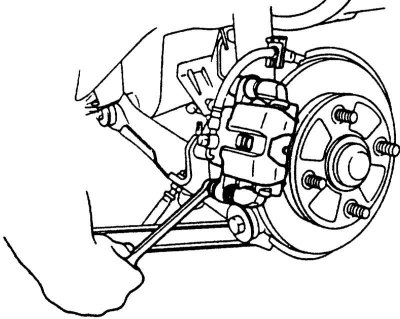
6. Cars produced before 9/89 and station wagon models: Unscrew the lower guide pin of the caliper housing. On vehicles from 10/89: Unscrew the upper guide pin, additionally release the brake hose from the guide on the shock absorber strut.
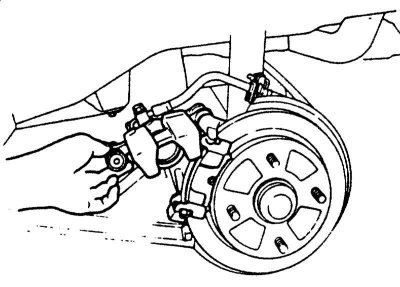
7. Fold the piston body upwards and hang it on a wire to the body so that the brake hose is not loaded.
Attention! Do not remove the brake hose, otherwise the system will need to be bled.
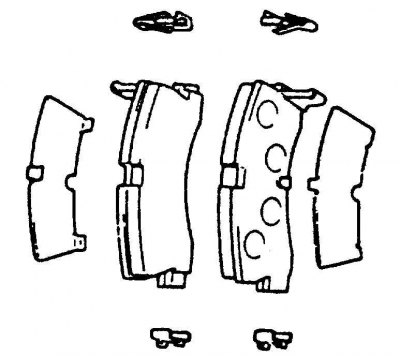
8. Cars produced before 9/89 and station wagon models: remove the brake pads with 2 upper and lower springs and 2 anti-squeak plates.
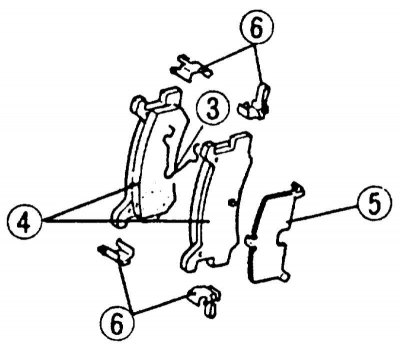
9. Cars produced since 10/89, except for station wagon models: Remove spring "3" with a screwdriver from the holes of the brake shoes. Then remove shoes "4" together with springs "6" and anti-squeak plate "5".
Installation
Caution! When the brake pads are removed, do not press the brake pedal, otherwise the piston will be pressed out of the housing. If the piston is accidentally pressed out, have it reinserted at a MAZDA workshop.
1. Clean the guide surfaces and the pad seating areas in the housing shaft with a suitable soft metal brush or wipe with a cloth with alcohol. Do not use solvents containing mineral oils or tools with sharp edges.
2. Before installing the pads, check the brake disc for grooves by feeling it with your fingers. Brake discs with grooves should be replaced.
3. Measure the thickness of the brake disc.
4. Check the dust cover and protective cuffs in the caliper for cracks. A damaged cap must be replaced, as penetrating dirt will quickly lead to a leak in the caliper. To do this, the brake caliper must be removed and disassembled (is done in the workshop).
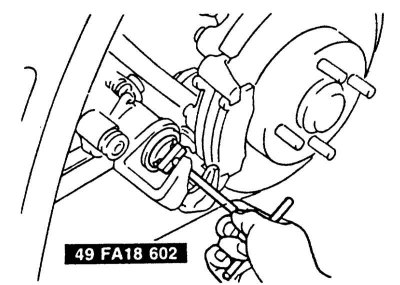
5. Slowly screw the piston to the right, clockwise, using a special device, until it stops. Then turn the piston so that the grooves are straight.
Caution! The brake piston must be screwed in. If it is simply pushed in, the handbrake adjustment in the caliper will be automatically destroyed.
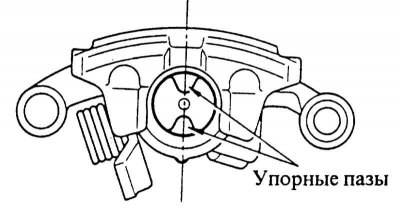
6. A special tool for screwing in fits into the stop grooves so that the piston can be turned. If there is no special device, you can make something similar yourself or contact a workshop.
Attention! When screwing in the piston, the brake fluid is forced out of the brake cylinder into the expansion tank. Monitor the fluid level in the tank, it is possible to pump out some of the fluid with a suction device. To pump out the brake fluid, use a suction device or a plastic bottle that is intended only for brake fluid. Do not use drinking glass.
Warning! Brake fluid is poisonous and should never be sucked out by mouth through a hose. After replacing the pads, the "MAX" mark on the expansion tank should not be exceeded, as the fluid expands when heated. Leaking fluid flows down onto the brake cylinder, destroys the varnish and causes corrosion.
7. The following step is optional: To prevent disc brakes from squeaking, coat the back and sides of the brake pad base with anti-squeak paste (for example Plastilube, Tunap VC 582/S, Chevron SRJ/2, Liqui Moly LM-36 or LM-508-ASC). In this case, apply lubricant only to the reverse side.
Caution! The paste must not under any circumstances come into contact with the brake pad or brake disc.
8. If necessary, wipe off the paste immediately and clean the area with alcohol.
9. Install on brake pads new springs, see illustrations in the Removal section.
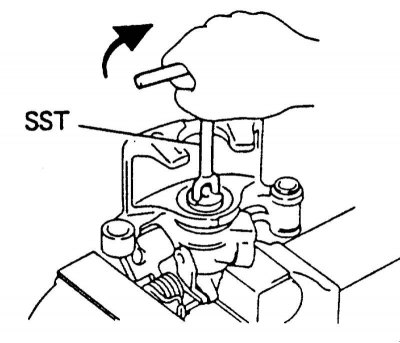
10. Insert both brake shoes with anti-squeal plates and tilt the piston housing downwards. In this case, the bulge on the inner brake shoe will enter the piston stop groove. When tilting downwards, make sure that the cuff is not damaged.
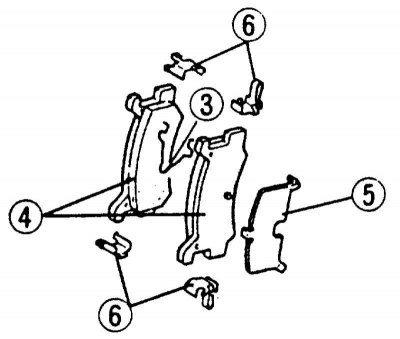
11. Cars produced since 10/89, except for station wagon models: Insert spring "3" into the holes of the brake pads.
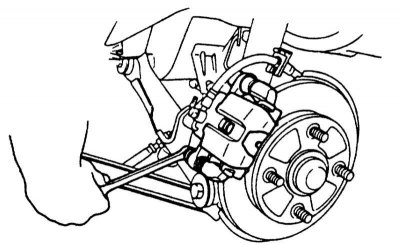
12. Screw the lower, on cars from 10/89 onwards the upper guide pin onto the caliper holder with force 20 Nm. Secure the brake hose to the mount on the shock absorber strut.
13. If installed, unscrew the wheel nuts. Screw the wheel on, taking into account the mark on the hub. Lower the car and tighten the nuts crosswise with force 100 Nm.
Caution! Press the brake pedal several times until you feel a noticeable resistance. This sets the parking brake adjuster.
14. Check the brake fluid in the expansion tank and top up to the maximum mark if necessary.
15. Adjust the handbrake, see Section Adjusting the handbrake.
16. Carefully break in the new pads by reducing the vehicle speed from 80 to 40 km/h several times by lightly pressing the brake pedal. Take breaks in between to cool the brakes.
Attention! During the first 200 km, do not apply full braking.