


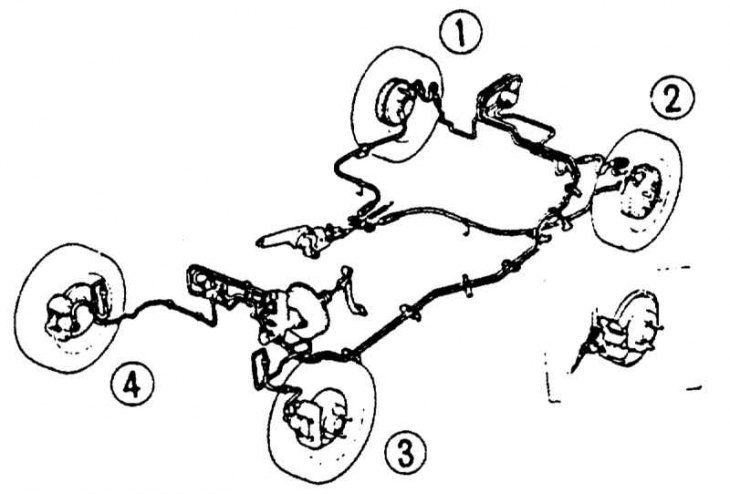
2. Air is removed from the brake system by pumping the brake pedal, for this you need the help of an assistant. If you need to bleed the entire system, you should bleed each cylinder separately. This is the case when air gets into each cylinder.
Pumping sequence:
- 1 - rear right wheel cylinder,
- 2 - rear left wheel cylinder,
- 3 - front right brake caliper,
- 4 - front left brake caliper.
3. If only one caliper was replaced or repaired, it is usually sufficient to bleed air from it alone.
4. Before bleeding, unscrew the cap of the expansion tank and fill it with brake fluid to the maximum mark.
Caution! When bleeding, observe the fluid level in the reservoir. The fluid level should not drop too low, otherwise air will penetrate through the reservoir. Always add fresh brake fluid.
5. Only brake system with ABS: Turn on the ignition and press the brake pedal 4-5 times. Then, if necessary, add brake fluid to the reservoir up to the maximum mark. When bleeding rear brakes, leave the ignition on during the entire bleeding process. When the bleeding valve is opened, the ABS hydraulic pump will turn on and create pressure.
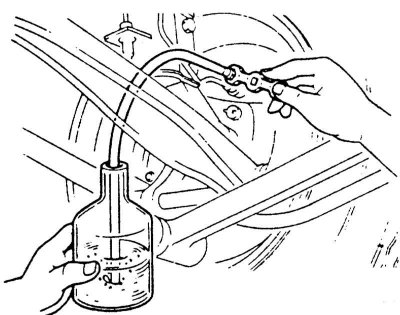
6. Remove the boot-1 of the wheel cylinder bleed bolt. Clean the bolt, put on a clean hose, and lower the other end of the hose into a bottle half-filled with brake fluid. On older models, carefully coat the bleed valve with a rust-corrosive agent and carefully open it.
7. Ask an assistant to pump the brake pedal until pressure is created, which is felt by increasing resistance when pressing the pedal.
8. When sufficient pressure has been created, fully depress the brake pedal and hold it in this position.
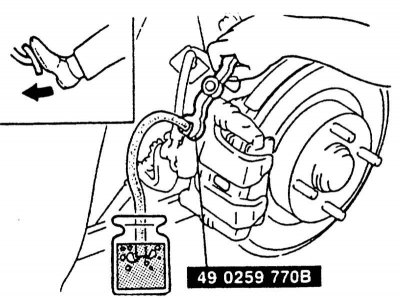
9. Open the air bleed screw on the caliper by 1/2 turn with a spanner. Collect the leaking fluid in a bottle. Make sure that the end of the hose is constantly immersed in brake fluid.
10. When the pressure drops, close the valve immediately. On ABS models, the fluid pressure is unlikely to drop due to the pump being on, in this case, close the bleed valve after 2 seconds to prevent damage to the hydraulic pump.
11. Repeat the bleeding process until pressure is created. Press the pedal down and fix it in this position. Open the air bleed screw, when the pressure drops, close the valve.
12. Repeat this process on one cylinder until there are no more air bubbles in the brake fluid flowing into the bottle.
13. Then, with the pedal depressed, tighten the air bleed bolt with force 10 Nm.
14. Remove the hose and put the dust cover on the valve.
15. Bleed the remaining cylinders in the same way.
16. After bleeding, screw the cap onto the expansion tank. If necessary, add brake fluid to the "MAX" mark.