


For vehicles with anti-lock brakes: if one of the chambers of the brake fluid reservoir is completely empty (for example, if there are leaks in the brake system or if the mechanic forgot to add fluid to the reservoir when bleeding air from the brakes), then you need to perform the air bleeding procedure in the workshop. There they will remove the fault codes from the self-diagnostic unit and perform the air bleeding procedure from the hydraulic unit of the anti-lock system.
In the workshop, air is usually removed from the brakes using a special device for pumping fluid under pressure. For cars with anti-lock braking systems, it is necessary to ensure that the fluid supply pressure is no more than 1 bar.
You can do without a device for removing air. In this case, air is removed from the system by "pumping" the brake pedal, for which you will need an assistant.
If air must be removed from the entire system, then the brakes of each wheel are bled separately. This is done if air has entered each wheel cylinder. If only one brake caliper or wheel brake cylinder was replaced or repaired, then it is enough to remove air from this cylinder (caliper).
Sequence of air removal (bleeding):
Ford Fiesta/Mazda 121:
- 1. Front left wheel support.
- 2. Front right wheel support.
- 3. Rear right wheel support.
- 4. Rear left wheel support.
Ford KA:
- 1. Front left wheel support.
- 2. Rear right wheel support.
- 3. Front right wheel support.
- 4. Rear left wheel support.
Note: During operation, it is necessary to monitor the brake fluid level in the reservoir from time to time. The level should not fall too low, otherwise air will enter the system through the reservoir. Always fill only with fresh brake fluid.
Caution: Release the pressure in the system by pressing the brake pedal at least 20 times.
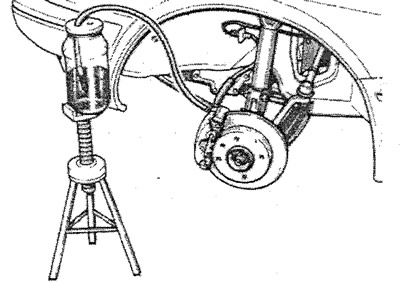
Precautions: When bleeding the rear brakes, carefully unscrew the valves (bolts) to remove air, as the brake fluid may be under very high pressure.
Caution: Remove the dust cap from the bleed valve (bolt). Clean the valve, put a clean hose on it, and lower the other end of the hose into a container partially filled with brake fluid. The container (bottle) should be about 30 cm above the valve so that the hose is filled and air does not enter the caliper through the valve thread.
Unlike the picture, the car should be on a flat surface on its wheels when bleeding the brakes. Carefully unscrew the air bleeding valve so as not to damage it. It is recommended to apply a rust dissolving compound to the valve two hours before the bleeding procedure. If the valve does not unscrew, it is better to carry out the operation in a workshop.
The assistant should press the brake pedal several times to build up pressure in the brake system. This will be felt by the increased force on the pedal.
When sufficient pressure has been created, press the brake pedal fully and hold it in this position.
Loosen the air bleed valve on the caliper by about half a turn using a spanner. Collect the leaking brake fluid in a container. Make sure that the end of the hose in the container is constantly immersed in brake fluid.
As soon as the liquid stops coming out of the hose, tighten the valve.
Repeat the pumping process until pressure is created. Press the brake pedal and hold it in the lower position. Unscrew the valve, wait until the liquid stops coming out, tighten the valve.
Repeat the process of bleeding the air from the brake wheel cylinder until there are no air bubbles left in the fluid coming out of the hose.
After removing the air, remove the hose from the valve and put the dust cap on it.
Bleed the air from the brake cylinders of the remaining wheels in the same manner, following the sequence indicated above.
After completing the procedure, fill the tank to the "MAX" mark and close it.
Conduct a security check.
Security check
Are the air bleed valves tightened?
Is there enough brake fluid?
Conduct a tightness check with the engine running. To do this, press the brake pedal with a force of 200-300 N (20-30 kg) for about 10 seconds, it should not drop. Check the tightness: of all connections.
Finally, brake the car several times on a road with light traffic.
Do not reuse brake fluid that has been pumped out of the system.