


Examination
Mark the position of the front wheels on the hubs so that you can then install the wheels in their original positions. Loosen the wheel nuts with the vehicle on the ground. Raise and support the vehicle from the front and remove the front wheels.
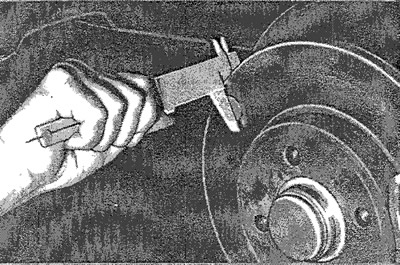
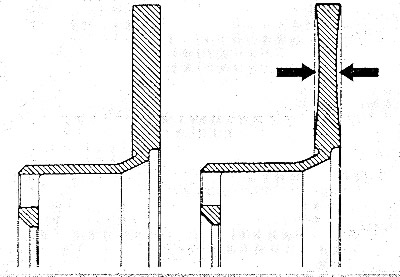
Measure the thickness of the brake disc. In workshops, a special caliper or a specially shaped micrometer is used for this, since a ridge forms on the disc due to wear.
 |
 |
You can measure the thickness of the brake disc with a regular caliper, but you need to place a coin under each of its lips, the total thickness of which is taken into account when processing the measurement results.
Note: Measurements must be taken at several points around the circumference of the brake disc.
Note: Always measure the thickness of the disc at its thinnest point (arrows).
The dimensions of the brake discs are indicated in the table at the beginning of the chapter.
If the wear limit is reached, replace the brake disc.
For severe scratches and dents (deeper than 0.5 mm) replace brake discs.
Note: The brake disc runout can be measured in the workshop. The lateral runout should not exceed 0.1 mm. The measurement is taken in the middle of the working surface of the disc.
Install the front wheels in accordance with the marks made earlier, having first lightly lubricated the centering holes of the disk with consistent grease. Do not lubricate the threads of the wheel studs. Tighten the wheel nuts. Lower the car and tighten the wheel nuts crosswise to a torque of 90 Nm.