
MazBook.ru
English Русский
Български
Беларускі
Український
Српски
Hrvatski
Română
Polski
Slovenský
Magyar
• Bookmark • Sitemap • Contacts •   
Cars Opel Cars Ford Cars Volkswagen Cars Audi Cars Kia Cars Renault Cars Peugeot


Familia Capella Mazda3 Mazda6 CX-? Others Articles
Familia 5 (1985-1989) Familia 6 (1989-1994)

Checking the thickness of brake pads (Mazda Familia BG)

  • Home
  • Mazda Familia
  • Familia BG (1989-1994)
  • General information
  • Maintenance
  • Checking the thickness of brake pads
0
Contents: Disc brakes ⇓ Drum brakes ⇓ Visual inspection of brake lines ⇓

Disc brakes


1. Mark the position of the wheel disk relative to the hub so that the balanced wheel can be installed in its original place. Loosen the wheel bolts.

2. Raise the car, remove the wheels.
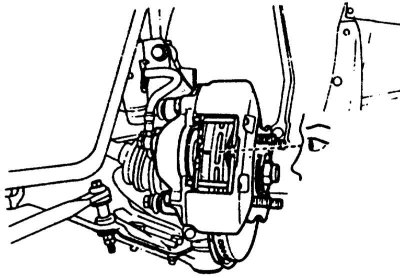
2. Raise the car, remove the wheels.


3. Visually check the thickness of the brake pads - without the main metal plate - from the front through the brake piston housing. If in doubt, remove the brake pads and measure the thickness with a caliper.

4. The wear limit of disc brake pads is reached when the lining has a thickness of 1 mm (up to 9/89.) or 2 mm (since 10/89 issue.). The value applies only to the overlay without the base.

5. If the wear limit is reached, replace the brake pads. Be sure to replace all pads on one axle.

Note: According to the unspoken rule, 1 mm of brake pad thickness corresponds to a distance of 1000 km. This rule applies to severe operating conditions. Under normal conditions, the pads last much longer. With a disc brake pad thickness of 5.0 mm (not counting the back plate) its resource is at least another 4000 km.


(The full text is on the website: www.MazBook.ru)

5. Install the wheels, taking into account the mark on the hub, lower the car and tighten the wheel nuts crosswise with force 100 Nm.

Drum brakes


1. Raise the rear of the vehicle.

2. Remove the brake drum, see Chapter Brake system, Sections Removal and installation rear brake shoes/brake drum, Removal and installation the wheel brake cylinder.
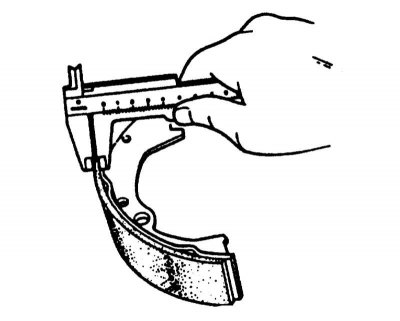
2. Remove the brake drum, see Chapter Brake system, Sections Removal and installation rear brake…


3. Measure the thickness of the linings with a caliper. The wear limit is reached if the lining has a thickness of 1 mm (without metal block).

4. If the wear limit is reached, the brake pads must be replaced. It is essential to replace all pads on one axle.
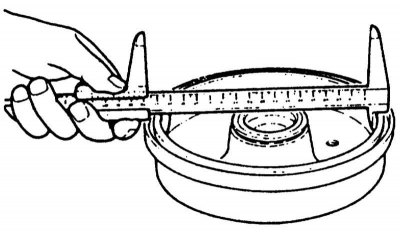
4. If the wear limit is reached, the brake pads must be replaced. It is essential to replace all…


5. Measure the inner diameter of the brake drum with a caliper. The limit is worn if the inner diameter of the drum exceeds 201 mm.


6. Install the brake drum, see Chapter Brake system, Sections Removal and installation rear brake shoes/brake drum, Removal and installation the wheel brake cylinder.

7. Install the rear wheels, taking into account the marks on the hubs. Lower the car and tighten the wheel nuts crosswise with force 100 Nm.

Visual inspection of brake lines


1. Raise the car.

2. Clean the brake lines with cold cleaner.

Caution! To protect against corrosion, the brake pipes are coated with a polymer layer. Damage to this layer may lead to corrosion of the pipes. Therefore, the brake pipes must not be cleaned with a wire brush, sandpaper or screwdriver.


3. Check the lines from the main brake cylinder to the wheel brake cylinders using a lamp. The main brake cylinder is located in the engine compartment under the brake fluid expansion tank.

4. Brake pipes should not be bent or flattened. They should also not have rusty or worn areas. Otherwise, the pipe should be replaced to the next connection point.

5. Brake hoses connect the brake pipes to the wheel cylinders on the moving parts of the car. They are made of high-strength material, but over time they can crack, wear out, or get cut by sharp objects. In this case, they should be replaced.
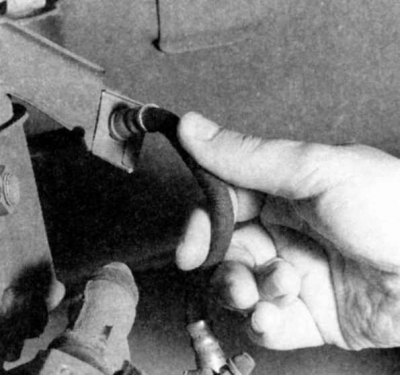
5. Brake hoses connect the brake pipes to the wheel cylinders on the moving parts of the car. They…


6. Bend the brake hoses from side to side and check for damage. The hoses should not be twisted, pay attention to the colored lines, if any.


7. Turn the steering wheel from side to side. The brake hoses should not touch any parts of the car in any position.

8. The connection points of the brake pipes and hoses must not be wet due to oozing brake fluid.

Caution! If the expansion tank and gaskets are wet due to brake fluid, this does not necessarily indicate a faulty master cylinder. Most often, brake fluid leaks through the hole or gasket in the expansion tank cap.


9. Lower the vehicle.
This article is available at: russian, bulgarian, belarusian, ukrainian, serbian, croatian, romanian, polish, slovak, hungarian
This text was checked by: Evdokia Filimonova
Share with friends on social networks:

Previous
Familia 6 » Maintenance
Next

Checking the brake fluid level
Brakes / tires / wheels
Checking/Adjusting the Clutch Pedal
Checking the clutch fluid level
Checking the rubber seals of the drive shafts
Checking the parking brake
Replacing brake fluid
Checking tire pressure
Checking the tread on the tires
Checking the tire valve
More articles on repairing other Mazda models
Rear brake disc pads — replacement Mazda Capella 3 (1982-1992, petrol)
Checking the operation of the parking brake Mazda3 BK (2003-2009)
Checking the operation of the parking brake Mazda6 GG (2002-2008)
Brake pads Mazda CX-5KE (2012-2017)
Checking the thickness of brake pads Mazda 121 (3) (1996-2003)
Link in different formats to this article
Comments and feedback from visitors
No comments yet


How much will 19 + 37 ?


Familia 6 (1989-1994) 
  • General information
  • Introduction to guide
  • User manual
  • Maintenance
  • Power unit
  • Petrol engines
  • Diesel engines
  • Lubrication system
  • Cooling system
  • Ignition system
  • Supply system
  • Carburetor
  • Injection system
  • Exhaust system
  • Transmission
  • Clutch
  • Car gearbox
  • Chassis
  • Front suspension
  • Rear suspension
  • Steering
  • Brake system
  • Wheels and tires
  • Body
  • Body elements
  • Doors and windows
  • Body Care
  • Electrical equipment
  • Equipment and devices
  • Power devices
  • Heating system
  • Lighting and headlights
  • Windshield wipers and washers
  • Wiring diagrams (since 1987)
  • Wiring diagrams (since 1991)
Familia 5 (1985-1989) 
  • General information
  • Vehicle data
  • Model «E» engine
  • Engine repair
  • Cooling and lubrication system
  • Power and ignition system
  • Model «B» engine
  • Engine repair
  • Cooling and lubrication system
  • Ignition system
  • Power system (carburetor)
  • Power system (injector)
  • Transmission
  • Clutch
  • Mechanical gearbox
  • Automatic gearbox
  • Front wheel drive
  • Chassis
  • Steering
  • Front suspension
  • Rear suspension
  • Brake system
  • Electrical equipment
  • Equipment and devices
  • Electrical circuits
  • Wiring diagrams (station wagon)
MazBook.ru © 2018–2026 · Mobile version · Articles and news · Sitemap: EN BG BY UA RS HR RO PL SK HU · Feedback · Site search · Add to bookmarks Familia 5 (BF) · Familia 6 (BG) · Capella 3 (GC) · Capella 3 and 4 (GC) · Capella 4 (GD) · Capella 5 (GE) · Capella 6 (GF) · Mazda3 BK · Mazda6 GG · CX-5KE · Mazda 121 (3) · Mazda BT-50 (1) ·
By continuing to use the site, you agree to the use of cookies 🔐