MazBook.ru
English Русский
Български
Беларускі
Український
Српски
Hrvatski
Română
Polski
Slovenský
Magyar
• Bookmark • Sitemap • Contacts •   
Cars Opel Cars Ford Cars Volkswagen Cars Audi Cars Kia Cars Renault Cars Peugeot


Familia Capella Mazda3 Mazda6 CX-? Others Articles
Mazda3 BK (2003-2009)

Body frame — characteristics and deformation zones (Mazda 3 BK)

  • Home
  • Mazda 3
  • Mazda3 BK (2003-2009)
  • Body
  • Body elements
  • Body frame — characteristics and deformation zones
0
Contents: Main characteristics ⇓ Deformation zone ⇓ Cabin ⇓ Radiator frame panel ⇓ Front bumper reinforcement ⇓
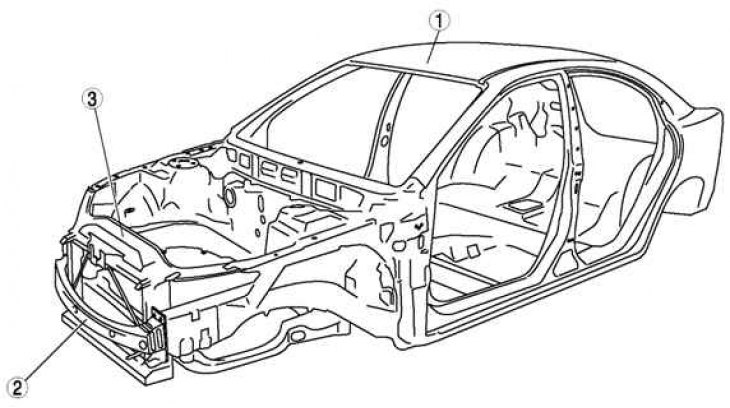
Fig. 8.1. Mazda 3 car body frame: 1 – body frame; 2 – front bumper reinforcement; 3 – casing panel

Fig. 8.1. Mazda 3 car body frame: 1 – body frame; 2 – front bumper reinforcement; 3 – casing panel


Main characteristics


The body frame is designed to increase rigidity and reduce impact on the body, thereby increasing safety. Crumple zone, H-shaped design (triple H-shaped construction), absorbs the impact energy and prevents injury to passengers. The steel bumper reinforcement also serves to increase safety. The use of a polymer casing panel improves repairability.

Deformation zone


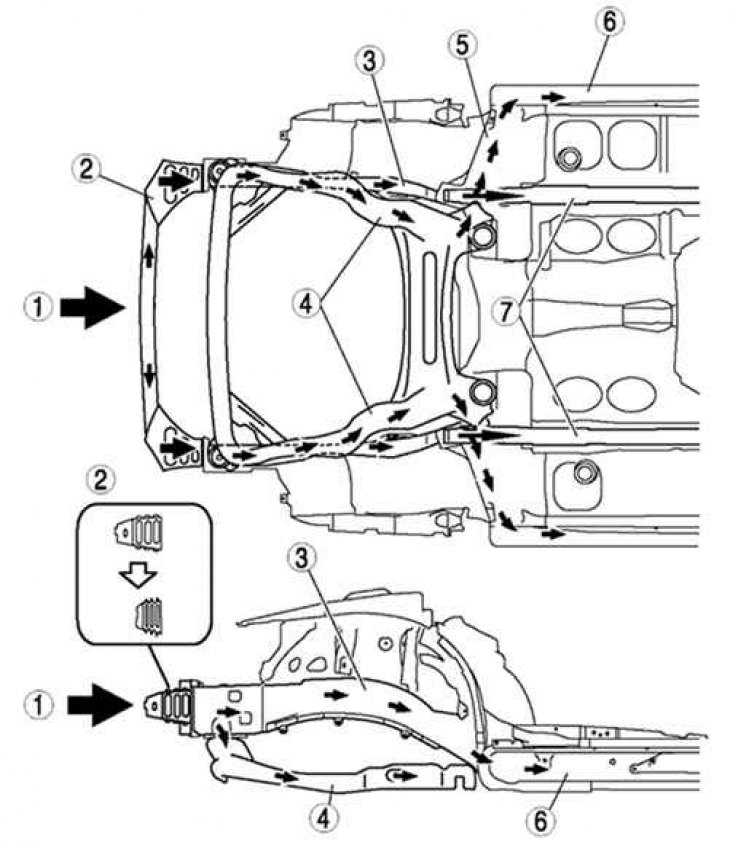
To reduce damage to the passenger compartment, front and rear frames are designed to deform upon impact and effectively absorb/dissipate collision energy.

In moderate frontal collisions, the impact is dispersed to the front side frames and front suspension components in the area of the bumper reinforcement.

Fig. 8.2. Body deformation zones: 1 – collision energy; 2 – front bumper reinforcement; 3 – front…

Fig. 8.2. Body deformation zones: 1 – collision energy; 2 – front bumper reinforcement; 3 – front side frame; 4 – front cross member; 5 – caisson; 6 – lateral longitudinal beam; 7 – Front B-frame


If a collision occurs close to the passenger compartment, the impact energy is dissipated by the side beams and front B-frames through the torsion box, reducing the impact on the passenger compartment.

Cabin
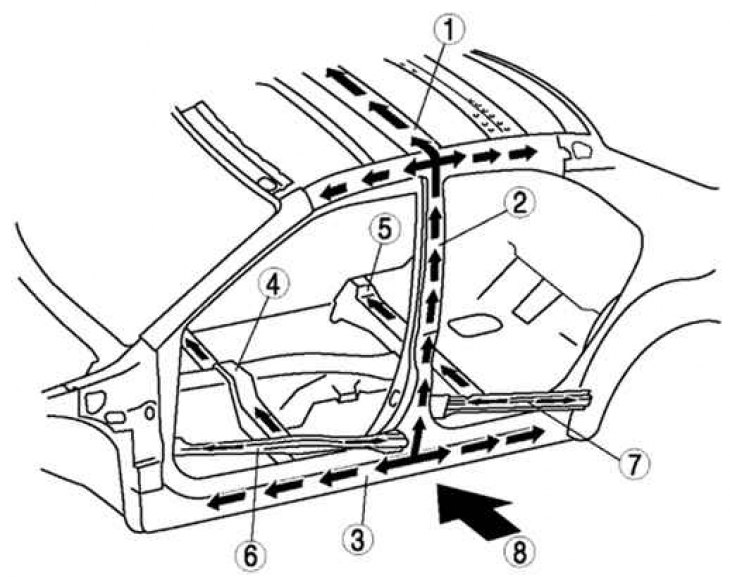


Fig. 8.3. Vehicle cabin: 1 – roof reinforcement; 2 – central pillar; 3 – lateral longitudinal beam;…

Fig. 8.3. Vehicle cabin: 1 – roof reinforcement; 2 – central pillar; 3 – lateral longitudinal beam; 4 – cross member No.2; 5 – cross member No.3; 6 – front door impact-resistant beam; 7 – rear door impact bar; 8 – collision energy


The floor, side frame and roof form three rigid, H-shaped frames (triple H-shaped construction), which resist the impact force in the event of a side collision. Handling stability is improved by preventing body twisting.

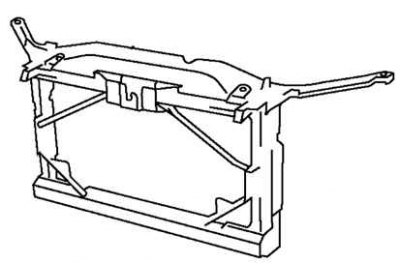
Radiator frame panel


Fig. 8.4. Radiator frame panel

Fig. 8.4. Radiator frame panel


The radiator frame panel is made of durable fiberglass polymer.

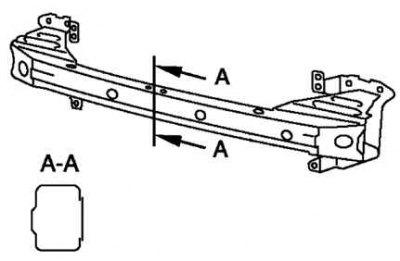
Front bumper reinforcement


Fig. 8.5. Front bumper reinforcement

Fig. 8.5. Front bumper reinforcement


A large cross-section profile is used to increase strength. The frame and connection area have a deformable design. In case of minor collisions, the impact is absorbed and dissipated, reducing the force of impact on the frame and other elements.
This article is available at: russian, bulgarian, belarusian, ukrainian, serbian, croatian, romanian, polish, slovak, hungarian
This text was checked by: Evdokia Filimonova
Share with friends on social networks:

Previous
Mazda3 BK » Body elements
Next

General information about the body
Body add-on components
Removal and installation the hood
Adjusting the hood position
Removal and installation the front wing panel
Removal and installation the front bumper
More articles on repairing other Mazda models
Main technical characteristics of the engine Mazda Familia 5 (1985-1989)
Throttle Body (EGI) — inspection Mazda Capella 3 (1982-1992, petrol)
Main characteristics of the body frame Mazda6 GG (2002-2008)
Damage to the car body Mazda CX-5KE (2012-2017)
General information about the car body Mazda 121 (3) (1996-2003)
Link in different formats to this article
Comments and feedback from visitors
No comments yet


How much will 37 + 13 ?


Mazda3 BK (2003-2009) 
  • User manual
  • Vehicle description
  • Keys, locks and alarms
  • Controls and instruments
  • Air conditioning and heater
  • Seat adjustment
  • Security systems
  • Driving and operation
  • Faults en route
  • Maintenance
  • Power unit
  • Engine device (gasoline)
  • Engine repair (gasoline)
  • Diesel engine (Z6)
  • Lubrication system
  • Cooling system
  • Fuel system
  • Exhaust system
  • Engine electrical equipment
  • Engine management system
  • Transmission
  • Clutch
  • Mechanical gearbox
  • Automatic gearbox
  • Drive mechanism
  • Chassis
  • Suspension and wheels
  • Steering
  • Brake system
  • Body
  • Body elements
  • Doors and windows
  • Air conditioning and heater
  • Electrical equipment
  • Equipment and devices
  • Power devices
  • Lighting system
  • Windshield wipers and washers
  • Equipment checks
MazBook.ru © 2018–2026 · Mobile version · Articles and news · Sitemap: EN BG BY UA RS HR RO PL SK HU · Feedback · Site search · Add to bookmarks Familia 5 (BF) · Familia 6 (BG) · Capella 3 (GC) · Capella 3 and 4 (GC) · Capella 4 (GD) · Capella 5 (GE) · Capella 6 (GF) · Mazda3 BK · Mazda6 GG · CX-5KE · Mazda 121 (3) · Mazda BT-50 (1) ·
By continuing to use the site, you agree to the use of cookies 🔐