


Checking the brake fluid level
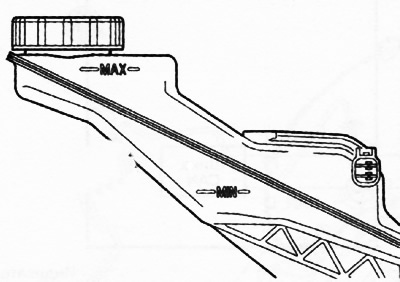
Make sure that the brake fluid level in the reservoir is between the MAX and MIN marks. If the brake fluid level is below the MIN mark, add brake fluid to the reservoir.
Removal air from the brake system circuit (bleeding)
Caution. Brake fluid can damage the paintwork of the car body. Make sure that brake fluid does not come into contact with painted body surfaces. If this does happen, immediately remove the brake fluid from the body surface.
Note:
- When bleeding the brake system, ensure that the brake fluid level in the reservoir does not fall below full.
- You need to start bleeding the brake system from the brake caliper that is furthest from the master brake cylinder.
1. Remove the cap from the brake reservoir and add brake fluid to the upper mark (MAX).
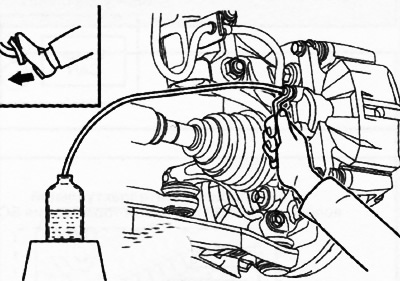
2. Remove the cap from the bleeder screw on the brake caliper and connect the vinyl tube.
3. Place the other end of the tube in a clean container half filled with brake fluid.
4. The work is carried out by two people. The first of them should press the brake pedal several times, and then press and hold the pedal.
5. With the brake pedal fully depressed, the second person should loosen the bleed nipple with a flange nut wrench and drain the brake fluid containing air bubbles. Then tighten the bleed nipple again to a torque of 6.9-9.8 Nm.
The article is copied from the website [mazbook.ru]
6. Repeat steps 4 and 5 until there are no air bubbles in the escaping brake fluid.
7. Perform the above procedure for all brake calipers.
8. Clean the brake calipers.
9. After bleeding the brake system, check the following:
- Functioning of brakes.
- Presence of brake fluid leaks.
- Brake fluid level in the reservoir.