


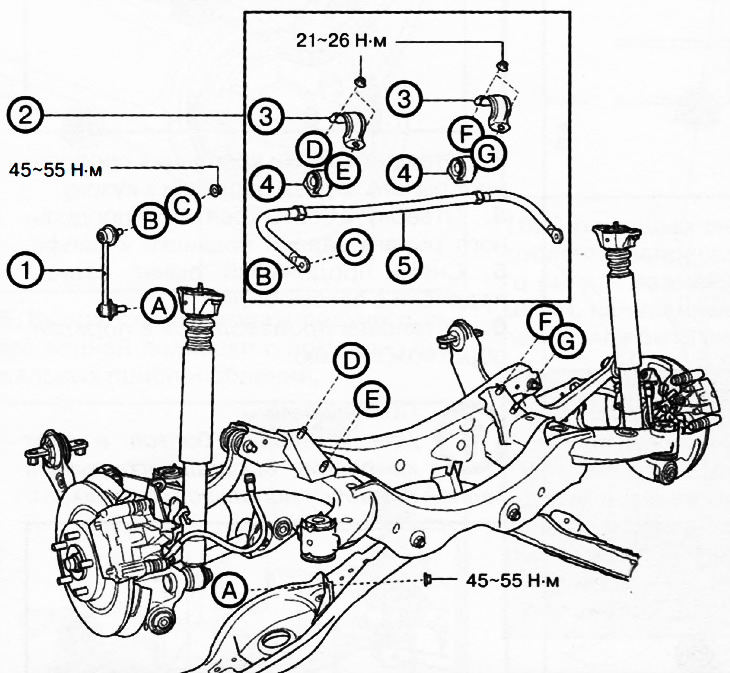
Front-wheel drive version (2WD):
1. Rear transverse stabilizer bar.
2. Rear anti-roll bar assembly.
3. Rear anti-roll bar brackets.
4. Rear anti-roll bar bushings.
5. The bar of the rear stabilizer bar.
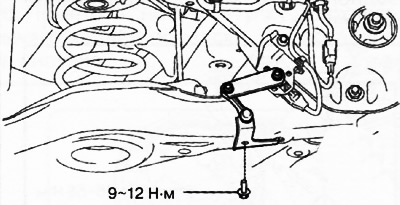
1. Versions with automatic leveling sensor: Working from the left side of the vehicle, disconnect the automatic leveling sensor linkage.
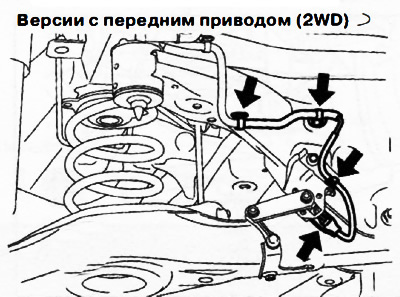
2. Versions with automatic leveling sensor: Disconnect the electrical wiring clamps and connectors installed on the rear subframe.
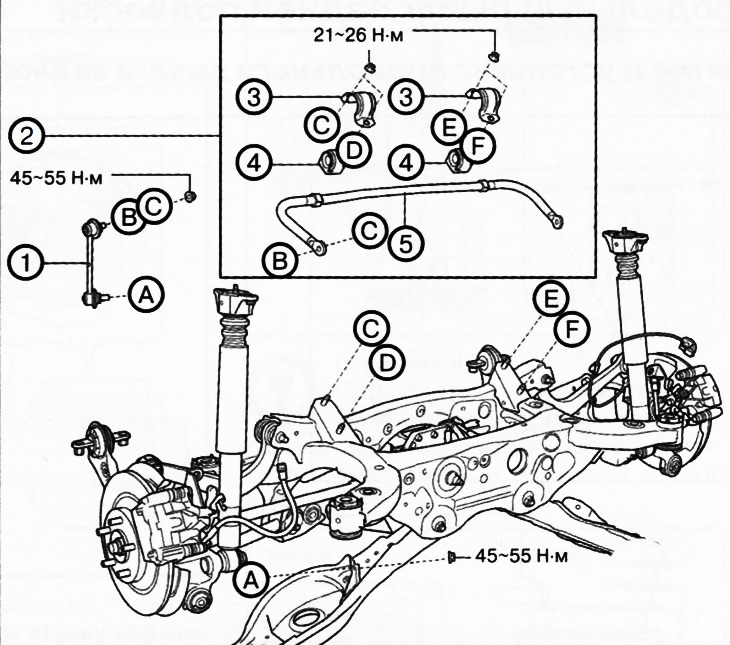
All-wheel drive (4WD) version:
1. Rear transverse stabilizer bar.
2. Rear anti-roll bar assembly.
3. Rear anti-roll bar brackets.
4. Rear anti-roll bar bushings.
5. The bar of the rear stabilizer bar.
Removal the rear anti-roll bar
Caution: Performing the following procedure without first removing the front ABS wheel sensor may cause an accidental open circuit in the wiring harness. Disconnect the front ABS wheel sensor wiring harness before performing the following procedures (from the drive shaft side) and secure the wiring in a suitable location where it will not be accidentally touched when servicing the vehicle.
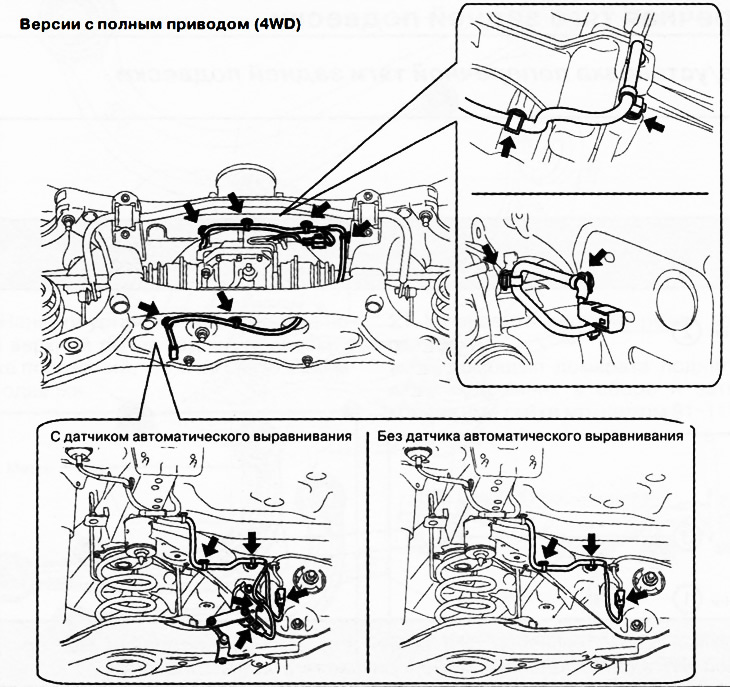
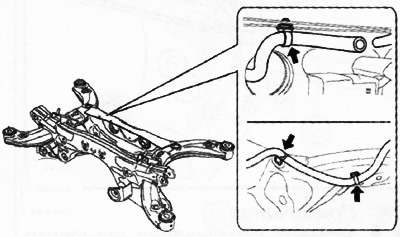
3. 4WD versions: Move the rear final drive breather hose to the side.
4. Disconnect the rear ABS wheel sensor wiring from the axle and set it aside.
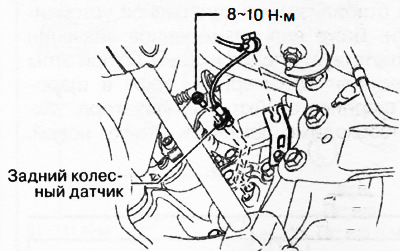
Front-wheel drive (2WD) versions
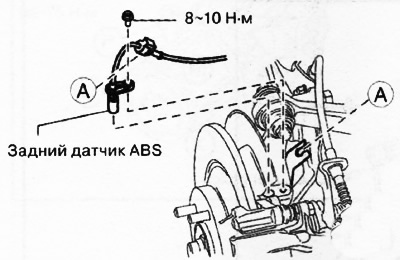
All-wheel drive (4WD) versions
5. All-wheel drive (4WD) versions: remove the propeller shaft.
6. Remove the three-way catalytic converter.
7. Remove the middle section of the exhaust pipe.
8. Remove the rear suspension coil springs.
9. Loosen the nuts and disconnect the anti-roll bar struts.
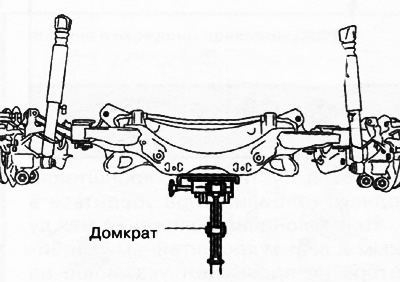
10. Support the rear subframe assembly with a jack and unscrew the mounting nuts.
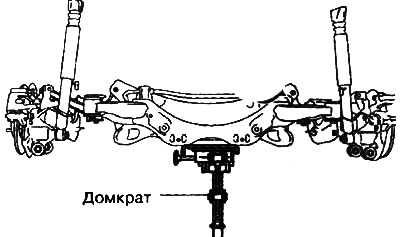
11. Using a jack, lower the rear subframe assembly enough to allow removal of the rear anti-roll bar assembly.
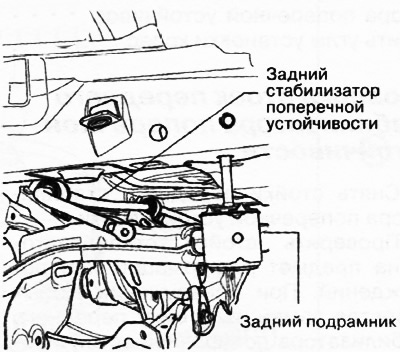
12. Loosen the mounting bolts and remove the anti-roll bar with brackets from the subframe.
13. Having secured the flange of the anti-roll bar bracket in a vice, remove the anti-roll bar bushing from the bracket.
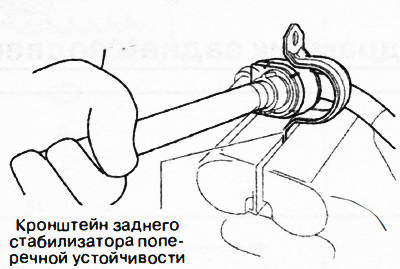
14. Remove the mounting bushings from the stabilizer bar.
15. Installation is carried out in the reverse order of removal, taking into account the following:
Install the bushings onto the front anti-roll bar so that the cuts in the bushings face the rear of the vehicle.
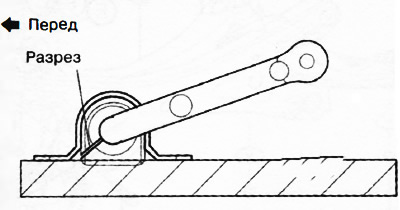
Manually install the bracket onto the front anti-roll bar bushing. If you cannot install the bracket onto the bushing manually, use a vice.
Attention.
- When using a vice to install the front anti-roll bar bracket, the bracket may become deformed.
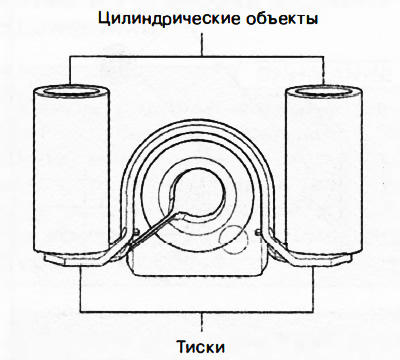
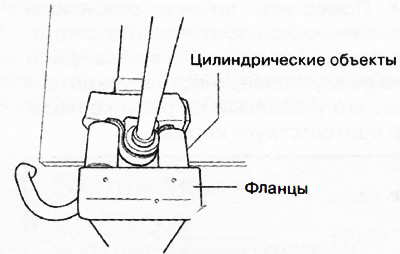
- Install the cylindrical objects as shown in the figure so that the pressure is applied to the flanges of the front stabilizer bar bracket, then install the front stabilizer bar onto the stabilizer bar bushing.
 |
 |
When installing the front stabilizer bracket, ensure that the deviation of the relative position of the bracket and bushing corresponds to the range shown in the figure.
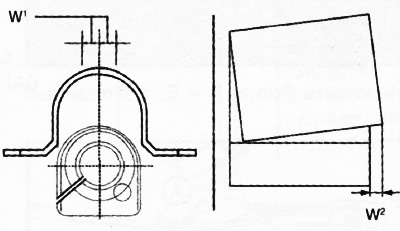
W1: no more than 0.5 mm
W2: no more than 2 mm
After installing the front anti-roll bar bracket, make sure that the bushing protrusion from the anti-roll bar bracket corresponds to the value shown in the figure.
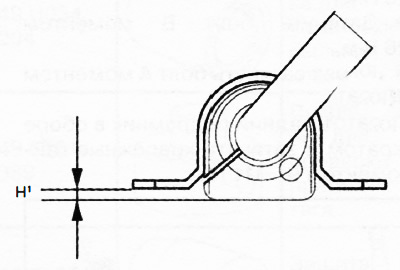
H1: no more than 13 mm
After installing the front stabilizer bracket, make sure that the position deviation between the right and left stabilizer brackets does not exceed the value shown in the figure.
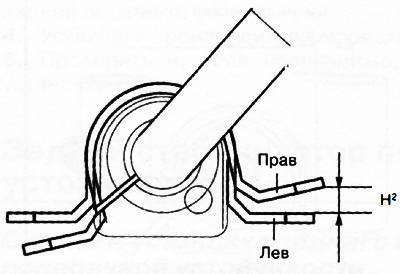
H2: no more than 3 mm.
Place the anti-roll bar with the bushings and brackets installed on a flat surface and make sure that the parameter shown in the figure corresponds to the standard.
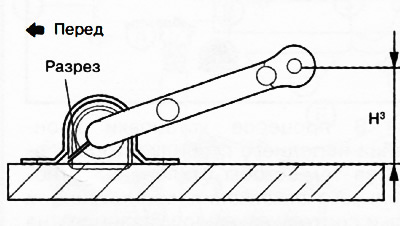
NZ:
- Front-wheel drive versions: 66.5-76.5 mm
- All-wheel drive versions: 41.8-51.8 mm
Tighten bolts A and B as shown in the figure.
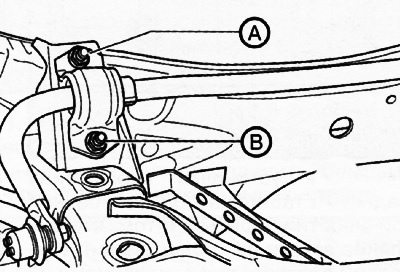
(The original article is posted on: MAZbook.ru)
Tighten bolt A to 21-26 Nm.
Tighten bolt B to 21-26 Nm.
Tighten bolt A again to 21-26 Nm.
16. Raise the rear subframe assembly with a jack and tighten the mounting nuts to a torque of 91-111 Nm.
17. After installing the rear anti-roll bar, check the wheel alignment angles.