


Contents: Engine oil contamination ⇓ Oil dilution in gasoline engines ⇓ Viscosity of motor oil ⇓ All-season oil ⇓ Oils with antifriction additives…⇓ Motor oil specification ⇓ Oil consumption ⇓
Engine oil contamination
Depending on the operating conditions, engine oils are subject to varying effects. Therefore, it is very difficult to determine the effect of different conditions on lubrication. Engines that run for a long time at high speeds or under full load reach high temperatures. Under the influence of high temperatures and oxygen in the air, the oil begins to oxidize. Oxidation products make the oil thicker and can be deposited on the top of the piston, in the grooves of the piston rings and on the valve stems. This can cause carbon deposits to form on the valve plates.
Oil dilution in gasoline engines
If the cylinders receive too rich a mixture, the engine cannot develop maximum power or the engine constantly runs too cold (urban cycle), carbon deposits inevitably form. Soot, burnt oil and other products, unburned fuel itself and condensation of liquid lead to the formation of sludge, acid and asphalt. Unburned fuel settles on the cylinder surface and flows into the crankcase, washing away the oil film on the cylinders and pistons. Consequences: insufficient lubrication of the piston working surface and dilution of the oil, which reduces the lubricating properties of the oil depending on the amount of fuel that has penetrated. If dilution is too high, premature oil change may be necessary. Since gasoline particles evaporate from the oil in a hot engine, the oil level should be monitored, especially in winter (many cold starts - increased fuel content in the oil).
Viscosity of motor oil
Viscosity is the resistance of a liquid to the internal movement of its layers. Depending on the temperature, each oil tends to change its viscosity. As the temperature increases, the oil becomes more liquid. Because of this, the adhesion and strength of the oil film deteriorate. When cold, the oil becomes viscous, and the internal resistance to friction increases.
Applications/Viscosity Classes
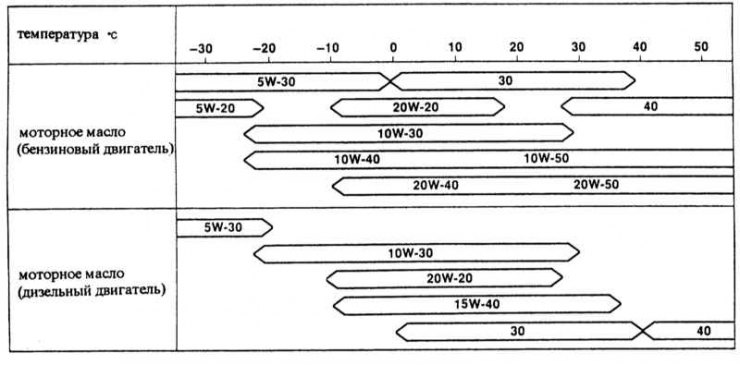
When the engine is cold, the oil must be thin enough to not hinder the starter and to reach all lubrication points as quickly as possible during starting. This requires the use of motor oil with a viscosity that changes the least at different temperatures. Oil viscosity has the same meaning as the internal friction of the oil and is designated by the SAE system (Society of Automotive Engineers), such as SAE 30, SAE 10, etc. High SAE numbers indicate thick oil, low numbers indicate thin oil. Viscosity does not indicate the lubricating properties of the oil.
All-season oil
For MAZDA 323 engines, all-season oil should be used. All-season oils have the advantage that they can be used in both winter and summer. All-season oils are based on liquid seasonal oils (for example, 15 W). The so-called thickeners stabilize the oil in a hot state, so that the necessary lubricating properties are provided for each state. "W" in the SAE system indicates that the oil can be used in winter.
Oils with antifriction additives (light-duty oils)
Low-friction oils are all-season oils with anti-friction additives, so that fuel savings of up to 2% are possible. Low-friction oils have low viscosity (for example, 10 W - 30. An unusual base is used for them (synthetic oils). When purchasing a light-duty oil, you should pay attention to the fact that this oil is suitable for MAZDA. Since adjacent SAE classes overlap, short-term temperature fluctuations are permissible. It is permissible to mix oils of different viscosity classes with each other if it is necessary to top up the oil and the external temperatures do not correspond to the viscosity class of the oil in the engine. No additives should be added to either the fuel or the oil.
Motor oil specification
Only HD oils are allowed for modern engines. HD oils are oils whose lubricating properties have been significantly improved by adding various substances to them. These additives provide stronger protection against corrosion, oxidation, especially a reduced tendency to form sludge in the crankcase, better viscosity, cleaning and dissolving properties. Cleaning and dissolving additives not only reduce the formation of sediment in the engine, but also have the ability to dissolve sediment and separate it and other contaminants into small particles and hold it in the oil pan in a suspended state, so that when changing the oil, the contaminants drain along with it. The quality of HD oil is designated by the API classification (American Petroleum Institute). European manufacturers are also focusing on this system.
The designation consists of two letters.
The first letter indicates the area of application:
- S = Service is for gasoline engines;
- C = Commercial for diesel engines.
The second letter denotes the quality in alphabetical order.
The highest quality oils according to API specification are SG for gasoline engines and CE for diesel engines.
Motor oils specified by the manufacturer for diesel engines are not suitable for petrol engines. There are oils suitable for both diesel and petrol engines. In this case, both designations are on the can (eg SF/CD). For MAZDA 323 with gasoline engines sE, SF and SG motor oils have been defined according to the API specification, for diesel engines API - CC and CD.
Oil consumption
When talking about oil consumption in an internal combustion engine, we mean the amount of oil that is consumed as a result of the combustion process. Oil consumption should never be confused with oil loss due to leaks in the oil pan, cylinder head cover, etc. Normal oil consumption occurs due to the combustion of a small amount in the cylinders, due to the removal of combustion residues and wear particles. Oil wears out due to high temperatures and high pressures that occur in the engine. Oil consumption is also greatly influenced by external factors, driving style, and the precision of the parts. Oil consumption can be a maximum of 1.0 l per 1000 km.
Once the limit mark is reached, oil must be added.
(Article is available on the website Mazbook)
Caution! Do not pour in large amounts of oil at once. If too much oil has been poured into a vehicle with a catalytic converter, the excess must be drained, otherwise unburned oil will penetrate the exhaust system and may destroy the catalytic converter.