


Measuring wheel alignment angles is impossible without special measuring devices. Therefore, we will limit ourselves here to a description of the basic concepts necessary for measurement.
Convergence/camber/transverse tilt of the wheel rotation axis/longitudinal tilt of the wheel rotation axis (coasting)
Under convergence is understood as the lateral distance between the wheels. The front wheels, as a rule, should have a positive toe-in, since the wheels, due to camber and rolling resistance, run slightly outward, since there is play in the hub bearings, wheel suspension and steering rod ends. Positive toe-in means compensates for the tendency of the front wheels to run outward. With positive toe-in, the wheels are installed so that, measured at the height of the midpoint of the wheel, the front is closer to each other than the rear.
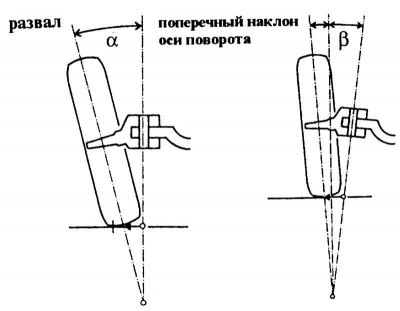
Camber and lateral tilt of the steering axis reduce the transfer of shocks from the road to the steering and maintain the lowest friction when cornering.
Camber is the angle at which the wheel surface deviates from vertical control. The front wheels are thus at an angle; with negative camber, for example, the wheels are further apart at the mounting points than at the top. Lateral tilt of the wheel pivot axis - is the angle beta between the axis of inclination of the steering knuckle and the vertical drawn through the wheel attachment point, looking in the longitudinal direction.
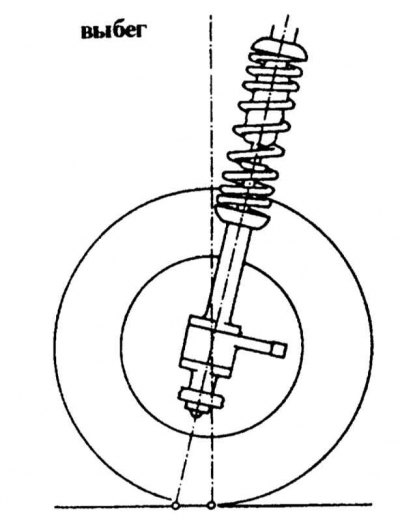
Due to the camber angles and the transverse tilt of the steering axis, the points of contact of the wheels with the road are located closer to the axis of the steering knuckle. This keeps the so-called rolling shoulder as small as possible. The smaller the rolling shoulder, the easier the control. Also, impacts from the road have a weaker effect on the steering. Longitudinal incline axis of rotation wheels (run-out) - is the angle between the axis of the steering knuckle and the vertical at the wheel attachment point, looking in the transverse direction of the car. The run-out has a significant effect on the movement of the wheels in a straight line. Too little run-out causes a deviation from the specified direction when driving on bad streets or in a crosswind and does not allow the steering to return to its original position after turning. On the other hand, a large run-out increases the steering force.
The coast, camber and lateral tilt of the steering axis of the wheel on the MAZDA 323 can only be checked, they are not subject to adjustment. If the measured values are outside the permissible limits, the suspension parts are damaged or worn.
Adjustment
To check the wheel alignment angles, you need an inspection pit or a lift with a platform. The following conditions must be met for each measurement.
- Prescribed tire pressure
- The car is unloaded and fully fueled.
- Rock the car vigorously beforehand
- The steering wheel is in the middle position.
- Absence of unacceptable play in the steering rods (maximum play of the steering wheel at the outer edge is 30 mm)
- No unacceptable play in the wheel suspension
- The vertical and lateral runout of the wheel disks must not exceed 2.0 mm.
- The difference in height between the left and right sides of the vehicle, measured at the edge of the wing, must not be more than 10 mm.