
MazBook.ru
English Русский
Български
Беларускі
Український
Српски
Hrvatski
Română
Polski
Slovenský
Magyar
• Bookmark • Sitemap • Contacts •   
Cars Opel Cars Ford Cars Volkswagen Cars Audi Cars Kia Cars Renault Cars Peugeot


Familia Capella Mazda3 Mazda6 CX-? Others Articles
Mazda 121 (3) (1996-2003) Mazda BT-50 (1) (2006-2011)

Wheel alignment angles of a car (Mazda 121 (3))

  • Home
  • Mazda
  • 121 JASM (1996-2003)
  • Chassis
  • Steering
  • Wheel alignment angles of a car
0
Contents: Toe/Camber/Steering Axis Tilt/Pitch ⇓ Prerequisites for inspections ⇓
Optimal driving characteristics and minimal tire wear are only achieved when the wheels are installed correctly. If the tires wear excessively and unevenly, lack stability, poor directional stability when driving straight and poor steering when driving in a turn, you should visit a workshop and have the wheel installation checked optically.

Accurate measurements of wheel geometry cannot be made without the appropriate equipment. Therefore, the description in this chapter is limited to an explanation of the basic necessary concepts.

Toe/Camber/Steering Axis Tilt/Pitch


Toe-in is the lateral distance between the wheels. Positive toe-in means that the wheels, measured at the height of the midpoints, are spaced less apart in front than in the rear. Negative toe-in (discrepancy) means that the front of the wheels are slightly wider than the rear.
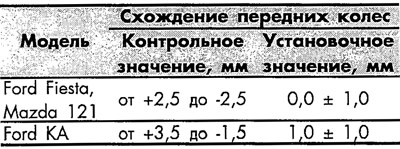
Toe-in and caster prevent road irregularities from being transmitted to the steering wheel and keep…


Toe-in and caster prevent road irregularities from being transmitted to the steering wheel and keep cornering friction as low as possible.

Camber is the angle at which the plane of the wheel deviates from the vertical. The front wheels are therefore at an angle, for example, with negative camber the lower points of the wheels are wider than the upper ones.


The transverse inclination of the steering axis is the angle between the steering axis of the steering knuckle and the vertical at the point where the wheel touches the ground, looking along the vehicle.

The longitudinal tilt of the steering axis is the angle between the steering axis of the steering knuckle and the vertical at the point where the wheel touches the ground, looking across the car. The longitudinal tilt angle significantly affects the stability of the front wheels. Too small an angle contributes to the deviation of the wheel from the direction of travel on bad roads or in a crosswind and, in addition, leads to the fact that after a turn the steering does not return well to the straight-ahead position.

[Content based on information from: MAZbook.ru]

Prerequisites for inspections


The steering is adjusted correctly.

There is no unacceptable play in the steering rods and suspension, the wheels and tires are in order.

The tire pressure is correct.

The car has an operational weight: the spare wheel and jack are in their designated places. Apart from this, there should be nothing else in the car.

The car was rocked a lot before this.
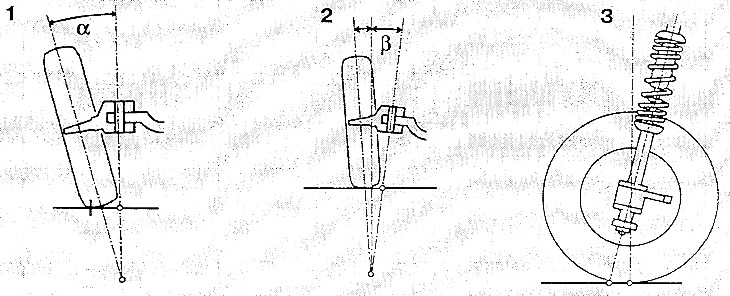
1. Collapse; 2. Transverse tilt of the pivot axis; 3. Longitudinal tilt of the pivot axis.

1. Collapse; 2. Transverse tilt of the pivot axis; 3. Longitudinal tilt of the pivot axis.
This article is available at: russian, bulgarian, belarusian, ukrainian, serbian, croatian, romanian, polish, slovak, hungarian
This text was checked by: Evgeny Mereshnikov
Share with friends on social networks:

Previous
Mazda 121 (3) » Steering
Next

Bleeding the steering gear
Removal and installation rubber steering gear boots
Removal and installation the steering rod joint
Removal and installation the steering wheel
Precautions when working with an airbag
More articles on repairing other Mazda models
Checking and adjusting the front wheel alignment angles Mazda Familia 5 (1985-1989)
Wheel alignment angles Mazda Capella 5 (1991-1997)
Full rear wheel alignment Mazda3 BK (2003-2009)
Front wheel alignment Mazda6 GG (2002-2008)
Preliminary check of wheel alignment angles Mazda CX-5KE (2012-2017)
Link in different formats to this article
Comments and feedback from visitors
No comments yet


How much will 15 + 33 ?


Mazda BT-50 (1) (2006-2011) 
  • General information
  • Introduction to guide
  • User manual
  • Maintenance
  • Power unit
  • Engine repair (diesel)
  • Cooling and lubrication system
  • Fuel injection system
  • Intake and exhaust system
  • Engine electrical equipment
  • Transmission
  • Clutch
  • Mechanical gearbox
  • All-wheel drive system
  • Transfer case and gearboxes
  • Chassis
  • Front suspension
  • Rear suspension
  • Steering
  • Brake system
  • Body
  • Exterior (external elements)
  • Interior (internal elements)
  • Heating and air conditioning
  • Security system SRS
  • Electrical equipment
  • Equipment and devices
  • Electrical circuits
Mazda 121 (3) (1996-2003) 
  • General information
  • User manual
  • Maintenance
  • Power unit
  • Petrol engine 1.3 l
  • Petrol engine 1.25/1.4 l
  • Diesel engine
  • Lubrication system
  • Cooling system
  • Ignition system
  • Supply system
  • Fuel injection (gasoline)
  • Fuel injection (diesel)
  • Exhaust system
  • Transmission
  • Clutch
  • Car gearbox
  • Chassis
  • Front suspension
  • Rear suspension
  • Steering
  • Brake system
  • Wheels and tires
  • Body
  • Exterior (external elements)
  • Interior (internal elements)
  • Doors, windows and locks
  • Heating system
  • Electrical equipment
  • Troubleshooting
  • Equipment and devices
  • Lighting system
  • Power devices
  • Electrical circuits
MazBook.ru © 2018–2026 · Mobile version · Articles and news · Sitemap: EN BG BY UA RS HR RO PL SK HU · Feedback · Site search · Add to bookmarks Familia 5 (BF) · Familia 6 (BG) · Capella 3 (GC) · Capella 3 and 4 (GC) · Capella 4 (GD) · Capella 5 (GE) · Capella 6 (GF) · Mazda3 BK · Mazda6 GG · CX-5KE · Mazda 121 (3) · Mazda BT-50 (1) ·
By continuing to use the site, you agree to the use of cookies 🔐