


Starting the engine from an external power source
Starting the engine from an auxiliary battery can be dangerous if you do not follow the relevant instructions. Therefore, follow the description of all operations exactly. If you are not sure that you will be able to start the engine independently from the auxiliary battery, we strongly recommend that you seek technical assistance from specialists.
Attention.
- Always follow the safety precautions listed below.
- To ensure safe handling of the battery, please read the following safety precautions and warnings carefully before attempting to test or connect the battery.
- Make sure that the positive pole ("+") of the battery does not come into contact with the car body or any metal objects. This may cause sparking.
- Open flames or sparks are dangerous near batteries with the battery caps removed. Hydrogen gas released during normal battery operation can cause the battery to explode. If the battery explodes, people nearby can be seriously injured and may receive chemical burns.
- When working near the battery, do not touch the positive ("+") or negative ("-") terminals of the battery with metal tools.
- If the battery covers are removed, do not bring an open flame near the battery (including lit cigarettes) and sparkling objects.
- It is forbidden to start the engine from the auxiliary battery if the electrolyte in your vehicle's battery is frozen or the battery level is below normal. The battery may fail or explode, resulting in serious injury.
- Connect the negative terminal of the extension cable only to a solid metal part that is located at a sufficient distance from the battery.
- It is dangerous to connect the terminal of an extension cord to the negative (-) terminal of a discharged battery. An electrical discharge could cause the gas released by the battery to explode and injure people nearby. Route and position extension cords well away from moving parts.
- It is dangerous to connect extension cord terminals near or directly to moving parts, such as near the area where the fan blades rotate or near drive belts. This could cause the extension cord to become caught in moving parts when the engine starts, causing serious injury.
- Only 12-volt independent devices are allowed to be used to jump start the engine. When using a 24-volt starting device (for example, two 12-volt batteries connected in series, or a 24-volt electrical converter) your vehicle's electrical equipment that operates at 12V (including starter, ignition system and other components), may fail completely.
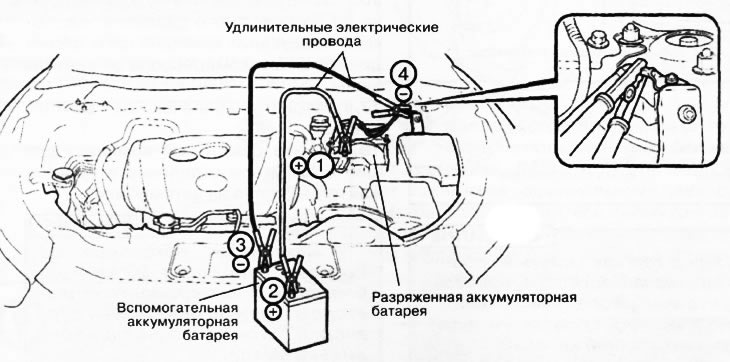
Note: Connect the extension cord terminals in the order that corresponds to the numbers shown in the illustrations. Disconnect the extension cord terminals in the reverse order.
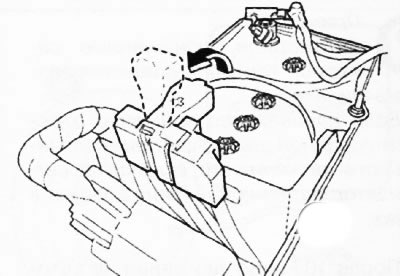
1. Remove the battery cover.
2. Make sure the booster battery you intend to use has a nominal voltage of 12 V and its negative terminal is connected to the vehicle ground.
3. If the additional battery is installed in another vehicle, the vehicles must not touch each other. Turn off the engine of the vehicle whose battery will be used as an additional battery. Turn off all unnecessary electrical consumers in both vehicles.
4. Connect the terminals of the extension wires strictly in the sequence shown in the figure.
- Connect the extension cable terminal to the positive terminal of the discharged battery (1).
- Connect the second terminal of this wire to the positive terminal of the auxiliary battery (2).
- Connect the terminal of the other extension cable to the negative terminal of the auxiliary battery (3).
- Attach the second terminal of this extension cable to a solid metal part of the vehicle (for example, to the engine support) at a sufficient distance from the discharged battery (4).
Based on website data (Mazbook)
5. Start the engine of the car with the booster battery and let it run for a few minutes. Then start the engine of the car with the discharged battery.
6. After the engine has started successfully, carefully disconnect the extension cable terminals in reverse order.
7. Install the battery cover in the reverse order of removal.
Note: Make sure the lids are securely fastened in place.