


Contents: Repair kit for temporary tire…⇓ Using a repair kit to temporarily…⇓ Testing the temporary tire repair kit ⇓
The repair kit that comes with your vehicle is designed to temporarily repair minor tire punctures (obtained, for example, from a nail or similar sharp objects).
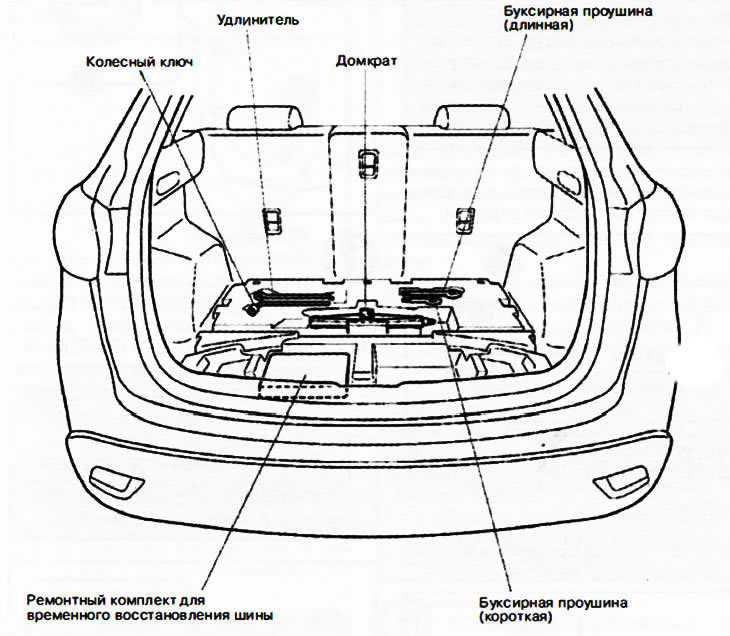
Note: Your vehicle is not equipped with a spare tire. In the event of minor damage to a tire, a repair kit should be used to temporarily restore the tire to working order. When using the repair kit, follow the instructions included with the kit. If you use the repair kit to temporarily restore the tire to working order, contact an authorized Mazda dealer as soon as possible to have the tire repaired or replaced.
Repair kit for temporary tire restoration
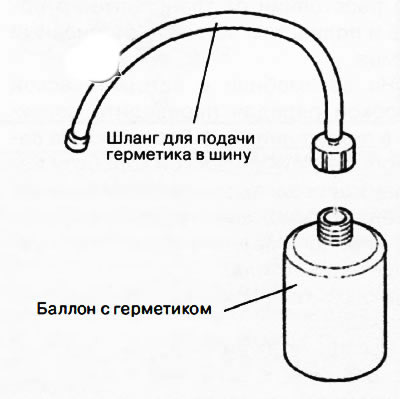
The temporary tire repair kit includes the components shown in the figure.
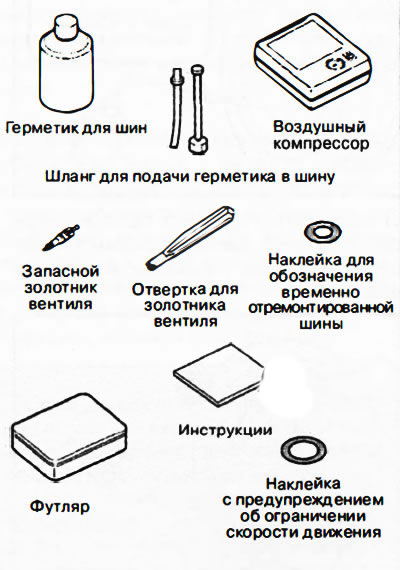
Attention.
- Do not allow children to touch the tire sealant can.
- Ingestion of sealant into the gastrointestinal tract is dangerous.
- If the sealant is accidentally swallowed, drink plenty of water and seek medical attention immediately.
- Do not allow children to touch the tire sealant can.
- Sealant coming into contact with the mucous membrane of the eyes or skin is dangerous. If the sealant gets into the eyes or on the skin, you should immediately rinse the eyes or skin area with plenty of water and seek immediate medical attention.
Note:
The sealant bottle is not reusable. Purchase a new sealant bottle from an authorized Mazda dealer.
The repair kit is not intended for use in the following cases. In such cases, you must contact an authorized Mazda dealer service station:
- Tire sealant has expired (the expiration date is indicated on the label on the can of sealant).
- The diameter of the puncture hole of the tire exceeds 4 mm. The damage is not on the tread, but in other parts of the tire.
- Before stopping, the vehicle was running on a completely flat or almost completely flat tire.
- The tire came off the wheel rim.
- The wheel rim is damaged.
- The tire has been punctured two or more times.
Using a repair kit to temporarily restore damaged tires
1. Stop the vehicle on a level, horizontal surface at a safe distance from traffic and fully apply the parking brake.
2. On a vehicle with an automatic transmission, move the selector lever to the "P" (Park) position. On a vehicle with a manual transmission, move the gearshift lever to the first or reverse gear position. Then turn off the engine.
3. Turn on the hazard warning lights.
4. Remove passengers from the vehicle, empty the trunk and remove the tire repair kit.
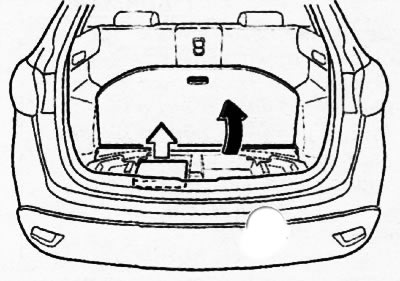
5. Shake the tire sealant can thoroughly several times.
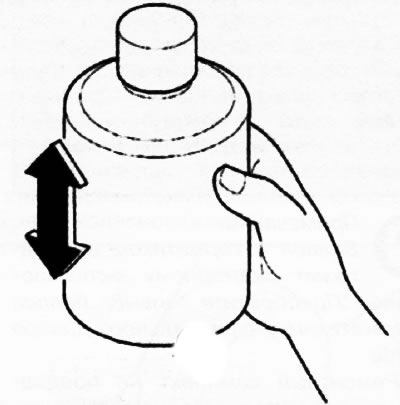
Caution. If you shake the can with the hose screwed on, the sealant may leak out through the hose. Sealant that gets on clothes or other things is almost impossible to remove. Shake the can several times before screwing on the hose.
Note: The tire sealant can be used at ambient temperatures down to -30°C. At temperatures below 0°C, the sealant hardens and its supply from the can to the tire becomes difficult. Therefore, warm up the sealant can in the car before injecting the sealant into the tire.
6. Remove the cylinder cap. Screw the hose onto the neck of the cylinder without opening the inner cap of the cylinder. When screwing the hose, the inner cap is simultaneously destroyed.
7. Remove the cap from the valve of the damaged tire. Press the valve core with the back of a valve core screwdriver to completely release any remaining air from the tire.
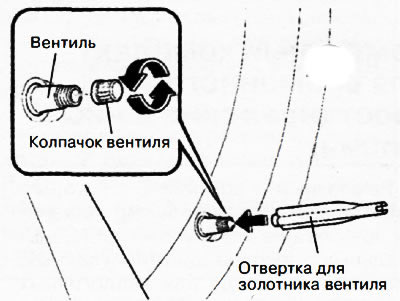
Caution: If there is excess air pressure left in the tire, the valve core may fly out of the valve when you unscrew it. Therefore, unscrew the valve core carefully.
8. Unscrew the valve core using a screwdriver designed for this purpose, turning it counterclockwise.
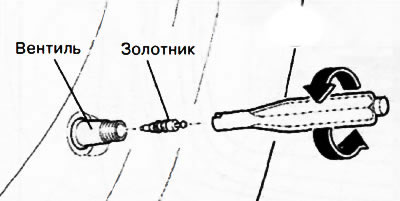
Note: Remove the valve core to prevent contamination.
9. Remove the plug from the hose and insert the end of the hose into the valve hole.
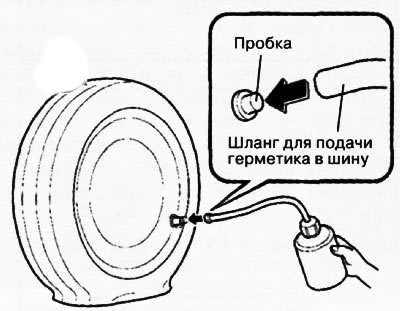
10. Lift and hold the can upside down. Squeeze the can with your hands and squeeze the sealant completely into the tire cavity.
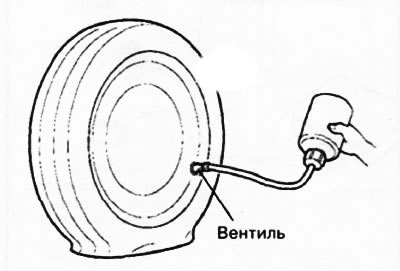
Note: The sealant bottle is not reusable. Purchase a new sealant bottle from an authorized Mazda dealer.
11. Remove the end of the hose from the valve. Screw the valve core into the valve and tighten it with sufficient force to ensure a tight seal.
12. Attach a sticker to the outer sidewall of the tire indicating temporary restoration of the tire's functionality using a sealant.
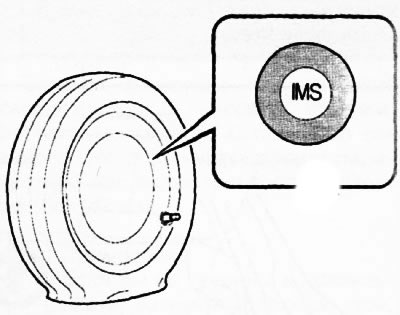
Note: Do not throw away the empty used sealant bottle. Return the empty sealant bottle to your authorized Mazda dealer when you have your tire replaced. The empty sealant bottle will be used to collect and dispose of the sealant when it is removed from the tire cavity.
Attention: Observe the speed limit indicated on the sticker.
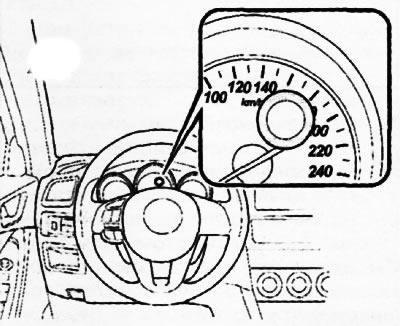
Attention.
- Do not attach a speed limit warning sticker to the instrument cluster: the sticker may obscure warning lights or control instruments, such as the speedometer, from the driver's view.
- It is dangerous to attach the sticker to the steering wheel hub cover: the sticker may prevent the front airbag from deploying and cause serious injury to the driver.
13. Screw the end of the air compressor hose onto the tire valve.
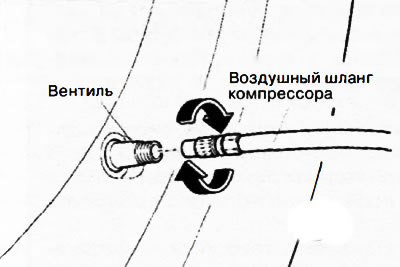
14. Connect the air compressor power cord plug to the auxiliary power outlet. Then turn the ignition switch to the "ACC" position.
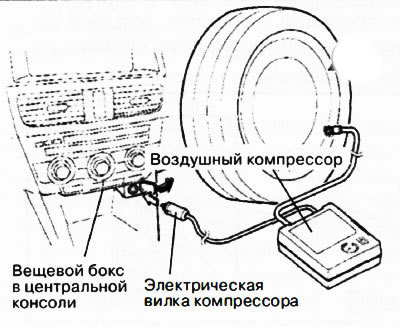
Attention.
- Before unplugging the compressor, make sure the compressor is switched off.
- The compressor is turned on and off with one button.
15. Press the switch button to turn on the compressor and inflate the tire exactly to the nominal pressure value.
Attention.
- Do not inflate the tire with a compressor to a pressure higher than 3.1 kgf/cm² (3 bar). It is dangerous to increase the pressure developed by the compressor to a value higher than 3.1 kgf/cm² (3 bar). If you increase the air pressure to a higher value, you can get burned by hot air coming out of the rear of the compressor.
- If the compressor's tire inflation rate has dropped or the compressor body temperature has increased significantly, this indicates that the compressor is overheating. Turn off the compressor immediately and let it cool for at least 30 minutes.
Note:
- The nominal value of the air pressure in the tires is indicated on the plate attached to the body pillar in the driver's door opening.
- Do not operate the air compressor continuously for more than 10 minutes. Longer operation may cause the compressor to fail.
- If the tire pressure does not increase when inflating the tire with a compressor, then repairing the damaged tire may be impossible. If the air pressure in the tire does not reach the nominal value after 10 minutes of compressor operation, then this is a sign of serious damage to the tire. In such a case, it is useless to try to restore the tire's functionality using a repair kit - it will not help. Contact the service station of an authorized Mazda dealer or the nearest tire repair shop to replace or repair the tire.
- If the air pressure in the tire is higher than normal, unscrew the valve cap on the compressor and release the pressure.
16. After the tire has been inflated to the rated pressure, turn off the air compressor and disconnect the compressor hose from the tire valve.
17. Screw the cap onto the tire valve.
18. Place the tire repair kit in the luggage compartment and continue driving the vehicle.
Attention.
- Drive carefully at a speed of no more than 80 km/h to the nearest tyre repair shop or to the nearest authorized Mazda dealer service station.
- At vehicle speeds above 80 km/h, vehicle vibration may be observed.
Note:
- Vehicles equipped with a tire pressure monitoring system.
- If the pressure in the temporarily repaired tire is below the nominal value, the tire pressure drop indicator will turn on.
19. After 10 minutes of driving or after 5 km of travel, stop and check the tire pressure using the pressure gauge built into the air compressor. If the air pressure in the tire has dropped below the nominal value, inflate the tire again to the required pressure (see operations starting from point 15).
Attention.
- If the air pressure in the tire has dropped to 1.3 kgf/cm² (1.3 bar) or lower, temporary restoration of the damaged tire using a repair kit is not possible. Park the car on a level horizontal surface in a safe place and contact the technical assistance service.
- If the tire pressure remains low after completing steps 14 through 20, park the vehicle on a level surface in a safe location and contact an authorized Mazda dealer for assistance.
Note: When checking tire air pressure using the compressor pressure gauge, be sure to turn off the compressor.
20. If the air pressure has not dropped, the temporary tire repair is complete. Drive the vehicle carefully to the nearest authorized Mazda dealer or tire repair shop to have the tire replaced. Remove the speed limit sticker after replacing the tire.
Attention.
- A tire that has been temporarily repaired using the sealant included in the repair kit is not suitable for further use on the vehicle. A temporarily repaired tire must be replaced with a new one.
- A temporarily repaired tire can continue to be used only if the sealant has been carefully removed from it and the tire has been checked for significant damage. However, the tire valve must be replaced.
Testing the temporary tire repair kit
Check the condition of the repair kit regularly:
- Check the expiration date of the sealant can.
- Check the serviceability and operation of the air compressor.
Note: The sealant can has a limited shelf life. Check the expiration date on the sealant can label and replace it with a new one if the expiration date has expired. It is recommended to contact an authorized Mazda dealer and replace the old can with a new one before the expiration date has expired.