


Note:
The following signs may indicate wheel damage:
- increasing the resistance to steering wheel rotation;
- increased vibration of the car;
- the car is pulled to the side.
If a wheel is damaged, to replace it, turn to the edge of the roadway and, observing safety precautions, move slowly to the nearest horizontal area, removed at a sufficiently safe distance from the roadway. Stopping the car on the roadway or on the edge of a road with heavy traffic is dangerous.
Attention.
- Follow all tire changing instructions carefully.
- Failure to follow the instructions for changing a faulty tire is dangerous! The vehicle may fall off the jack and seriously injure people nearby. If the vehicle is jacked up, do not stand under the vehicle or place any part of your body under it. The same applies to passengers and other people.
- Do not leave passengers in the car if the car is being lifted with a jack. Passengers may cause the car to fall off the jack and cause serious injury to people nearby.
Note: Before using the jack, make sure that its screw is well lubricated.
1. Stop the vehicle on a level, horizontal surface at a safe distance from traffic and fully apply the parking brake.
2. On a vehicle with an automatic transmission, move the selector lever to the "P" (Park) position. On a vehicle with a manual transmission, move the gearshift lever to the first or reverse gear position. Then turn off the engine.
3. Turn on the hazard warning lights.
4. Check that none of the passengers remain in the vehicle, make sure that all passengers are at a safe distance from the roadway and the vehicle.
5. Remove the jack, tools and spare tire.
6. Place wheel chocks under the wheel that is diagonally opposite the damaged one. Wheel chocks should be installed in front and behind the wheel.
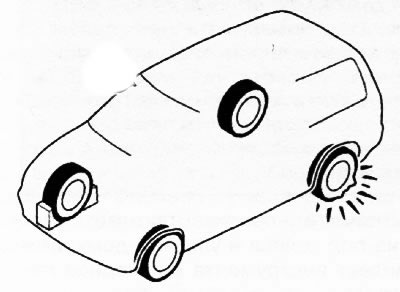
Note: Stones or wooden blocks of suitable size and shape can be used as wheel chocks if they can ensure that the vehicle remains immobile.
Removal a faulty wheel
1. Vehicles with steel wheels: If the wheel has a decorative cap, remove it using the flat end of the jack handle extension.
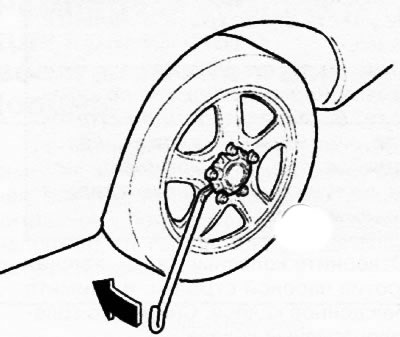
Note: Insert the pointed flat end of the extension between the wheel rim and the edge of the hubcap and pry the hubcap off.
2. Loosen the wheel nuts one turn (counterclockwise). Do not loosen the nuts completely until the wheel is completely off the ground.
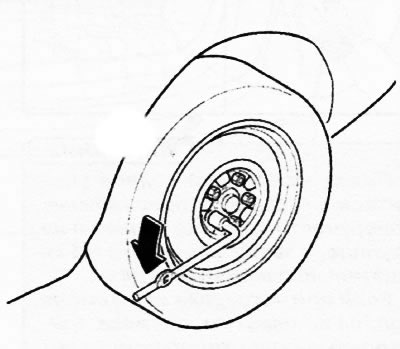
3. Place the jack on a supporting surface.
4. By turning the jack screw in the direction shown in the figure, raise the jack head to a height slightly less than the height of the supporting points of the car body.
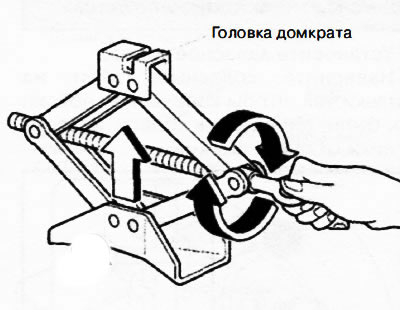
5. Place the jack under the support point closest to the damaged wheel. The jack head should be directly under the support point of the body.
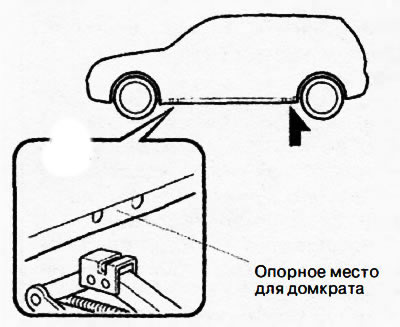
6. Slowly raise the jack head, turning the screw with your hands until the head rests against the support point of the body.
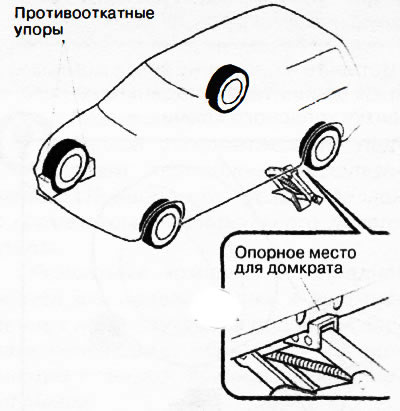
Attention.
- Install the jack only in the specially designed front and rear support areas on the body, as shown in the illustrations. It is dangerous to lift the vehicle if the jack is installed in other places than those intended for lifting the vehicle. The vehicle may fall off the jack and seriously injure or even kill a person nearby. Install the jack only in the front and rear support areas on the body, specially designed for lifting the vehicle on the jack (see pictures).
- It is prohibited to lift the vehicle by resting the jack on places not intended for lifting the vehicle; it is also prohibited to place any foreign objects under the jack itself or under its head.
- Lifting a car with the jack resting on places not intended for lifting the car, as well as placing any foreign objects under the jack itself or under its head is dangerous, as this can lead to deformation of the body, or the car can jump off the jack, and people nearby can be seriously injured by the jack or the falling car.
- Use only the jack that comes with your vehicle.
- It is dangerous to use a jack that is not designed for your Mazda. The vehicle could fall off the jack and cause serious injury to anyone nearby.
- It is prohibited to place any foreign objects under the jack.
- It is dangerous to lift a vehicle if the jack is supported by any pads. The jack may become unstable and people nearby may be seriously injured by the jack or the falling vehicle.
7. Insert the extension hook into the jack screw eye and place the wheel lug wrench handle on it.
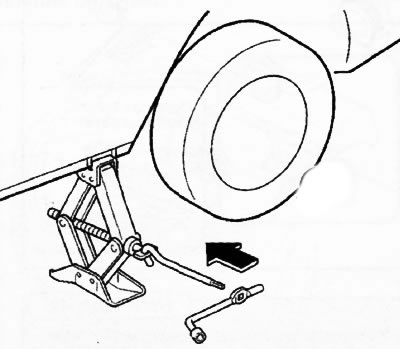
8. Turn the crank handle clockwise to raise the vehicle to a height sufficient to fit the spare wheel. Before unscrewing the wheel nuts, make sure that the vehicle is in a stable position and cannot fall off the jack or move spontaneously.
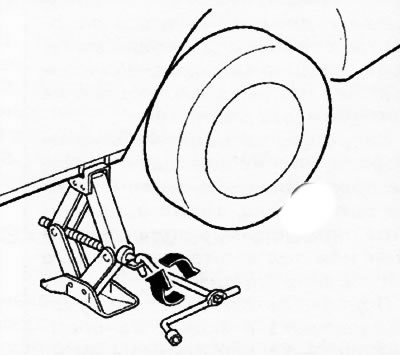
Attention.
- Do not lift the vehicle higher than necessary to change a tire. Lifting the vehicle higher than necessary to change a tire is dangerous because the vehicle may become unstable and fall off the jack.
- Do not start the engine or rock the vehicle while it is jacked up. Starting the engine or rocking the body of a vehicle while it is jacked up is dangerous because the vehicle may fall off the jack and cause injury.
- It is prohibited to be under a car raised on a jack. If the car falls off the jack, the person under the car may be seriously injured or killed.
9. Loosen the wheel nuts by turning them counterclockwise and remove the damaged wheel. Remove the decorative cap from the wheel.
Installing a spare tire
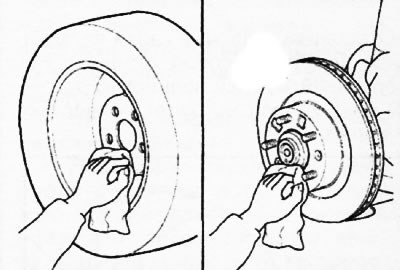
1. Use a rag to clean the mating surfaces on the wheel disk and hub, as well as the wheel mounting studs, from dirt.
Attention.
- Before installing the wheel, make sure that the mating surfaces on the wheel disc and hub, as well as the studs and nuts, are thoroughly cleaned of dirt.
- If you do not clean the mating surfaces of the wheel disk and hub, as well as the studs, from dirt when installing or replacing a wheel, this may lead to a dangerous incident during further operation of the vehicle. Due to loosening of the wheel nuts, the wheel may come off the hub while the vehicle is moving, which is fraught with a traffic accident.
2. Install the spare tire.
3. Thread the wheel nuts onto the studs so that the conical shoulders of the nuts face the wheel. Tighten the nuts by hand.
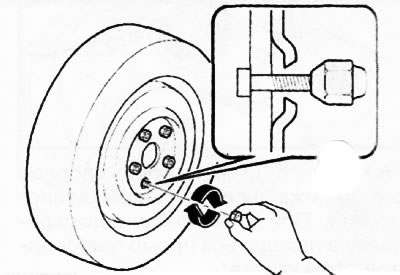
Caution. Do not apply oil or grease to the studs and wheel nuts. Do not tighten the wheel nuts to a torque greater than the rated value. Applying oil or grease to the studs or wheel nuts will result in dangerous consequences. Loose wheel nuts may cause the wheel to come off the hub while the vehicle is moving, which may result in an accident. In addition, wheel nuts and studs may be damaged due to overtightening.
4. Lower the vehicle by turning the jack screw counterclockwise with the wheel wrench. Tighten the nuts in a crisscross pattern with the wheel wrench to 108-147 Nm.
Note: If you are unsure whether the wheel nuts are tightened correctly, contact a tire shop or an authorized Mazda dealer as soon as possible to have the lug nuts checked for proper tightening torque.
Attention.
- Always tighten wheel nuts to the specified torque.
- Incorrectly or loosely tightened wheel nuts can cause dangerous consequences. The wheel may wobble or come off the hub. This can lead to loss of control of the vehicle and a serious traffic accident.
- When installing the wheel, use the same nuts that were used to secure the wheel. If necessary, replace the nuts with similar nuts with metric threads.
- Your vehicle uses metric threaded wheel studs and nuts. Therefore, it is dangerous to secure the wheels with nuts with a different thread type. This will result in an insecure wheel attachment and damage to the threads on the studs. As a result, the wheel may come off the hub, which can lead to a traffic accident.
5. Remove the wheel chocks from under the wheel and place the jack and tool kit in the stowed position.
6. Place the damaged wheel in the luggage compartment.
7. Check the air pressure in the tire.
8. Repair the damaged wheel or replace the damaged tire with a new one as soon as possible.
Warning. Do not operate the vehicle if the air pressure in at least one tire does not correspond to the nominal value. Incorrect air pressure in the tires creates a risk to traffic safety. If the air pressure in the tires does not correspond to the nominal value, this will negatively affect the controllability of the vehicle and may lead to a traffic accident. When checking the air pressure in the tires, be sure to check the air pressure in the spare tire.
Note: To prevent the jack and tools from rattling while the vehicle is moving, secure them properly in the stowed position.