


All carburetor engines and the 1.4-liter injection engine are equipped with a transistor ignition system. Engines with a fuel injection system are equipped with an electronic ignition system. The ignition system consists of:
- spark plugs
- ignition cables
- ignition coils
- ignition distributor with runner, Hall sensor and control device
The voltage generated in the ignition coil is fed through the distributor rotor and ignition cables to the corresponding spark plugs. A spark jumps across the spark plug electrodes, which ignites the fuel-air mixture in the cylinders. The ignition timing should automatically shift in the direction of early ignition as the number of revolutions increases. This shift in the transistor ignition system is carried out in the distributor by means of centrifugal weights and by means of a vacuum (vacuum hose from intake manifold to distributor). In an electronic ignition system, a microprocessor built into the distributor calculates the optimal ignition timing depending on the engine speed and load. In addition, the processor ensures ignition is switched off. The distributor's job is to distribute the ignition current in a given order between the cylinders and, using a Hall sensor, provide information about the engine speed and ignition timing to the ignition control device.
Engines with fuel injection system are equipped with electronic ignition system. Ignition control unit is combined with injection control unit. Microprocessor controls ignition timing based on the characteristic field recorded in its memory.
In a parametric ignition system, the optimal ignition timing depends on the engine condition. The parameters are the engine speed, temperature and load level (throttle position and amount of air intake). This refers to the instantaneous load of the engine, since there is a difference if the car is going uphill or downhill at 4000 rpm.
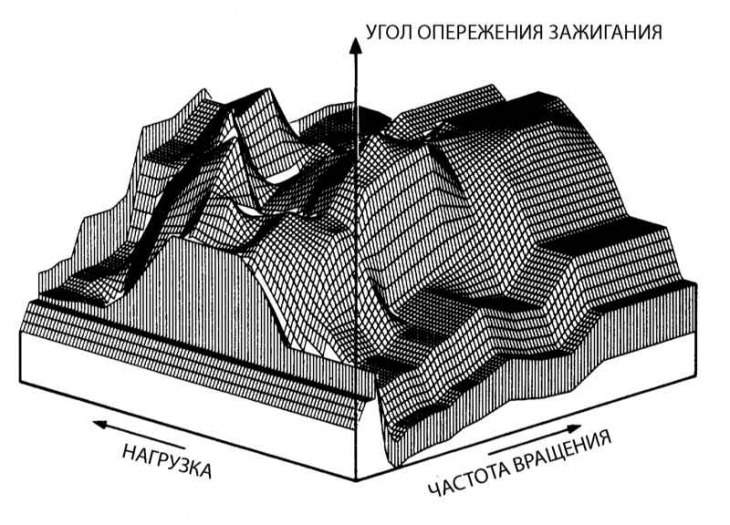
The required characteristics for the ignition system are determined during bench testing and then matched with real-world testing so that the optimum value for fuel consumption, exhaust gas composition and driving characteristics is achieved. The values determined in this way are stored in the control unit's memory.
Attention! When working on the ignition system, safety precautions must be observed.