


Attention.
- Observe safety precautions when working with the engine cooling system.
- Use coolant in a concentration that is appropriate for the environment in which the vehicle is operated, otherwise engine damage may occur.
- The engine has a large number of aluminum parts that need to be protected from corrosion by using an ethylene glycol-based coolant. This coolant also provides protection for the engine from freezing.
- Do not use coolants containing ethyl or methyl alcohol, borates or silicates. Such coolants may damage the cooling system.
- Use only soft (demineralized) water to make the cooling mixture. Water containing mineral salts significantly reduces the efficiency of engine cooling.
- Cooling liquid can damage the paintwork of the car. If the cooling liquid gets on the painted surfaces, it is necessary to wash it off immediately with plenty of water.
Note:
- If the cooling system cap has the symbol "FL22" on or near it, FL22 coolant must be used.
- Coolant FL22 is supplied as a ready-to-use solution. Additional dilution of such a liquid before filling the cooling system is not required.
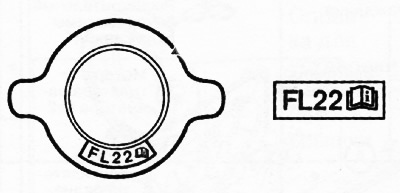
1. Remove the cooling system cover.
2. Remove the service hole cover (in the front protective pan No.1 of the engine) designed to drain the coolant.
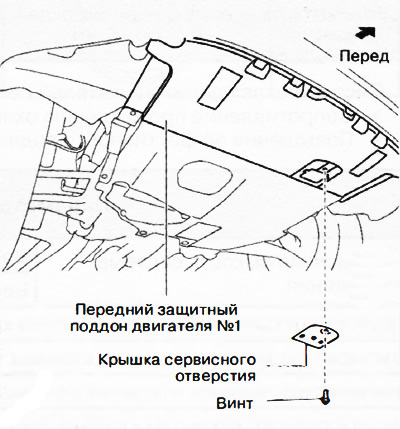
3. Unscrew the radiator drain plug and drain the engine coolant into a suitable container.
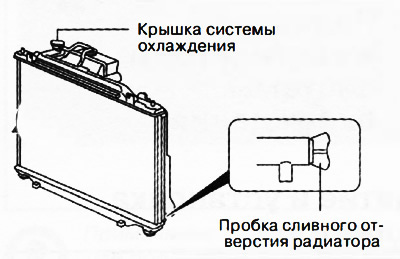
4. Flush the cooling system with clean water until clear water flows from the drain hole.
5. Allow the water to drain completely from the cooling system.
6. Tighten the radiator drain plug.
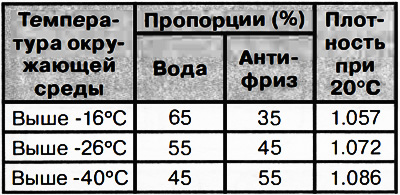
7. Using the following table, select the appropriate proportion of water and antifreeze for the engine coolant.
Antifreeze and water ratios for coolant (except coolant FL22)
8. Fill the engine cooling system through the radiator filler neck to the top.
9. Fill the coolant into the expansion tank of the cooling system up to the "F" mark on the tank.
10. Install the cooling system cover.
Caution: If the high coolant temperature warning light is flashing, stop the engine to allow the coolant to cool sufficiently to prevent overheating. Then troubleshoot the cooling system and repair it.
11. Start the engine and warm it up at idle speed to operating temperature.
12. After the engine has warmed up, perform the following checks, monitoring the coolant temperature to prevent the engine from overheating:
Let the engine run for five minutes at 2500 rpm.
Note: If the accelerator pedal is continuously depressed for a certain period of time, the engine speed may drop to idle speed. This is due to the fuel cut control function that prevents the engine from overheating, and is not a malfunction. The engine speed will return to normal after the accelerator pedal is released.
Increase the speed to 3,000 rpm for five seconds, then reduce it to idle speed.
Repeat the steps described several times.
13. Stop the engine and check the coolant level after it has cooled down. If the coolant level is low, repeat steps 8 through 12.
14. Check the tightness of the engine cooling system.
15. Install the service hole cover.