


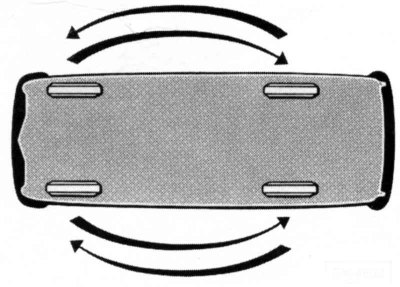
If the front tires are clearly worn, it is recommended to swap the front and rear wheels. This way, all tires have the same service life.
When tightening the wheel nuts, a torque wrench should always be used. This ensures uniform tightening of the bolts.
Do not replace tires one at a time. At least replace both tires on one axle at a time. Always install tires with a better profile at the front.
Attention! When replacing or dismantling tubeless tires, it is recommended to replace the rubber valve.
1. Remove traces of rust from the disc mating surfaces with a wire brush. To protect the discs from rust, coat the hubs front and rear with rolling bearing grease each time the wheels are removed.
2. Remove the wheel cap with the flat end of a lug wrench.
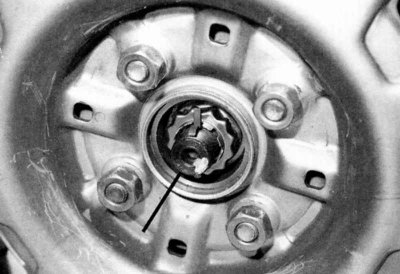
3. Before removing, mark the position of the wheel relative to the hub with chalk so that the wheel can be installed in its original position.
4. Light metal wheels are protected from corrosion by a transparent varnish. When replacing wheels, make sure that the protective varnish is not damaged, otherwise touch up with a colorless varnish.
Attention! For light metal wheels, use only the nuts intended for them.
Attention! If the car is equipped with light metal wheels, while the spare wheel has a steel wheel, it is recommended to have the appropriate nuts for the steel wheel in the car.
5. Clean contaminated nuts and threads.
6. Tighten the wheel nuts crosswise in several passes.
Caution! Tightening the nuts on one side may cause the wheel and/or hub to become skewed.
The primary source is the website: Mazbook
7. The tightening torque for all wheel nuts is 100 Nm, for both steel and light metal wheels.