


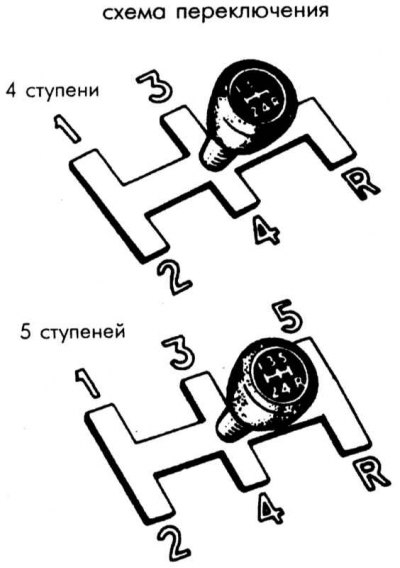
Note. A special safety device ensures that the driver cannot accidentally shift from 5th gear to reverse. Before the shift lever can be engaged in reverse, it must be in neutral.
Four wheel drive (four-wheel drive vehicles)
These vehicles are equipped with permanent four-wheel drive with a transfer case lock.
Transfer case lock off
The vehicle can be driven under most road conditions with the transfer case lock disengaged.
Transfer box lock enabled
When the transfer case lock is on, the front and rear wheels are connected to each other.
Engage the transfer case lock only to free a vehicle stuck in mud, etc. Observe the following guidelines to improve the dynamic performance and traction of tires, and to reduce fuel consumption and tire wear.
Turning the transfer box lock on and off
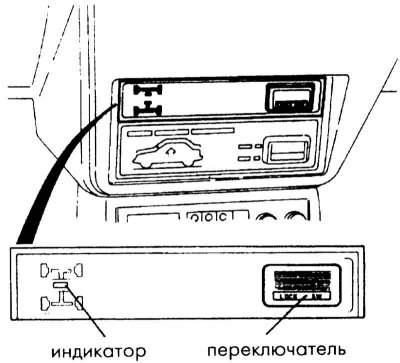
The transfer case lock is controlled by an electrical preselector switch, whereby the transfer case lock is mechanically engaged or disengaged with a slight delay to reduce shifting jolts and improve reliability.
 «Inclusion» When the key is latched, the indicator will flash until the switching process is completed. After that, the indicator starts to burn constantly. As a further confirmation of the end of the switching process, an acoustic signal sounds until the indicator stops flashing and remains lit.
 «Shutdown» Press the key to release it and the lock will turn off. When the switching process is completed, the indicator will turn off.
Before parking the car, the transfer box lock must be turned off by switching the key to the position «Shutdown», as the transfer case lock cannot be disengaged when the vehicle is stationary.
Attention! Never engage the transfer case lock under the following conditions, otherwise the kinetic chain will (front and rear differential, transfer case) may be damaged.
If a spare wheel is installed
Since the spare wheel is smaller than the normal wheel, the resulting speed difference cannot be compensated for when the transfer case lock is engaged.
If snow chains are fitted
(You can, however, engage the transfer case lock for a short time to facilitate starting in difficult conditions).
Attention! Wear snow chains on the front wheels only.
Attention! If the vehicle is towed with the wheels raised (front or rear).
Attention! If the brakes are strongly affected when the transfer case lock is on.
Note. Under heavy braking, the front and rear wheels may lock up, causing the vehicle to skid.
Note. For this reason, do not apply too much force on the brakes so that the wheels do not lock.
Normal driving on dry roads
Note. Do not engage the lock if you are driving at high speed on the autobahn or local highway.
If you are making a sharp turn, such as when parking or in a city cycle
Under these conditions, the wheels can rotate at different speeds. When the transfer case lock is engaged, the tires may rub against the road surface because of this.
- Be aware that when driving fast on wet roads, the front wheels may lose traction. Hydroplaning is noticeable on front-wheel drive vehicles by a sudden increase in engine speed. Therefore, choose the speed mode according to the road conditions.
- Never engage the transfer box lock when the vehicle is on a test roller (when checking car brakes).
- Otherwise, the transfer case will try to equalize the difference in speed between the wheels that are driven by the check rollers and the wheels that are on the ground.
- To check the vehicle on a roller test stand, the propeller shaft must be loosened and the transfer case lock engaged.